6013-T4 (AMS 4347)
Solution heat-treated and naturally aged. Formability is comparable with 2024-O and better in stretch forming. Unlike 2024-W, it stays formable for months at room temperature, so no refrigeration of formed blanks is needed.



6013 is a copper-bearing Al-Mg-Si alloy developed to give aircraft and vehicle designers 2024-class strength with the formability, weldability and corrosion resistance of the 6xxx family. Sheet is normally bought in T4 for stretch forming and aged to T6 after forming; plate is supplied in T651 for machining. Metline supplies 6013 to AMS and ASTM specifications, with full certification, to customers worldwide.
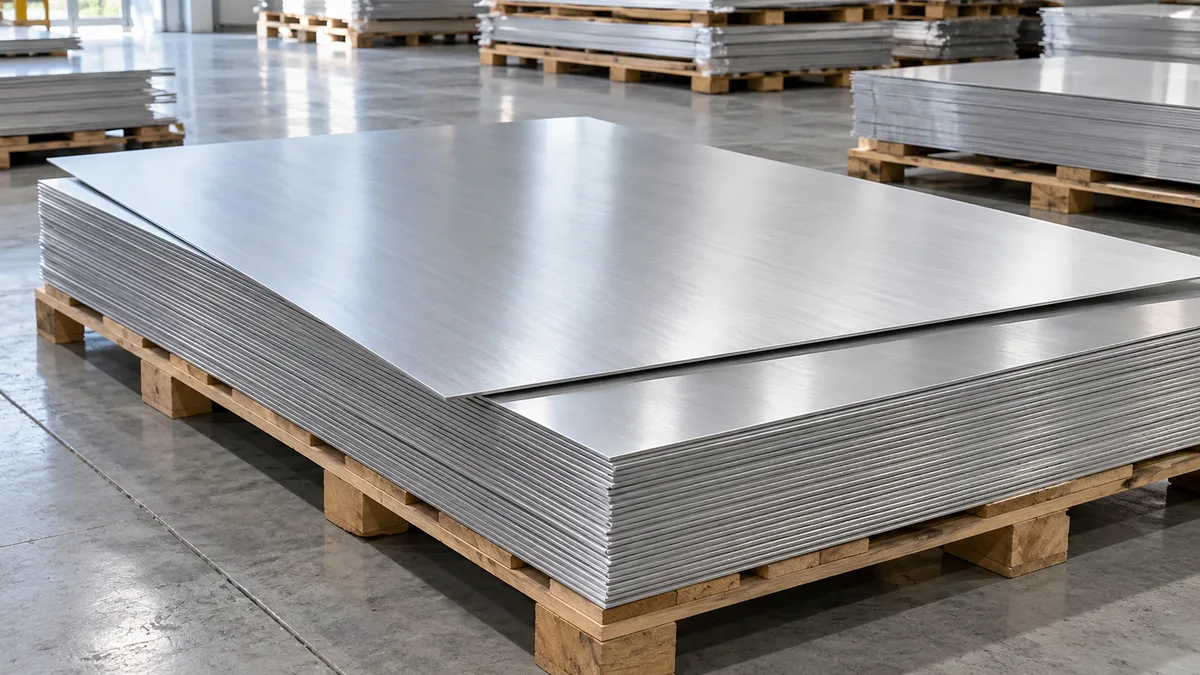
6013 was introduced in the 1980s as an aerospace sheet alloy. Compared with 6061 it carries more silicon, much more copper (0.6 – 1.1 %) and a manganese addition. Together these lift the strength of the precipitation-hardened alloy well above 6061 while keeping the processing advantages of the 6xxx series.
Its headline claim, published when it was registered, is that 6013-T6 sheet offers about 12 % more strength than Alclad 2024-T3, the classic fuselage skin material, at slightly lower density. Unlike 2024, it does not need a pure-aluminium cladding layer for corrosion protection, it can be fusion-welded and laser-welded, and it can be stretch-formed in T4 and then artificially aged without a second solution heat treatment.
That combination is what makes 6013 interesting beyond aerospace. Automotive engineers use it for body panels and highly stressed formed parts, bicycle makers use it for tubes and rims, and machinists use 6013-T651 plate when 6061 is not quite strong enough but 7075 would bring corrosion and welding penalties.
Registered Aluminum Association limits, used by AMS 4347, AMS 4216 and ASTM B209. Each lot is certified with its actual analysis.
| Element | Minimum | Maximum | Effect |
|---|---|---|---|
| Silicon (Si) | 0.60 | 1.0 | Excess Si over Mg2Si ratio raises aged strength |
| Iron (Fe) | — | 0.50 | Impurity |
| Copper (Cu) | 0.60 | 1.1 | Forms additional strengthening precipitates; main difference from 6061 |
| Manganese (Mn) | 0.20 | 0.80 | Grain control and toughness |
| Magnesium (Mg) | 0.80 | 1.2 | Combines with Si to form Mg2Si |
| Chromium (Cr) | — | 0.10 | Impurity limit |
| Zinc (Zn) | — | 0.25 | Impurity |
| Titanium (Ti) | — | 0.10 | Grain refiner |
| Others, each / total | — | 0.05 / 0.15 | |
| Aluminium (Al) | Remainder |
Typical values below are for comparison and early design. Guaranteed minimums come from the purchase specification (AMS 4347, AMS 4216 or ASTM B209) and vary with thickness and test direction; design to those, and to MMPDS allowables where your programme requires them.
| Temper | Tensile strength | Yield strength (0.2 %) | Elongation | Typical use |
|---|---|---|---|---|
| T4 sheet, typical | about 290 – 300 MPa | about 170 – 190 MPa | 20 % or more | Forming stock |
| T6 sheet, typical | about 380 – 400 MPa | about 340 – 360 MPa | 8 – 10 % | Skins, formed and aged parts |
| T651 plate, typical | about 380 MPa | about 350 MPa | 5 – 8 % (thicker plate lower) | Machined parts |
Published typical values for 6013 vary between producers by 20 – 40 MPa. Take acceptance values from the specification revision named on the order.
Solution heat-treated and naturally aged. Formability is comparable with 2024-O and better in stretch forming. Unlike 2024-W, it stays formable for months at room temperature, so no refrigeration of formed blanks is needed.
Artificially aged to peak strength. Yield strength, fatigue and toughness are in the same class as 2024-T3, with better corrosion resistance and a small density advantage.
Parts are stretch-formed in T4 and then given an artificial ageing treatment to reach T6. Because no second solution treatment and quench are needed, distortion of the formed part is small.
Solution treated, stretched to relieve quench stress and aged. Used for machined fittings, moulds and precision parts that need more strength than 6061-T651.
Light strains of roughly 2 – 13 % followed by solution treatment can cause grain growth. Plan forming so that heavily formed areas are not re-solution-treated.
Order T4 for anything that will be stretch-formed or bent; order T6 for flat or lightly formed parts; order T651 for plate that will be machined.
| System | Designation / specification | Covers |
|---|---|---|
| SAE AMS | AMS 4347 | 6013-T4 sheet (solution heat-treated and naturally aged), about 0.5 – 6.3 mm |
| SAE AMS | AMS 4216 | 6013-T6 sheet (solution heat-treated and artificially aged) |
| ASTM | ASTM B209 | Sheet and plate, including T651 plate |
| UNS | A96013 | — |
| European (EN) | EN AW-6013 (AlMg1Si0.8CuMn) | Chemistry to EN 573-3 |
| China (GB) | 6013 | GB/T 3190, sheet to GB/T 3880 |
Aerospace buyers often add customer specifications, source approvals or quality requirements (for example AS9100-related flow-down clauses) to the order. List these in your enquiry so we can confirm what documentation can accompany the material. Metline works under an ISO 9001 quality system and supplies mill certificates to EN 10204 3.1.
| Typical item | Temper | Specification | Weight |
|---|---|---|---|
| 0.032 × 48 × 144 in sheet | T4 | AMS 4347 | about 9.8 kg |
| 0.063 × 48 × 144 in sheet | T4 | AMS 4347 | about 19.2 kg |
| 0.071 × 48 × 144 in sheet | T6 | AMS 4216 | about 21.7 kg |
| 0.125 × 48 × 48 in sheet | T4 | AMS 4347 | about 12.7 kg |
| 0.500 × 12 × 12 in plate | T651 | ASTM B209 | about 3.2 kg |
| 1.000 × 24 × 24 in plate | T651 | ASTM B209 | about 25.6 kg |
6013 weighs 2.71 kg per m² per millimetre of thickness (about 0.098 lb/in³).
T4 sheet stretch-forms well and keeps that ability after long storage. Form, then artificially age to T6. Avoid forming in T6 except for gentle curvature.
Weldable by MIG, TIG, resistance and laser welding, which is unusual for an alloy of this strength. 4xxx fillers such as 4043 reduce hot-cracking risk. Expect strength loss in the heat-affected zone, as with all heat-treated 6xxx alloys.
T6 and T651 machine well, producing short chips and a good finish. Practice is similar to 6061: sharp carbide, high speeds, flood coolant.
Corrosion resistance is close to 6061 and much better than bare 2024, so 6013 skins normally do not need cladding. The copper content means it is slightly less resistant than copper-free 6xxx alloys in aggressive environments.
Anodises, paints and takes conversion coatings well. Chromic, sulphuric and hard anodising are all used.
Like other aged 6xxx alloys, prolonged service above roughly 150 °C over-ages the alloy and reduces strength.
A typical example: an aircraft repair shop replacing a stretch-formed skin panel orders 6013-T4 sheet to AMS 4347, forms the panel on a stretch press, ages it to T6 and anodises it, avoiding both the refrigeration that 2024-W blanks need and the cladding that 2024 sheet carries.
| Property | 6061-T6 | 6013-T6 | 2024-T3 | 7075-T6 |
|---|---|---|---|---|
| Typical tensile strength | 310 MPa | 380 – 400 MPa | 480 MPa | 570 MPa |
| Typical yield strength | 276 MPa | 340 – 360 MPa | 345 MPa | 505 MPa |
| Density | 2.70 g/cm³ | 2.71 g/cm³ | 2.78 g/cm³ | 2.81 g/cm³ |
| Fusion weldability | Good | Good | Poor | Poor |
| Corrosion resistance | Good | Good | Poor (needs cladding) | Fair |
| Formability (best temper) | Good (T4) | Very good (T4) | Good (O / W) | Fair (O / W) |
6013 is not a substitute for 7075 when maximum static strength is needed: 7075-T6 is roughly 50 % stronger. Its niche is the gap between 6061 and the 2xxx/7xxx aerospace alloys, where weldability, formability and corrosion resistance matter as much as strength. Against bare 2024-T3, 6013-T6 has similar yield strength, lower tensile strength and better corrosion behaviour; against Alclad 2024-T3, it is stronger.
Sheet is interleaved with paper or film, wrapped with desiccant, fitted with edge protectors and strapped to pallets or packed in wooden cases marked for export fumigation. Tell us any special packing or marking your receiving inspection needs.
Aircraft fuselage skins, cowlings and formed structure; car body panels; bicycle tubes and rims; brake and hydraulic housings; and machined fixtures and moulds from T651 plate.
Yes. In T6, 6013 typically reaches about 340 – 360 MPa yield strength against about 276 MPa for 6061-T6, thanks to its higher copper and silicon content.
No. 7075-T6 is considerably stronger (typical yield about 505 MPa). 6013 is chosen over 7075 when welding, forming or corrosion resistance matter more than peak strength.
6013-T6 has yield strength similar to 2024-T3 and about 12 % more strength than Alclad 2024-T3, with lower density, better corrosion resistance and the ability to be fusion-welded.
Yes. That is the intended route: form in T4, then artificially age to T6. No second solution heat treatment is needed, which limits distortion.
AMS 4347 for T4 sheet, AMS 4216 for T6 sheet and ASTM B209 for plate such as T651, unless your drawing names a customer specification.
Send the temper, size, quantity and specification. We will confirm availability, documents and a delivered price.





