7178-O
Annealed. Used for stretch forming, brake forming and joggling repair skins and doublers. After forming, parts are solution treated, quenched and aged to T6 under AMS 2770 or the repair manual process.



7178 is one of the strongest conventional aluminium alloys, with about 7 % zinc. It was used for compression-critical upper wing skins of early jet transports and is now supplied mainly for repair and spares. Metline supplies 7178 sheet and plate in the annealed O temper for forming and in T6, bare or alclad, to AMS-QQ-A-250/14 and /15, to aircraft maintenance and manufacturing customers worldwide.
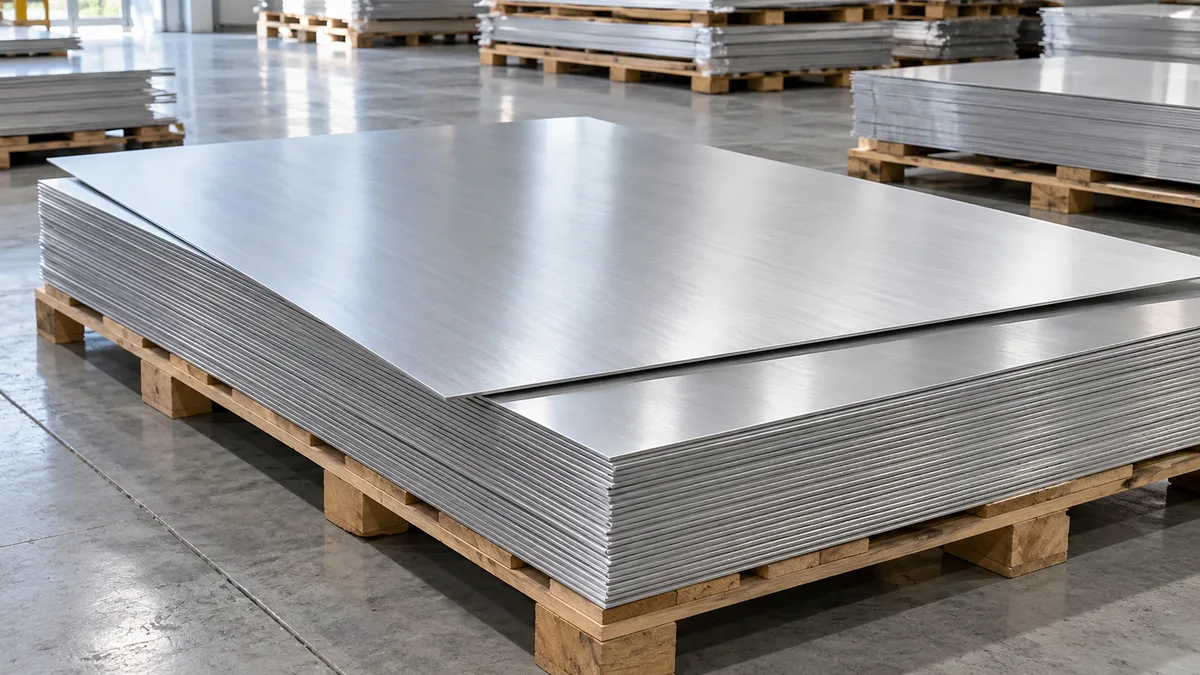
7178 pushes the 7075 recipe further: zinc rises to 6.3 – 7.3 % and copper and magnesium are slightly higher. In the T6 temper it reaches typical tensile strengths around 600 MPa, about 6 % above 7075-T6, which made it attractive for upper wing skins and stringers that mainly carry compression.
The extra strength came with lower fracture toughness and poor stress-corrosion and exfoliation resistance in T6. As damage-tolerance rules tightened, designers moved to 7075-T76, then to 7150 and 7055, which give similar or higher strength with much better toughness and corrosion behaviour. SAE notes on the alclad 7178 specification state that the alloy is not recommended for new designs.
Demand today comes from maintenance, repair and overhaul (MRO) of older aircraft whose structural repair manuals specify 7178 for skin repairs and doublers, and from manufacturers making spare parts to legacy drawings. The annealed O temper is common for this work: it can be formed into contour and then heat-treated to T6.
Registered Aluminum Association limits for 7178 (UNS A97178). Alclad 7178 is clad on both sides with a thin layer of 7072 (Al-1Zn), which corrodes preferentially and protects the core.
| Element | Minimum | Maximum | Role |
|---|---|---|---|
| Silicon (Si) | — | 0.40 | Impurity |
| Iron (Fe) | — | 0.50 | Impurity |
| Copper (Cu) | 1.6 | 2.4 | Strength |
| Manganese (Mn) | — | 0.30 | Minor |
| Magnesium (Mg) | 2.4 | 3.1 | Forms MgZn2 with zinc |
| Chromium (Cr) | 0.18 | 0.28 | Grain control |
| Zinc (Zn) | 6.3 | 7.3 | Main strengthening element |
| Titanium (Ti) | — | 0.20 | Grain refiner |
| Others, each / total | — | 0.05 / 0.15 | |
| Aluminium (Al) | Remainder |
Some sales sheets give 7178 a chemistry with 0.6 – 1.2 % manganese and germanium. That is not 7178; reject a certificate that does not show zinc in the 6.3 – 7.3 % range.
Typical values are from ASM and handbook data. Specified minimums depend on thickness and whether the sheet is bare or alclad (cladding lowers strength slightly because the 7072 layer is soft).
| Temper (typical) | Tensile strength | Yield strength (0.2 %) | Elongation |
|---|---|---|---|
| 7178-O | About 230 MPa / 33 ksi | About 105 MPa / 15 ksi | About 15 % |
| 7178-T6 | About 605 MPa / 88 ksi | About 540 MPa / 78 ksi | About 10 – 11 % |
| 7075-T6 (comparison) | 572 MPa / 83 ksi | 503 MPa / 73 ksi | 11 % |
Annealed. Used for stretch forming, brake forming and joggling repair skins and doublers. After forming, parts are solution treated, quenched and aged to T6 under AMS 2770 or the repair manual process.
Solution treated and aged to peak strength; T651 plate is also stretched. Highest strength, but low resistance to stress corrosion and exfoliation.
An over-aged condition was introduced later to improve exfoliation resistance at some cost in strength. Order it only where the drawing names it.
Alclad sheet carries 7072 cladding on both sides. It protects the core from corrosion and is standard for external skins; bare sheet is used inside the structure.
| Specification | Covers |
|---|---|
| AMS-QQ-A-250/14 | 7178 plate and sheet (bare) |
| AMS-QQ-A-250/15 | Alclad 7178 plate and sheet (7178 core, 7072 cladding) |
| AMS 4052 and related AMS sheet specifications | Alclad 7178 sheet in specific tempers, as called up on legacy drawings |
| AMS 2770 / AMS 2772 | Heat treatment of parts and raw material |
| Designations | UNS A97178; EN AW-7178 (AlZn7MgCu) |
AMS-QQ-A-250/15 has been stabilised, meaning it is no longer revised. It remains valid for procurement where a drawing calls it up.
| Thickness (mm) | kg per m² | 1220 × 2440 mm sheet (kg) |
|---|---|---|
| 0.5 | 1.42 | 4.2 |
| 0.8 | 2.26 | 6.7 |
| 1 | 2.83 | 8.4 |
| 1.27 | 3.59 | 10.7 |
| 1.6 | 4.53 | 13.5 |
| 2 | 5.66 | 16.8 |
| 2.5 | 7.08 | 21.1 |
| 3.2 | 9.06 | 27.0 |
| 4 | 11.32 | 33.7 |
| 5 | 14.15 | 42.1 |
| 6.35 | 17.97 | 53.5 |
Form in O or freshly quenched (W) condition. T6 sheet cracks on tight bends; allow generous radii.
Solution treat, quench quickly in water and age to T6. Control furnace uniformity to AMS 2750.
Riveted or bolted. Not fusion-welded.
Use alclad for external skins; anodise or conversion coat and prime bare parts. Seal faying surfaces.
| Alloy and temper | Strength vs 7178-T6 | Toughness and corrosion | Typical use |
|---|---|---|---|
| 7075-T6 / T76 | Lower | Similar (T6) to better (T76) | General airframe sheet |
| 7150-T7751 | Similar | Much better | Upper wing skins and stringers |
| 7055-T7751 | Higher | Much better | Upper wing skins on newer aircraft |
| 7475-T761 | Lower | Much better toughness | Fuselage and wing sheet |
A change of material on a certified aircraft needs approval from the type-certificate holder or the responsible design organisation. We can supply the alternative with the same certification standard once it is approved.
Yes. In T6, 7178 typically reaches about 605 MPa tensile and 540 MPa yield, against 572 and 503 MPa for 7075-T6. Its toughness and corrosion resistance are lower.
Annealed sheet can be formed into contoured skins and doublers, then solution treated and aged to T6. This is common in aircraft repair work.
A 7178 core with thin 7072 cladding on both surfaces. The cladding corrodes preferentially and protects the high-strength core, which suits external skins.
No. SAE notes it is not recommended for new designs. Modern upper-wing structure uses 7150 or 7055 instead.
No. It is riveted or bolted.
We supply cut pieces and full sheets where material is available, with mill certificates, worldwide.
Send the temper, cladding, thickness, size and specification. We will confirm availability and a delivered price.





