2024 / 2124
Al-Cu-Mg. 2024-T351 is the classic damage-tolerant alloy for fuselage and lower wing structure. 2124 is a high-purity version with better through-thickness toughness for thick plate.



Quenched and pre-stretched plate is heat-treatable aluminium plate that is stretched by 1.5 – 3 % straight after quenching, so the residual stresses locked in by the quench are almost entirely removed. It is what the "51" in tempers such as T351, T651, T7451 and T7751 means, and it is the reason aerospace and precision machinists can remove most of a plate without it warping. This guide explains the tempers, alloys, properties and standards, and Metline supplies pre-stretched plate worldwide.
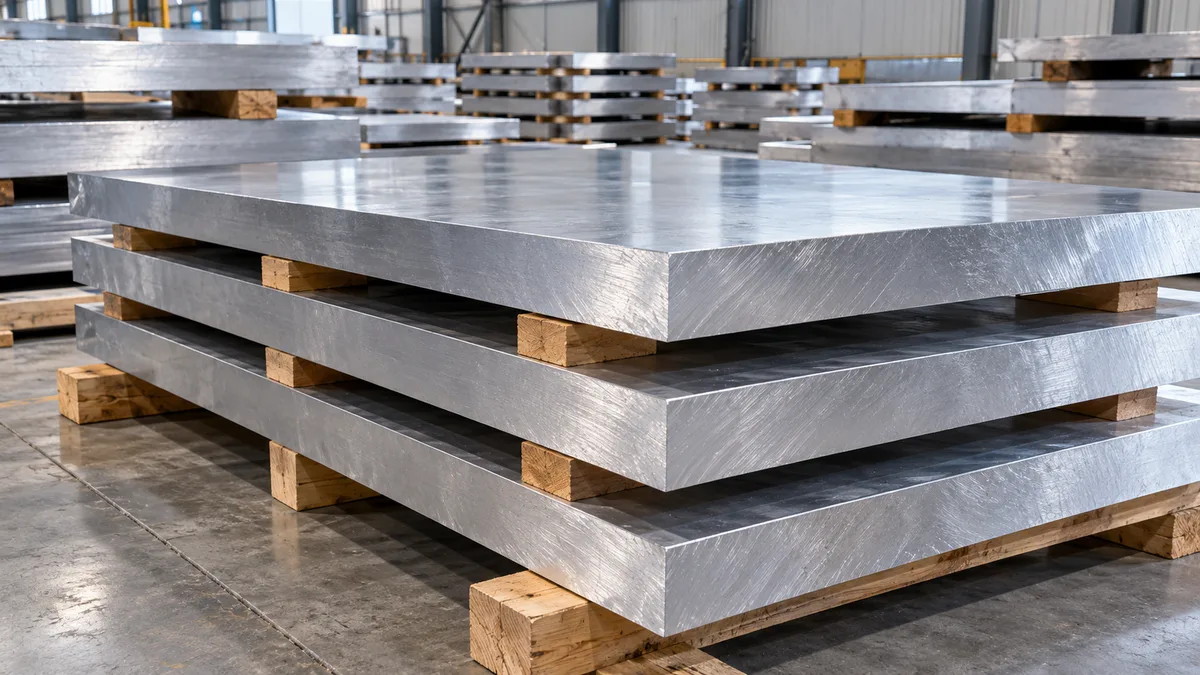
Heat-treatable alloys get their strength from a three-step cycle: solution heat treatment near 500 °C, rapid quenching in water, then natural or artificial ageing. The quench is essential for strength, but it cools the surface far faster than the centre. The surface ends up in compression and the core in tension, and in thick plate those stresses are large.
If an unstretched plate is machined, removing material upsets that balance and the part bends, twists or moves after it leaves the fixture. Stretching the plate permanently by a small, controlled amount yields the whole cross-section in tension, which evens out the stress pattern. ANSI H35.1 specifies a permanent set of 1.5 – 3 % for stretched plate; residual stresses typically fall by around an order of magnitude.
The cost is a small extra process step and some loss of length at the grip ends. The benefit is predictable machining: thin-walled aircraft ribs, spars and frames are hogged out of solid plate, often removing 80 – 90 % of the metal, and that is only practical with stretched plate.
Practical points make the difference between good and poor stretched plate. Over-stretching beyond the specified set reduces properties and can leave slip lines on the surface. Under-stretching leaves residual stress behind. A plate with poor hot-rolled shape stretches unevenly, and grip marks must be fully cut away. These are why plate is bought to a recognised standard with documented process control.
| Temper | Treatment | Typical alloys | Why it is chosen |
|---|---|---|---|
| T351 | Solution treated, stretched, naturally aged | 2024, 2017, 2219 | High toughness and fatigue resistance; standard for 2024 plate |
| T451 | Solution treated, stretched, naturally aged (T4 basis) | 2014, 6061, 6082 | Softer condition; can be aged to T651 after forming or machining |
| T651 | Solution treated, stretched, artificially aged to peak strength | 6061, 6082, 7075, 2014 | Maximum strength in the alloy; general precision machining |
| T851 | Solution treated, stretched (cold work), then artificially aged | 2024, 2124, 2219, 2618 | Higher yield than T351 and better stress-corrosion resistance |
| T7351 | Stretched, then over-aged for stress-corrosion resistance | 7075, 7475 | Much better SCC resistance than T651 at some loss of strength |
| T7451 | Stretched, over-aged to a balance of strength, toughness and SCC | 7050 | The workhorse temper for thick aerospace plate |
| T7651 | Stretched, over-aged for exfoliation resistance | 7075, 7050 | Wing skins and parts exposed to exfoliation risk |
| T7751 | Stretched, multi-step ageing for high strength with improved corrosion resistance | 7055, 7150 | Upper wing skins and compression-loaded structure |
A "52" suffix (for example T652) means stress relief by compression instead of stretching, used mainly for forgings and hand forgings. A "511" suffix is the stretched condition for extrusions, which may need minor straightening afterwards.
Al-Cu-Mg. 2024-T351 is the classic damage-tolerant alloy for fuselage and lower wing structure. 2124 is a high-purity version with better through-thickness toughness for thick plate.
Al-Cu. High strength and good machinability; used for heavy-duty fittings, tooling and propeller components.
Al-Cu with good weldability and useful strength from cryogenic temperatures to about 300 °C. Used for propellant tanks and elevated-temperature parts.
Al-Cu-Mg-Ni-Fe developed for elevated temperature; engine and wheel parts.
Al-Mg-Si. The general-engineering choice for jigs, fixtures, machine frames and vacuum chambers in T651.
Al-Zn-Mg-Cu. Very high strength in T651; over-aged T7351 or T7651 when stress corrosion or exfoliation matters.
Al-Zn-Mg-Cu-Zr with low quench sensitivity, so thick plate keeps its properties at the centre. Standard for bulkheads, spars and frames.
High-purity 7075 variant with superior fracture toughness for fuselage and wing skins.
The highest-strength plate alloys in general aerospace use, in T7751, for compression-dominated upper wing structure.
Typical values below are published handbook figures (Aluminum Association / ASM) for plate. Design must use the specified minimums, which fall as thickness increases and differ between longitudinal, long-transverse and short-transverse directions.
| Alloy & temper | Typical tensile | Typical yield (0.2 %) | Typical elongation |
|---|---|---|---|
| 2014-T651 | 483 MPa | 414 MPa | 13 % |
| 2024-T351 | 469 MPa | 324 MPa | 19 % |
| 2024-T851 | 483 MPa | 448 MPa | 6 % |
| 2219-T851 | 455 MPa | 350 MPa | 10 % |
| 6061-T451 | 241 MPa | 145 MPa | 22 % |
| 6061-T651 | 310 MPa | 276 MPa | 12 % |
| 7075-T651 | 572 MPa | 503 MPa | 11 % |
| 7075-T7351 | 503 MPa | 434 MPa | 13 % |
| 7050-T7451 | 524 MPa | 469 MPa | 11 % |
Specified minimum values for the thinnest plate band (about 6.3 – 12.5 mm, long-transverse) give a feel for design allowables:
| Alloy & temper | Min. tensile | Min. yield | Min. elongation |
|---|---|---|---|
| 2024-T351 | 440 MPa | 290 MPa | 12 % |
| 2219-T851 | 425 MPa | 315 MPa | 8 % |
| 6061-T651 | 290 MPa | 240 MPa | 10 % |
| 7050-T7451 | 510 MPa | 441 MPa | 9 % |
Summarised from ASTM B209 and the relevant AMS specifications. Thicker bands have lower minimums, and very thick plate also carries short-transverse requirements. The certificate states the values that apply to your plate.
| Specification | Covers |
|---|---|
| ASTM B209 / B209M | Commercial and general-engineering sheet and plate in all common alloys and tempers |
| AMS 4037 | 2024-T3 / T351 sheet and plate |
| AMS 4027 | 6061-T6 / T651 sheet and plate |
| AMS 4045 / AMS 4078 | 7075-T6 / T651 and 7075-T7351 plate |
| AMS 4050 | 7050-T7451 plate |
| AMS 4101 | 2124-T851 plate |
| AMS 4202 | 7475-T7351 plate |
| AMS 4206 / AMS 4252 | 7055-T7751 and 7150-T7751 plate |
| AMS-QQ-A-250 series | Legacy federal plate specifications still cited on many drawings |
| EN 485-1/-2/-3 and EN 4213 | European commercial plate and aerospace 6061 plate |
| AMS-STD-2154 / ASTM B594 | Ultrasonic inspection of wrought aluminium products |
| ANSI H35.1 / H35.2 | Temper designations and dimensional tolerances |
Aircraft manufacturers also publish their own material specifications. When a drawing calls up a company specification, the plate must come from a source approved under that specification. Send it with your enquiry so we can confirm what can be certified.
For aerospace orders, inspection plans normally include ultrasonic testing of the full plate, conductivity checks to confirm the over-aged tempers, and traceability from cast to finished piece. Commercial T651 plate for tooling is usually supplied with a mill certificate and dimensional check only. If your part has a critical flatness requirement, state it on the order rather than relying on the standard tolerance tables, which allow more deviation as width and thickness increase.
The common thread is heavy machining. Wherever a large proportion of a plate is cut away, or a part must hold tight flatness and position tolerances after it leaves the machine, a stretched temper is the default. Plate that will only be cut into simple blanks, bent or welded does not need it, and thin sheet is rarely supplied stretched because quench stresses are already low.
It means the plate was stress-relieved by stretching after quenching, with a permanent set of 1.5 – 3 % for plate, and receives no further straightening. The digit before it (3, 4, 6, 7, 8) describes the ageing treatment.
Only slightly in most tempers. In T8 tempers such as 2024-T851 the stretch acts as cold work before ageing and raises yield strength noticeably compared with T351.
When stress-corrosion cracking is a risk, especially in thick parts loaded in the short-transverse direction. Over-aged tempers trade some strength for much better corrosion resistance.
7050 is less quench-sensitive, so the centre of a thick plate cools fast enough to reach full properties. 7075 loses more strength at the core as thickness increases.
Yes. It is solution treated, quenched, stretched and artificially aged. It is the most common stretched plate for general machining.
Yes. Pre-stretched plate can be saw-cut into blocks or blanks to your dimensions, which reduces freight and machining stock.
Send the alloy, temper, size, specification and inspection requirements. We reply with availability, certification and a delivered price.





