Overaged (T7-type)
The usual aerospace condition: solution treated, stretched and overaged for stress-corrosion and exfoliation resistance.



7014 sheet and plate are high-strength Al-Zn-Mg-Mn-Cu aerospace products specified on UK and legacy airframe drawings, supplied bare or clad with a pure-aluminium surface layer and used in the solution-treated and overaged condition. Because volumes are small, each order is made against a named specification. Metline sources 7014 plate to the drawing, or supplies approved alternatives such as 7075-T7351, 7050-T7451 and 7010, certified and shipped worldwide.
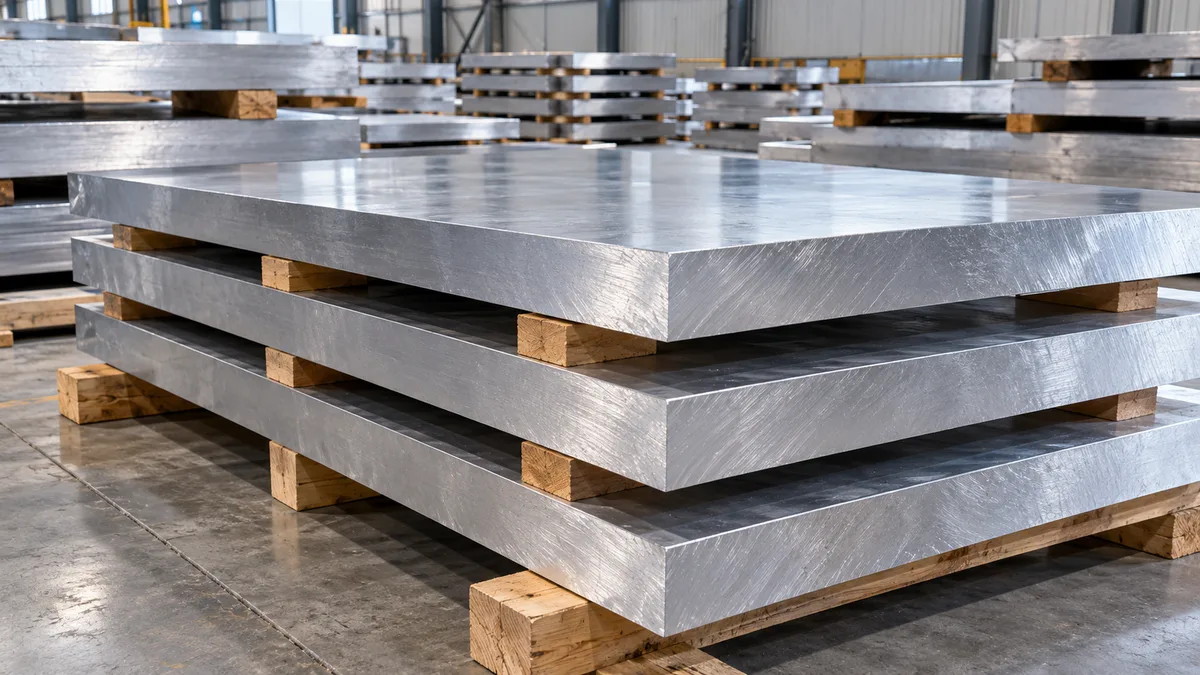
7014 is a British 7xxx alloy with a nominal composition of 5.7 % zinc, 2.7 % magnesium, 0.5 % manganese and 0.5 % copper. It is best known as a forging alloy (BS L 171), but it has also been specified as sheet and plate on legacy UK airframes, sometimes in clad form.
As with other high-strength 7xxx alloys, the plate is solution heat-treated, quenched, normally stretched to relieve stress, and aged. For aerospace use it is taken into the overaged range, which gives better resistance to stress-corrosion cracking and exfoliation than peak-aged material. The manganese in 7014 controls grain structure in place of chromium, and the alloy contains no zirconium, so it is more quench-sensitive than modern thick-plate alloys and is best suited to thinner sections.
Few rolling mills produce 7014 plate as a regular product. Buyers are usually maintaining existing aircraft or producing spares to original drawings. In that situation the most useful thing a supplier can do is confirm quickly whether the specified product can be made in the required size, and if not, help the customer present an alternative to the design authority.
7014 is defined by British aerospace specifications rather than by a widely published international data sheet. Its nominal composition, given in the titles of BS L 171 and BS L 172, is Zn 5.7 – Mg 2.7 – Mn 0.5 – Cu 0.5. The ranges below are the indicative limits most often quoted for the alloy; the governing values are those of the specification and revision on your order, and every lot is certified against it.
| Element | Nominal | Indicative range | Role |
|---|---|---|---|
| Zinc (Zn) | 5.7 | 5.2 – 6.2 | Main strengthening element with Mg |
| Magnesium (Mg) | 2.7 | 2.2 – 3.2 | Forms MgZn2; high Mg gives strength at modest Zn |
| Manganese (Mn) | 0.5 | 0.3 – 0.7 | Grain control in place of chromium |
| Copper (Cu) | 0.5 | 0.3 – 0.7 | Improves stress-corrosion resistance and strength |
| Silicon (Si) | — | ≤ 0.50 | Impurity |
| Iron (Fe) | — | ≤ 0.50 | Impurity |
| Titanium + zirconium | — | ≤ 0.20 | Grain refinement |
| Aluminium (Al) | Remainder |
An earlier version of this page listed a composition with 1.2 % magnesium maximum and 0.25 % zinc maximum. That analysis is not 7014 (it resembles a 6xxx alloy) and has been removed.
Clad aerospace plate has a thin layer of pure aluminium or a low-alloy aluminium-zinc alloy roll-bonded to one or both faces. The cladding is anodic to the core, so it corrodes preferentially and protects the high-strength alloy beneath, even at scratches.
| Feature | Bare plate | Clad plate |
|---|---|---|
| Corrosion protection | Relies on anodising and paint | Cladding gives sacrificial protection plus coatings |
| Typical use | Machined parts where the surface is removed | Skins and panels whose surfaces remain |
| Strength | Full section strength | Slightly lower overall, since the cladding is soft |
| Fatigue | Higher | Cladding layer reduces fatigue strength slightly |
Cladding only makes sense for sheet and thinner plate. On thick plate that will be machined, the cladding is removed and offers no benefit.
Mechanical property limits for 7014 sheet and plate are set by the governing specification for each thickness and are reported on the certificate. We do not quote single typical values for this alloy because published data are limited and older supplier figures conflict.
The usual aerospace condition: solution treated, stretched and overaged for stress-corrosion and exfoliation resistance.
Highest strength but poor short-transverse stress-corrosion resistance; only used if the drawing calls for it.
Soft condition for forming, followed by full heat treatment by the user.
Some listings show 7014 plate in T79 for "engine casings" or "turbine blades". T79 is a slightly overaged 7xxx temper, but no aluminium alloy is used for turbine blades or hot engine sections, and the claim should be disregarded.
| Specification | Comment |
|---|---|
| Legacy UK MoD (DTD) specifications | Cover 7014 sheet and plate, including clad product, on older UK drawings |
| Purchaser / OEM specifications | Many orders are placed against the airframe maker's material specification |
| BS L 171 / BS L 172 | Define 7014 forgings and forging stock; confirm the alloy chemistry |
| AMS-QQ-A-250/13 | Covers clad 7075 plate and sheet, not 7014; it is sometimes quoted wrongly for 7014 |
If your drawing references a US QQ-A-250 specification together with 7014, ask the design authority which document governs before ordering.
7014 weighs about 2.78–2.80 kg per square metre per millimetre of thickness. A 1,250 × 2,500 × 6 mm plate weighs roughly 52 kg.
Machines well with carbide tools. Stretched plate keeps residual stress low.
Form in O or freshly quenched condition, then age. Overaged plate has limited cold formability.
Not fusion-welded; use riveting and bolting.
Anodise and prime bare plate. Do not abrade through the cladding on clad plate.
Modern plate alloys with SAE AMS or EN specifications are often approved in place of 7014. Each must be accepted by the design authority.
| Alloy and temper | Why it is considered | Typical specifications |
|---|---|---|
| 7075-T73 / T7351 | Overaged, stress-corrosion-resistant 7xxx with worldwide availability | SAE AMS bar, plate and forging specifications; ASTM B211, B209, B247 |
| 7050-T74 / T7451 | Higher strength than 7075-T73 with good SCC resistance, low quench sensitivity | SAE AMS plate, extrusion and forging specifications |
| 7175-T74 | High-purity forging alloy with excellent toughness | SAE AMS forging specifications |
| 7010-T7451 | European thick-plate and forging alternative | AMS 4205, EN 485 |
For clad skins, Alclad 7075 sheet is the closest widely available product.
No. It is produced to order against legacy UK or purchaser specifications, usually in small quantities for existing aircraft.
Plate with a thin pure-aluminium or low-alloy layer bonded to its surface. The layer protects the high-strength core from corrosion by corroding preferentially.
No. That specification covers clad 7075 plate and sheet. If a drawing pairs it with 7014, clarify which governs with the design authority.
7075-T7351, 7050-T7451 and 7010-T7451 plate, or Alclad 7075 sheet for skins, are common candidates, subject to design approval.
Send the drawing, specification and quantity. We will confirm sourcing, certification and a delivered price.





