Closed-die forgings
Near-net-shape fittings, brackets, levers and housings with grain flow following the contour. Best mechanical properties and least machining.



7014 forgings are high-strength Al-Zn-Mg-Mn-Cu aerospace parts made to BS L 171 from BS L 172 forging stock, and used in the solution-treated and overaged condition for strength with stress-corrosion resistance. They are found mainly on UK and legacy airframe, helicopter and engine drawings. Metline sources 7014 die forgings, hand forgings and rings against the drawing and specification, or proposes approved 7xxx alternatives, with full certification and worldwide delivery.
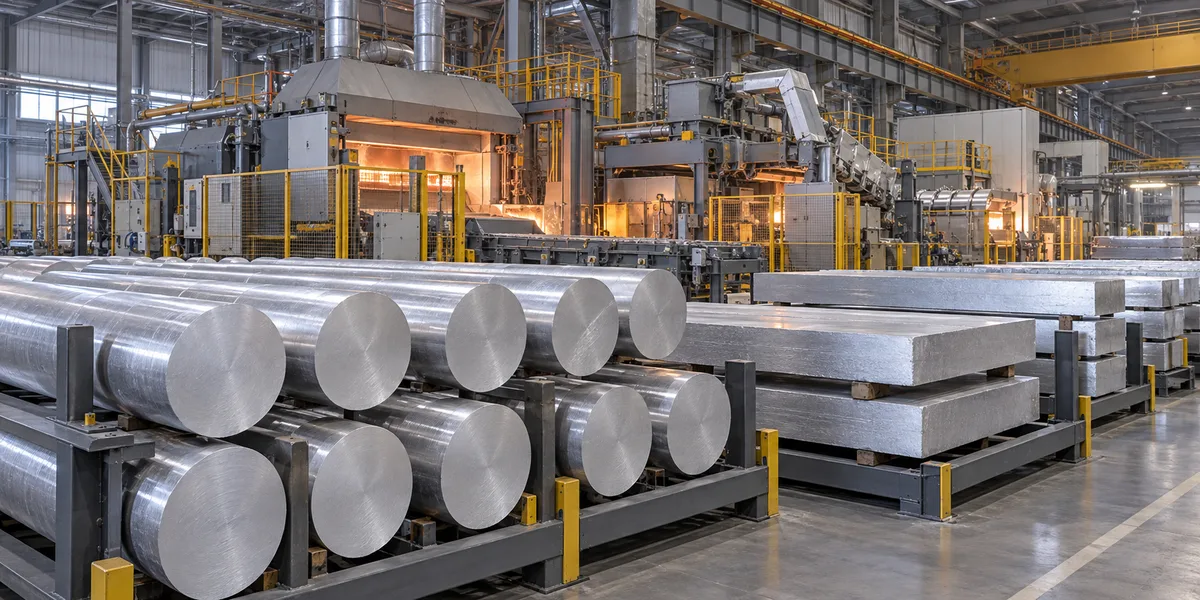
BS L 171 defines 7014 forgings as parts of an aluminium-zinc-magnesium-manganese-copper alloy, not exceeding 150 mm in diameter or minor sectional dimension, supplied as-forged or annealed and then used in the solution-treated and overaged condition. BS L 172 covers the extruded, rolled or cast stock the forgings are made from.
The section limit is significant. Like other high-strength 7xxx alloys without zirconium, 7014 is sensitive to quench rate: the centre of a very thick forging cools too slowly to reach full strength. Limiting the section to 150 mm keeps properties consistent through the part. For thicker forgings, low-quench-sensitivity alloys such as 7050 or 7010 are the usual choice.
Overageing is the other defining feature. Peak-aged 7xxx alloys (T6) are vulnerable to stress-corrosion cracking, particularly in the short-transverse direction of forgings where the grain flow ends at a machined surface. Overageing coarsens the precipitates at grain boundaries and greatly reduces that risk, at the cost of a modest drop in strength. This is the same principle behind the T73 and T74 tempers of 7075, 7050 and 7175.
Today 7014 forgings are mostly bought for continuing production and spares of existing designs. Because volumes are small, each order is planned individually around the drawing, the forging route and the test plan.
7014 is defined by British aerospace specifications rather than by a widely published international data sheet. Its nominal composition, given in the titles of BS L 171 and BS L 172, is Zn 5.7 – Mg 2.7 – Mn 0.5 – Cu 0.5. The ranges below are the indicative limits most often quoted for the alloy; the governing values are those of the specification and revision on your order, and every lot is certified against it.
| Element | Nominal | Indicative range | Role |
|---|---|---|---|
| Zinc (Zn) | 5.7 | 5.2 – 6.2 | Main strengthening element with Mg |
| Magnesium (Mg) | 2.7 | 2.2 – 3.2 | Forms MgZn2; high Mg gives strength at modest Zn |
| Manganese (Mn) | 0.5 | 0.3 – 0.7 | Grain control in place of chromium |
| Copper (Cu) | 0.5 | 0.3 – 0.7 | Improves stress-corrosion resistance and strength |
| Silicon (Si) | — | ≤ 0.50 | Impurity |
| Iron (Fe) | — | ≤ 0.50 | Impurity |
| Titanium + zirconium | — | ≤ 0.20 | Grain refinement |
| Aluminium (Al) | Remainder |
An earlier version of this page gave 1.2–1.8 % magnesium and 5.5–6.5 % zinc for 7014 forgings, which contradicts the nominal 2.7 % magnesium named in the BS titles. The table above follows the BS nominal values.
7014 forgings follow the classic three-step route for heat-treatable aluminium: solution treatment, quench and ageing. What sets the forging specification apart is the ageing step, which goes beyond peak strength into the overaged range.
Supplier listings sometimes offer 7014 forgings in T6, T651, T73 or T7351. T651 is a stretched temper for plate and bar and does not apply to forgings. The condition that matters is the one named in BS L 171 or on your drawing, and we quote only to that.
BS L 171 specifies minimum tensile strength, proof stress and elongation for 7014 forgings by direction and section. Those values, and the actual results for each lot, are reported on the certificate. We do not publish single typical figures for 7014 because the open literature is thin and older supplier data are inconsistent.
| Property | What to expect | How it is verified |
|---|---|---|
| Strength | High, in the class of overaged 7xxx forging alloys | Tensile tests on test pieces from the forging or a prolongation |
| Stress-corrosion resistance | Much better than peak-aged 7xxx | Overaged condition confirmed by conductivity and hardness |
| Toughness and ductility | Best in the longitudinal (grain-flow) direction | Elongation in L and transverse directions per the specification |
| Density | ≈ 2.78 – 2.80 g/cm³ | — |
| Modulus of elasticity | ≈ 70 – 72 GPa | — |
| Service temperature | Strength falls with long exposure above about 120 °C | Design allowance |
Near-net-shape fittings, brackets, levers and housings with grain flow following the contour. Best mechanical properties and least machining.
Blocks, bars and simple shapes forged with a machining allowance. Used for prototypes and low volumes where die cost is not justified.
Seamless forged or rolled rings for flanges and mounting rings, with circumferential grain flow.
Upset forgings with radial grain flow for wheel-type parts.
Extruded, rolled or cast stock to BS L 172 for customers who forge in-house.
Rough- or finish-machined parts with inspection to the drawing.
All sizes are confirmed against the drawing and the 150 mm section limit of BS L 171.
| Specification | Scope |
|---|---|
| BS L 171 | Forgings of Al-Zn-Mg-Mn-Cu alloy 7014, up to 150 mm diameter or minor section, supplied as-forged or annealed for use solution treated and overaged |
| BS L 172 | Extruded, rolled or cast forging stock for forgings to BS L 171 |
| UK DTD specifications | Legacy Ministry of Defence material specifications for 7014 bar, section, forgings and plate; still cited on older drawings |
| Purchaser / OEM specifications | Many 7014 orders are placed against the airframe or engine maker's own material specification |
| Supporting standard | Use |
|---|---|
| AMS-STD-2154 / ASTM B594 | Ultrasonic inspection of forgings when called up |
| ASTM E1417 | Liquid penetrant inspection of finished parts |
| ASTM B557 / EN ISO 6892-1 | Tensile testing methods |
| EN 10204 | Inspection documents (type 3.1 certificate) |
Locate highly stressed features along the grain flow. Avoid machining through the parting line on stressed surfaces, where end grain is exposed.
Even in overaged condition, short-transverse properties are the lowest. Check bolt-hole and lug orientation against grain flow.
Quenched forgings carry residual stress. Allow for distortion when machining thin walls, or specify a compressively stress-relieved condition where the specification permits.
Anodise and prime finished parts; 7xxx alloys need a protective system in service.
Machines well with carbide tools. Leave balanced stock on both sides of thin features.
Not fusion-welded. Use fasteners and bushings.
When 7014 is impractical for the quantity, size or lead time involved, design authorities often approve one of the alloys below. We can supply each of them as forgings with AMS or EN certification.
| Alloy and temper | Why it is considered | Typical specifications |
|---|---|---|
| 7075-T73 / T7351 | Overaged, stress-corrosion-resistant 7xxx with worldwide availability | SAE AMS bar, plate and forging specifications; ASTM B211, B209, B247 |
| 7050-T74 / T7451 | Higher strength than 7075-T73 with good SCC resistance, low quench sensitivity | SAE AMS plate, extrusion and forging specifications |
| 7175-T74 | High-purity forging alloy with excellent toughness | SAE AMS forging specifications |
| 7010-T7451 | European thick-plate and forging alternative | AMS 4205, EN 485 |
BS L 171 covers 7014 forgings up to 150 mm diameter or minor section, and BS L 172 covers the forging stock. Legacy MoD and purchaser specifications are also used.
Overageing greatly improves resistance to stress-corrosion cracking, especially in the short-transverse direction, at the cost of a small drop in strength.
Not under BS L 171. The alloy is quench-sensitive, so thicker sections would not reach consistent properties. For thick forgings, 7050 or 7010 is normally used.
Yes. BS L 171 allows forgings to be supplied as-forged or annealed for subsequent heat treatment, or we can deliver fully heat-treated parts to the drawing.
7075-T73, 7050-T74 and 7175-T74 forgings are common approved alternatives. Any change needs design authority approval.
An EN 10204 3.1 certificate with chemistry, mechanical, conductivity and NDT results, plus first-article reports when required.
Send the drawing, specification and quantity. We will confirm the forging route, certification and a delivered price.





