6082-T6511
Solution treated, stretched for stress relief with minor straightening, and aged. The usual aerospace condition (L111 bar is normally supplied this way); parts stay true during machining.



6082 is the European structural workhorse among heat-treatable aluminium alloys and, as BS L111 and EN 2326, an established aerospace bar for fittings, brackets, ground equipment and machined parts. In T6 and T6511 it gives about 310 MPa minimum tensile strength with good machinability, weldability and corrosion resistance. Metline supplies 6082 round, square, hex and flat bar in O, T4, T6, T6510 and T6511 to aerospace and EN standards, worldwide.
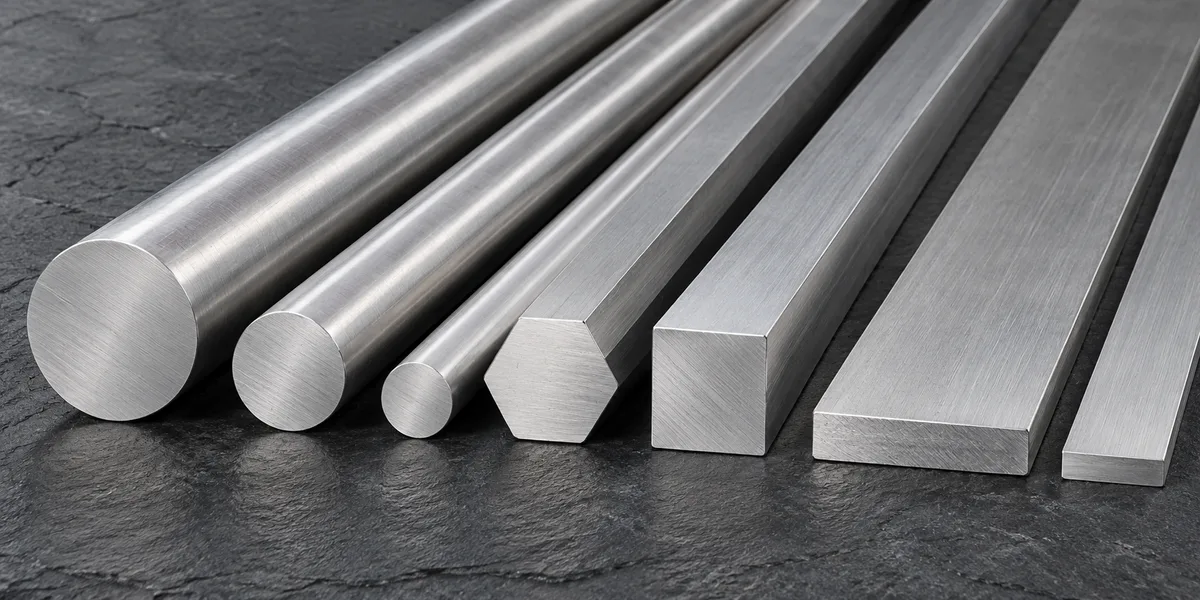
6082 contains more silicon and manganese than 6061 and almost no copper. The extra silicon raises aged strength; manganese controls grain structure in extrusions. The result is a bar with slightly higher strength than 6061 in most sizes and better resistance to corrosion.
British and European aerospace practice adopted 6082 long ago. The UK L-series lists it in every wrought form: L111 for bars and sections, L112 for forging stock and forgings, L113 for sheet, L114 for drawn tube and L115 for plate. EN 2326 and EN 2636 carry the same material into the European aerospace standards as AL-P6082-T6, with EN 2636 adding a limit on peripheral coarse grain.
In aircraft, 6082 bar goes into machined brackets and fittings for secondary structure, interior and cargo system components, hinge pins and bushes, actuator and linkage parts, avionics and equipment racks, and a very wide range of ground support equipment. It is not used for engine blades, turbine discs or other hot-section parts, which need nickel or titanium alloys, nor for highly loaded primary structure, where 7xxx and 2xxx alloys dominate.
Limits follow EN 573-3 for EN AW-6082 and the Aluminum Association registration, which are identical. BS L111 and EN 2326 call the same chemistry.
| Element | Minimum | Maximum | Role in the alloy |
|---|---|---|---|
| Silicon (Si) | 0.70 | 1.30 | Excess Si over the Mg2Si ratio raises aged strength |
| Iron (Fe) | — | 0.50 | Impurity |
| Copper (Cu) | — | 0.10 | Kept low for corrosion resistance |
| Manganese (Mn) | 0.40 | 1.00 | Suppresses recrystallisation and coarse grain; adds strength |
| Magnesium (Mg) | 0.60 | 1.20 | Main strengthening element with Si |
| Chromium (Cr) | — | 0.25 | Grain control |
| Zinc (Zn) | — | 0.20 | Impurity |
| Titanium (Ti) | — | 0.10 | Grain refiner |
| Others, each / total | — | 0.05 / 0.15 | |
| Aluminium (Al) | Remainder | About 95.2 – 98.3 % |
Minimum values for extruded bar vary with size because thick sections cool more slowly during quenching. The figures below are EN 755-2 limits for T6 bar; BS L111 gives the same values for its size bands. Design to these minimums, not to the higher typical values.
| Temper / size (diameter or thickness) | Tensile strength (min) | 0.2 % proof stress (min) | Elongation A (min) |
|---|---|---|---|
| O / H111, ≤ 200 mm | ≤ 160 MPa (max) | ≤ 110 MPa (max) | 14 % |
| T4, ≤ 150 mm | 205 MPa | 110 MPa | 14 % |
| T6 / T6511, ≤ 20 mm | 295 MPa | 250 – 255 MPa | 8 % |
| T6 / T6511, 20 – 150 mm | 310 MPa | 260 – 270 MPa | 8 % |
| T6 / T6511, 150 – 200 mm | 280 MPa | 240 MPa | 5 – 6 % |
| T6, 200 – 250 mm | 270 MPa | 200 MPa | 6 % |
Typical T6 values are about 330 – 340 MPa tensile, 290 – 310 MPa proof stress and 95 – 100 HB. L111 quotes a proof stress of 255 MPa up to 20 mm and 270 MPa from 20 to 150 mm, slightly above EN 755-2.
Solution treated, stretched for stress relief with minor straightening, and aged. The usual aerospace condition (L111 bar is normally supplied this way); parts stay true during machining.
As T6511 but with no straightening after stretching. Chosen when straightness from stretching alone is enough.
Solution treated and aged without stretching. Common for commercial bar and smaller sizes.
Solution treated and naturally aged. Formable; can be aged to T6 after forming.
Annealed for cold forming or as forging and re-heat-treat stock.
Plate designation, often mis-applied to bar. For bar, specify T6510 or T6511.
Extruded 6082 bar can form a band of large, recrystallised grains near the surface, called peripheral coarse grain (PCG) or a coarse-grain ring. It develops where the outer layer is heavily sheared in the die and then recrystallises during solution treatment. PCG lowers strength and fatigue performance locally, can cause orange-peel on bent or anodised surfaces and may be removed when bar is turned, revealing a different structure under the skin.
For machined fittings, ask for EN 2636 or a stated maximum PCG depth, or allow enough machining stock to remove the affected layer.
| System | Designation / standard | Note |
|---|---|---|
| European | EN AW-6082 (EN AW-AlSi1MgMn) | EN 573-3 chemistry |
| UK aerospace | BS L111 (bar & sections), L112 (forgings), L113 (sheet), L114 (tube), L115 (plate) | British aerospace L-series |
| European aerospace | EN 2326 / EN 2636 (AL-P6082-T6 bars and sections) | EN 2636 adds peripheral coarse-grain control |
| UK (legacy) | HE30 / H30 (BS 1474, BS 1470) | Superseded by EN 755 / EN 485 |
| German Werkstoff | 3.2315 (AlMgSi1) | — |
| ISO | AlSi1MgMn | — |
| UNS | A96082 | — |
| USA | Registered 6082; ASTM B221 lists it | Nearest common US grade: 6061 |
Some older stock lists also cite DTD or BS L100-series numbers for 6082. Send us the exact reference from your drawing and we will confirm which document governs before quoting.
BS L111 and EN 2326 formally cover sizes up to 200 mm; larger bar is normally certified to EN 755-2 or a customer specification.
Round bar weight per metre is π/4 × d² × 2.70 ÷ 1000 kg (d in mm):
| Diameter (mm) | kg per metre | kg per 3 m bar | Diameter (in) |
|---|---|---|---|
| 6.35 | 0.086 | 0.26 | 0.25 |
| 10 | 0.212 | 0.64 | 0.39 |
| 12.7 | 0.342 | 1.03 | 0.50 |
| 16 | 0.543 | 1.63 | 0.63 |
| 20 | 0.848 | 2.54 | 0.79 |
| 25.4 | 1.368 | 4.10 | 1.00 |
| 30 | 1.909 | 5.73 | 1.18 |
| 40 | 3.393 | 10.18 | 1.57 |
| 50.8 | 5.472 | 16.42 | 2.00 |
| 60 | 7.634 | 22.90 | 2.36 |
| 76.2 | 12.313 | 36.94 | 3.00 |
| 101.6 | 21.890 | 65.67 | 4.00 |
| 127 | 34.203 | 102.61 | 5.00 |
| 152.4 | 49.252 | 147.76 | 6.00 |
| 203.2 | 87.559 | 262.68 | 8.00 |
| 254 | 136.811 | 410.43 | 10.00 |
| 304.8 | 197.008 | 591.02 | 12.00 |
Good in T6 and T6511 with sharp carbide tools; chips are slightly longer than 6061 because there is little copper. Chip breakers help on lathes.
TIG and MIG with ER4043 or ER5356 (5183 for higher strength). The heat-affected zone falls to roughly half the T6 strength unless re-heat-treated.
Bend in O or T4 and age afterwards; T6 bar needs generous radii.
Takes protective and hard anodising well; decorative clarity is lower than 6063.
Good resistance to atmospheric and marine exposure; better than 6061 because of the low copper.
Like other 6xxx alloys, strength declines with long exposure above about 150 °C.
A typical example is an engine-stand cradle for line maintenance: the welded frame uses 6082-T6 tube and the pick-up blocks are machined from 6082-T6511 round bar, so the entire assembly shares one alloy and finish.
| Property | 6082-T6 | 6061-T6 | 6066-T6 | 7075-T6 |
|---|---|---|---|---|
| Minimum tensile (bar, mid sizes) | 310 MPa | 260 – 290 MPa | 345 MPa | 540 MPa and up |
| Typical tensile | 330 – 340 MPa | 310 MPa | 395 MPa | 570 MPa |
| Copper content | ≤ 0.10 % | 0.15 – 0.40 % | 0.7 – 1.2 % | 1.2 – 2.0 % |
| Weldability | Good | Good | Poor | Poor |
| Corrosion resistance | Good | Good | Fair | Fair |
| Main market | Europe, UK aerospace | Americas, global | USA | Global aerospace |
6082 and 6061 are often interchangeable in practice, but they are not identical, so a substitution needs approval. Read our 6061 vs 6082 comparison for details.
BS L111 is the British aerospace specification for 6082-T6 bars and extruded sections. It is normally supplied in the stretched T6511 condition and has minimum tensile strengths of 295 – 310 MPa depending on size.
Both cover 6082-T6 aerospace bars and sections up to 200 mm. EN 2636 adds control of peripheral coarse grain, which matters for fatigue-sensitive or heavily machined parts.
Not for hot-section parts such as blades or turbine discs, which need nickel or titanium alloys. 6082 is used for brackets, housings and fittings around the engine where temperatures are moderate.
In most extruded bar sizes, slightly: about 310 MPa minimum tensile in T6 for 20 – 150 mm against about 260 – 290 MPa for 6061. 6082 also has better corrosion resistance because of its low copper.
T6511. Stretching relieves quench stresses so the part stays straight and flat as material is removed.
Yes. Metline supplies 6082 bar certified to the specification on your order, with an EN 10204 3.1 certificate, to customers worldwide.
Send the shape, size, temper, specification and quantity. We will reply with availability, certification and a delivered price.





