Seamless drawn tube
Extruded from a pierced billet, then cold-drawn over a mandrel to size before heat treatment. Closest tolerances, best surface and the form used for BS L114 and most aerospace orders.



6082-T6 tube is the standard European structural aluminium tube and, as BS L114 and EN 2390, an aerospace tube for frames, struts, push-pull rods, seat and cargo structures and ground equipment. It offers about 290 – 310 MPa minimum tensile strength, good weldability and good corrosion resistance. Metline supplies seamless drawn and extruded 6082 round, square and rectangular tube in O, T4 and T6, certified to aerospace and EN standards, worldwide.
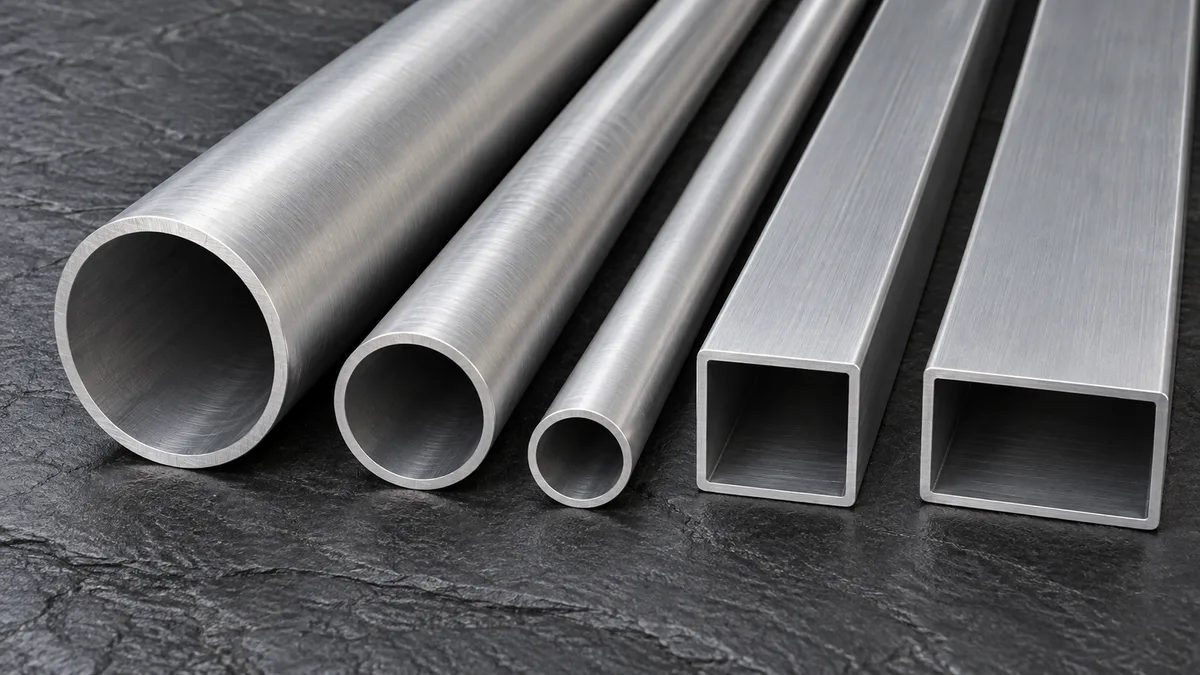
Tube is the most efficient shape for members loaded in compression, torsion or bending in every direction. 6082-T6 combines good strength with weldability and corrosion resistance, which makes it a natural choice for tubular frames that must be welded, bent or mechanically joined.
In British and European aerospace practice the alloy is covered by BS L114 for drawn 6082-T6 tube and by EN 2390 for AL-P6082-T6 tubes for structures with walls from 0.6 to 12.5 mm. Typical uses are seat and cargo-system frames, interior monument structure, push-pull control rods for secondary systems, antenna masts, stretcher and equipment racks, UAV airframes and, above all, ground support equipment such as towbars, stairs and maintenance stands.
Tube for fuel, hydraulic and oxygen lines follows its own specifications: 6061-T6 (AMS 4083), 5052 or 3003 drawn tube for low-pressure lines and corrosion-resistant steel or titanium for high-pressure hydraulics. 6082 is not a standard hydraulic-line material, and it is not used for landing-gear members or engine exhaust parts, which need far stronger or hotter-running alloys.
Limits follow EN 573-3 (EN AW-6082) and the Aluminum Association registration. Some trade sheets list copper at 0.6 – 1.2 % and chromium at 0.25 – 0.35 %; those figures are wrong for 6082, whose copper is capped at 0.10 % and chromium at 0.25 %.
| Element | Minimum | Maximum | Role in the alloy |
|---|---|---|---|
| Silicon (Si) | 0.70 | 1.30 | Excess Si over the Mg2Si ratio raises aged strength |
| Iron (Fe) | — | 0.50 | Impurity |
| Copper (Cu) | — | 0.10 | Kept low for corrosion resistance |
| Manganese (Mn) | 0.40 | 1.00 | Suppresses recrystallisation and coarse grain; adds strength |
| Magnesium (Mg) | 0.60 | 1.20 | Main strengthening element with Si |
| Chromium (Cr) | — | 0.25 | Grain control |
| Zinc (Zn) | — | 0.20 | Impurity |
| Titanium (Ti) | — | 0.10 | Grain refiner |
| Others, each / total | — | 0.05 / 0.15 | |
| Aluminium (Al) | Remainder | About 95.2 – 98.3 % |
Minimums for extruded tube follow EN 755-2; drawn tube to EN 754-2 and BS L114 reaches similar or slightly higher values because of cold drawing before heat treatment. Always design to the minimums on the certificate.
| Temper / wall thickness | Tensile strength (min) | 0.2 % proof stress (min) | Elongation A (min) |
|---|---|---|---|
| O / H111, extruded, ≤ 25 mm | ≤ 160 MPa (max) | ≤ 110 MPa (max) | 14 – 15 % |
| T4, extruded, ≤ 25 mm | 205 MPa | 110 MPa | 14 % |
| T6, extruded, ≤ 5 mm | 290 MPa | 250 MPa | 8 % |
| T6, extruded, 5 – 25 mm | 310 MPa | 260 MPa | 10 % |
| T6, drawn (EN 754-2 / BS L114) | about 310 MPa | about 255 MPa | 8 % typical minimum |
Values for drawn tube depend on the standard edition and wall band; check the exact figures in the specification on your order. Typical T6 values are about 330 – 340 MPa tensile and 95 HB.
Extruded from a pierced billet, then cold-drawn over a mandrel to size before heat treatment. Closest tolerances, best surface and the form used for BS L114 and most aerospace orders.
Extruded over a mandrel without drawing. Used for heavier walls and larger diameters; tolerances to EN 755-7 or ANSI H35.2.
Extruded through a bridge die, which leaves longitudinal weld seams. Fine for many GSE and architectural uses but generally not accepted for pressure or aerospace structural tube unless the specification allows it.
Normally extruded; used for frames, rails and racks.
T6 for structure, T4 for tube that will be bent or flared and then aged, O for severe forming.
If the drawing says "seamless", state it on the order; porthole tube is the cheaper default in many markets.
| Standard | Scope |
|---|---|
| BS L114 | 6082-T6 drawn tube, British aerospace series |
| EN 2390 | Aerospace series: AL-P6082-T6 tubes for structures, 0.6 ≤ wall ≤ 12.5 mm |
| EN 754-2 / EN 754-7 / EN 754-8 | Drawn tube: properties and tolerances (seamless and porthole) |
| EN 755-2 / EN 755-7 / EN 755-8 | Extruded tube: properties and tolerances |
| ASTM B221 / B241 | Extruded and seamless tube (6082 is registered but rarely ordered to ASTM) |
| Legacy UK | HE30 (BS 1474), HT30 (BS 1471 drawn tube) |
| System | Designation |
|---|---|
| European | EN AW-6082 / AlSi1MgMn |
| German Werkstoff | 3.2315 (AlMgSi1) |
| UNS | A96082 |
| ISO | AlSi1MgMn |
Round tube weight per metre is π × (OD − wall) × wall × 2.70 ÷ 1000 kg, with dimensions in mm. Reference values:
| OD × wall (mm) | kg per metre | kg per 6 m length |
|---|---|---|
| 6 × 0.5 | 0.023 | 0.14 |
| 8 × 1 | 0.059 | 0.36 |
| 10 × 1 | 0.076 | 0.46 |
| 12 × 1 | 0.093 | 0.56 |
| 16 × 1 | 0.127 | 0.76 |
| 20 × 1 | 0.161 | 0.97 |
| 25 × 1.5 | 0.299 | 1.79 |
| 30 × 2 | 0.475 | 2.85 |
| 40 × 2 | 0.645 | 3.87 |
| 50 × 2.5 | 1.007 | 6.04 |
| 60 × 3 | 1.450 | 8.70 |
| 70 × 3 | 1.705 | 10.23 |
| 80 × 3 | 1.959 | 11.76 |
| 100 × 3 | 2.468 | 14.81 |
| 120 × 5 | 4.877 | 29.26 |
| 150 × 5 | 6.150 | 36.90 |
TIG and MIG with ER4043, ER5356 or ER5183. The heat-affected zone loses roughly 40 – 50 % of T6 strength; design welded frames to as-welded allowables or re-heat-treat.
Bend T4 or O tube with mandrel support, then age to T6. T6 tube bends only to large radii (typically at least 3 – 4 × OD).
Swaged, riveted or bonded end fittings are common on push-pull rods; machined 6082 or 7075 inserts are used.
Anodise or prime; boric-sulphuric or chromic anodising where aerospace process specifications require.
Good in atmospheric and marine service; seal tube ends and drain holes to avoid trapped water.
Good in T6; use sharp tools to avoid burrs on thin walls.
A typical example is an aircraft towbar: the main beam is 6082-T6 round or rectangular tube, welded to machined 6082 end blocks and finished with anodising and paint for outdoor service.
| Property | 6082-T6 | 6061-T6 | 6063-T6 | 7075-T6 |
|---|---|---|---|---|
| Minimum tensile (typical tube walls) | 290 – 310 MPa | 260 – 290 MPa | 205 – 215 MPa | 530 MPa and up |
| Weldability | Good | Good | Very good | Poor |
| Corrosion resistance | Good | Good | Very good | Fair |
| Typical use | European structural tube | Aircraft fluid lines, US structural | Light frames, trim | Highly loaded rods and struts |
BS L114 covers drawn 6082-T6 tube in the British aerospace series, and EN 2390 covers AL-P6082-T6 tubes for structures with walls from 0.6 to 12.5 mm. Commercial orders use EN 754-2 (drawn) or EN 755-2 (extruded).
Not normally. Aircraft fluid lines use alloys and specifications written for that purpose, such as 6061-T6 to AMS 4083 or 5052 and 3003 drawn tube for low pressure. 6082 tube is used for structure.
Extruded tube to EN 755-2 has minimum tensile strength of 290 MPa for walls up to 5 mm and 310 MPa from 5 to 25 mm, with proof stress of 250 and 260 MPa respectively.
Seamless tube is made over a mandrel and has no longitudinal welds; porthole tube is formed in a bridge die and contains seam welds. Aerospace and pressure applications normally require seamless tube.
Only to large radii in T6. For tight bends, use T4 or O tube with mandrel bending and age it to T6 afterwards.
Yes. Metline supplies full lengths or cut pieces, deburred and capped, with an EN 10204 3.1 certificate, shipped worldwide.
Send the OD, wall, length, temper, tube type and specification. We will reply with availability, certification and delivered cost.





