6061-O (AMS 4025)
Annealed for maximum formability. Used for deep-drawn, spun or stretch-formed parts such as fairings, ducts and covers that are heat-treated to T6 after forming.



Aerospace-grade 6061 sheet and plate is ordinary 6061 chemistry made, tested and certified to aerospace material specifications, mainly SAE AMS 4025 (O), AMS 4026 (T4) and AMS 4027 (T6/T651). It is the weldable, corrosion-resistant workhorse for aircraft fittings, brackets, ground-support equipment and spacecraft structure where 2024 and 7075 are not needed. Metline supplies 6061 aerospace sheet and plate cut to size with full traceability, worldwide.
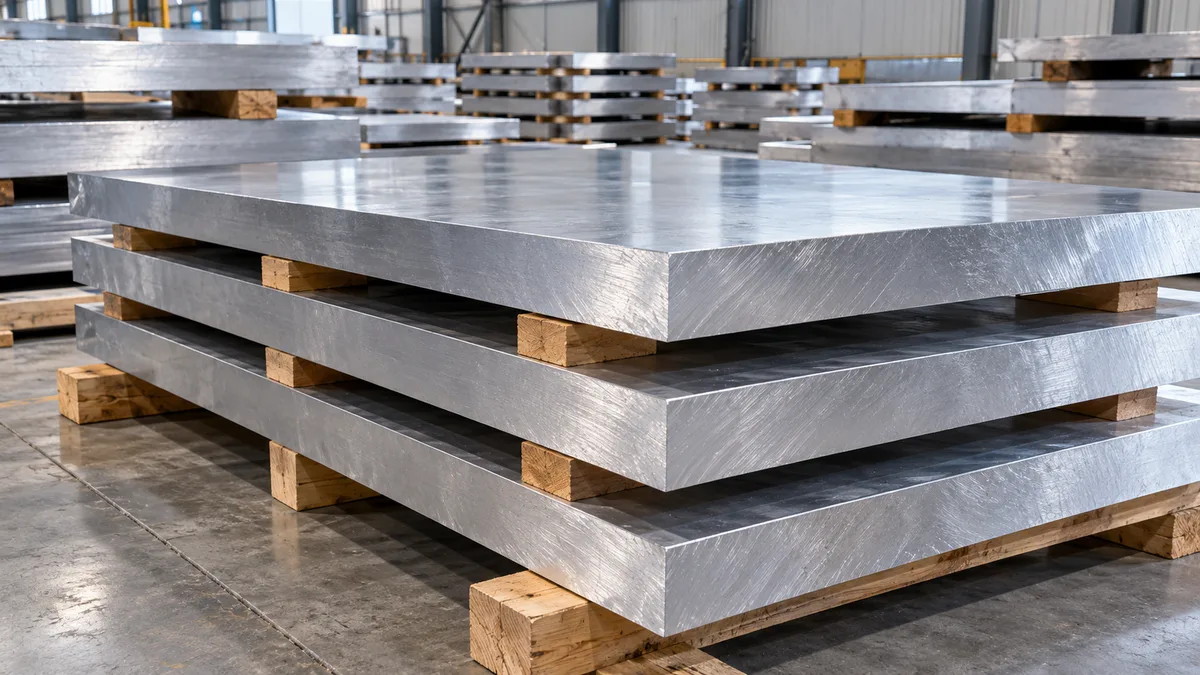
There is no separate aerospace alloy called 6061. What turns standard 6061 sheet or plate into aerospace material is the specification it is produced and certified to, the testing that specification demands, and the traceability that follows the metal from cast to finished part.
Commercial 6061 is normally sold to ASTM B209 or EN 485. Aerospace buyers usually call up SAE Aerospace Material Specifications instead: AMS 4025 for annealed sheet and plate, AMS 4026 for T4 and AMS 4027 for T6 and T651. These documents tighten the rules on how lots are defined and sampled, how tensile tests are taken, what grain size and heat-treatment response are acceptable, how the material is marked, and what the certificate must show. Some airframe makers add their own requirements on top, such as ultrasonic inspection of thick plate or approval of the source mill.
The chemistry and the basic mechanical property levels are the same as commercial 6061. A part designer gains confidence and documentation, not a stronger metal. That is why the first question in any 6061 aerospace enquiry is: which specification, and which revision, is on the drawing?
The table lists the specifications most often seen on drawings and purchase orders for 6061 flat-rolled products. Where several apply, the order should name one as governing.
| Specification | Scope | Tempers |
|---|---|---|
| SAE AMS 4025 | 6061 sheet and plate, annealed | O |
| SAE AMS 4026 | 6061 sheet and plate, solution heat-treated | T4, T451 |
| SAE AMS 4027 | 6061 sheet and plate, solution and precipitation heat-treated | T6, T651 |
| AMS-QQ-A-250/11 | Former federal 6061 plate and sheet specification, still cited on older drawings | O, T4, T451, T6, T651 |
| ASTM B209 / ASME SB-209 | General aluminium sheet and plate | All standard tempers |
| EN 485-2 / EN 573-3 | European sheet, strip and plate: properties and chemistry (EN AW-6061) | O, T4, T6, T651 |
| ISO 6361 | International wrought sheet, strip and plate (AlMg1SiCu) | O, T4, T6, T651 |
| JIS H4000 | Japanese sheet and plate (A6061P) | O, T4, T6 |
Spec revisions change over time. Quote the revision letter on your order (for example AMS 4027 with its current letter) so the certificate can state compliance with the right edition.
AMS 4025, 4026 and 4027 use the registered Aluminum Association composition for 6061, the same limits as ASTM B209 and EN 573-3. Each heat is analysed and the result appears on the certificate.
| Element | Minimum | Maximum | Role in the alloy |
|---|---|---|---|
| Silicon (Si) | 0.40 | 0.80 | Forms the strengthening Mg2Si phase with magnesium |
| Iron (Fe) | — | 0.70 | Impurity; held low for toughness and surface quality |
| Copper (Cu) | 0.15 | 0.40 | Adds strength; a small penalty in corrosion resistance |
| Manganese (Mn) | — | 0.15 | Grain structure control |
| Magnesium (Mg) | 0.80 | 1.20 | Main strengthening element with silicon |
| Chromium (Cr) | 0.04 | 0.35 | Limits recrystallisation, improves stress-corrosion resistance |
| Zinc (Zn) | — | 0.25 | Impurity |
| Titanium (Ti) | — | 0.15 | Grain refiner |
| Others, each / total | — | 0.05 / 0.15 | |
| Aluminium (Al) | Remainder | About 95.8 – 98.6 % |
Two kinds of numbers matter. Specified minimums (or maximums, for O temper) are what the material specification guarantees and what you design to. Typical values describe what production material usually achieves and are useful for comparison only.
| Temper / thickness | Tensile strength | Yield strength (0.2 %) | Elongation (min) |
|---|---|---|---|
| O, sheet and plate (max values) | ≤ 150 MPa / 22 ksi | ≤ 85 MPa / 12 ksi | 14 – 18 % |
| T4 / T451, sheet and plate (min) | 205 MPa / 30 ksi | 110 MPa / 16 ksi | 14 – 18 % |
| T6, sheet 0.15 – 6.3 mm (min) | 290 MPa / 42 ksi | 240 MPa / 35 ksi | 8 – 10 % |
| T651, plate 6.3 – 100 mm (min) | 290 MPa / 42 ksi | 240 MPa / 35 ksi | 10 – 6 % (falls with thickness) |
| T651, plate 100 – 150 mm (min) | 275 MPa / 40 ksi | 240 MPa / 35 ksi | About 6 % |
| T6 / T651, typical | 310 MPa / 45 ksi | 276 MPa / 40 ksi | 12 % |
Limits summarised from ASTM B209 and AMS 4025 – 4027; exact elongation bands depend on thickness and test direction. Minimums for thick plate also apply to properties measured in the transverse direction where the specification requires it.
Strength falls slowly at moderate temperature: 6061-T6 keeps most of its room-temperature strength up to about 100 °C, but long exposure above roughly 150 °C over-ages the alloy. At cryogenic temperatures strength and toughness actually increase, which is one reason 6061 is used for propellant and cryogenic hardware in launch vehicles.
Annealed for maximum formability. Used for deep-drawn, spun or stretch-formed parts such as fairings, ducts and covers that are heat-treated to T6 after forming.
Solution treated and naturally aged. Moderately strong and still formable; parts can be formed in T4 and artificially aged to T6. T451 plate is stretched for flatness.
Peak-aged sheet up to about 6 mm. Used flat or lightly formed for panels, doublers, brackets and enclosures.
Peak-aged plate stretched 1.5 – 3 % to relieve quench stresses. The standard choice for machined fittings, mounts and frames because it stays flat when material is removed.
The designation used when O or T4 material is solution treated and aged by the part maker rather than the mill. Properties are close to T6.
Patterned 6061 sheet for cabin and cargo floors, maintenance stands and access platforms where slip resistance matters.
Ultra-flat and precision-milled plate can be supplied for tooling and machined parts. Tell us the flatness you need.
6061 weighs 2.70 kg per square metre for each millimetre of thickness (0.0975 lb/in³). Use the table for quick estimates or the plate weight calculator for any size.
| Thickness (mm) | kg per m² | 1220 × 2440 mm (kg) | 1250 × 2500 mm (kg) | 1524 × 3048 mm (kg) |
|---|---|---|---|---|
| 0.5 | 1.35 | 4.0 | 4.2 | 6.3 |
| 0.8 | 2.16 | 6.4 | 6.8 | 10.0 |
| 1 | 2.70 | 8.0 | 8.4 | 12.5 |
| 1.2 | 3.24 | 9.6 | 10.1 | 15.1 |
| 1.6 | 4.32 | 12.9 | 13.5 | 20.1 |
| 2 | 5.40 | 16.1 | 16.9 | 25.1 |
| 2.5 | 6.75 | 20.1 | 21.1 | 31.4 |
| 3 | 8.10 | 24.1 | 25.3 | 37.6 |
| 4 | 10.80 | 32.1 | 33.8 | 50.2 |
| 5 | 13.50 | 40.2 | 42.2 | 62.7 |
| 6 | 16.20 | 48.2 | 50.6 | 75.3 |
| 8 | 21.60 | 64.3 | 67.5 | 100.3 |
| 10 | 27.00 | 80.4 | 84.4 | 125.4 |
| 12.7 | 34.29 | 102.1 | 107.2 | 159.3 |
| 16 | 43.20 | 128.6 | 135.0 | 200.7 |
| 20 | 54.00 | 160.7 | 168.8 | 250.8 |
| 25.4 | 68.58 | 204.1 | 214.3 | 318.6 |
| 30 | 81.00 | 241.1 | 253.1 | 376.3 |
| 40 | 108.00 | 321.5 | 337.5 | 501.7 |
| 50 | 135.00 | 401.9 | 421.9 | 627.1 |
| 63.5 | 171.45 | 510.4 | 535.8 | 796.4 |
| 76.2 | 205.74 | 612.4 | 642.9 | 955.7 |
| 100 | 270.00 | 803.7 | 843.8 | 1254.2 |
| 150 | 405.00 | 1205.6 | 1265.6 | 1881.3 |
Dimensional tolerances for AMS orders follow ANSI H35.2 (the tables referenced by ASTM B209). EN orders use EN 485-3 for hot-rolled plate and EN 485-4 for cold-rolled sheet. Cut blanks can be held tighter by sawing or machining.
Many 6061 aerospace parts can be made from more than one starting form, and the choice affects cost, scrap and certification. A thin bracket can be bent from T4 sheet and aged, or machined from T651 plate; a long angle can be machined from plate or bought as an extrusion. The rules below help decide before the request for quotation goes out.
| Part feature | Usually best from | Why |
|---|---|---|
| Flat or bent part under about 6 mm | T6 sheet, or O/T4 sheet formed then aged | Least machining, lowest cost per part |
| Pocketed fitting, frame or mount | T651 plate | Stress-relieved, stays flat during heavy machining |
| Long constant section (angle, channel, T) | 6061 extrusion to AMS 4150 or AMS 4173 | Far less scrap than machining from plate |
| Round or hollow part | 6061 bar or tube | Matches the shape; avoids cutting discs from plate |
| Highly loaded, three-dimensional part | 6061 forging to AMS 4127 | Grain flow follows the part; better ductility in all directions |
When a part is machined from plate thicker than about 75 mm, check whether the drawing requires short-transverse properties or ultrasonic inspection, because both add cost and narrow the list of qualifying material. For prototype work, buyers sometimes start from commercial ASTM B209 plate and switch to AMS 4027 material for qualification and production; if you do this, make sure the production specification is fixed early so test results remain valid.
T651 machines with short chips and a bright surface. Use sharp, high-rake carbide tools, high spindle speeds and flood coolant. Remove material evenly from both faces of thick plate to keep it flat.
T6 sheet needs inside bend radii of roughly 1 – 3 × thickness depending on gauge. For tight bends, form in O or freshly quenched W condition, then age.
TIG and MIG with 4043 or 5356 filler; friction stir welding gives better joint strength. The heat-affected zone drops towards T4 strength unless the part is re-heat-treated.
Accepts solid and blind rivets and structural adhesive bonding after suitable surface preparation (anodise or etch and prime).
Excellent response to sulphuric (Type II), hard (Type III) and chromic or boric-sulphuric anodising, and to conversion coatings for primer adhesion.
Solution treatment around 530 °C, rapid quench, then ageing around 160 – 175 °C to T6. Aerospace heat treatment is controlled to AMS 2770 with pyrometry to AMS 2750.
6061 is rarely used for primary wing and fuselage skins on transport aircraft; those use 2024, 2524, 7075 and newer aluminium-lithium alloys for fatigue performance and strength. 6061 earns its place where corrosion resistance, weldability and machinability matter more than peak strength. Outside aerospace the same sheet is widely used in automotive, marine, tooling and machine building.
| Property | 6061-T651 | 2024-T351 | 7075-T651 | 6082-T651 |
|---|---|---|---|---|
| Typical tensile strength | 310 MPa | 470 MPa | 570 MPa | 310 – 340 MPa |
| Typical yield strength | 276 MPa | 325 MPa | 505 MPa | 260 – 300 MPa |
| Fatigue performance | Moderate | Very good | Good | Moderate |
| Weldability (fusion) | Good | Poor | Poor | Good |
| Corrosion resistance | Very good | Fair (clad or coat) | Fair | Very good |
| Machinability | Very good | Good | Excellent | Very good |
| Relative cost | Low | Higher | Higher | Low |
Choose 6061 for welded and corrosion-exposed parts with moderate loads. Choose 2024 when fatigue and damage tolerance govern, and 7075 when static strength governs and welding is not needed. In Europe, 6082 is often the commercial substitute for 6061, but aerospace drawings that call for AMS 4027 require 6061 itself.
The alloy is the same. Aerospace 6061 is produced, tested and certified to an aerospace specification such as AMS 4027, with stricter lot definition, testing, marking and traceability. Commercial 6061 is usually certified only to ASTM B209 or EN 485.
AMS 4027 covers 6061 sheet and plate in T6 and T651. AMS 4025 covers the annealed O temper and AMS 4026 covers T4 and T451.
T651. It is stretched after quenching to remove internal stress, so it stays flat and dimensionally stable during heavy machining. T6 is normal for sheet up to about 6 mm.
Rarely on transport aircraft, where 2024, 2524 and 7075 are preferred for fatigue and strength. 6061 is common on light aircraft, kit aircraft, drones, spacecraft and in secondary structure and fittings.
It weighs 2.70 kg per m² per millimetre of thickness. A 1220 × 2440 × 3 mm sheet weighs about 24.1 kg; a 1250 × 2500 × 10 mm plate about 84.4 kg.
Yes, with qualified TIG, MIG or friction stir procedures. Welding lowers strength in the heat-affected zone, so welded designs use reduced allowables or post-weld heat treatment.
Yes. Plate can be ordered with ultrasonic inspection to AMS-STD-2154 or ASTM B594 at the class you specify, documented on the certificate. Metline ships it worldwide.
Send the specification, temper, sizes, quantity and destination. Our team will reply with availability, test plan and a delivered price.





