6061-O (AMS 4115)
Fully annealed and soft. Used for wire that will be headed, coiled into springs or bent tightly, then heat-treated by the parts maker to T4 or T6.



6061 wire is cold-drawn from the most widely used heat-treatable aluminium alloy and is chosen in aircraft and spacecraft work for rivets, pins, cold-headed fasteners, springs, lock wire substitutes and small machined parts that need moderate strength with good corrosion resistance. Metline supplies 6061 wire in O, T4 and T6 tempers to AMS 4115, AMS 4116, AMS 4117, ASTM B211 and ASTM B316, on spools, in coils or as straightened lengths, to buyers worldwide.
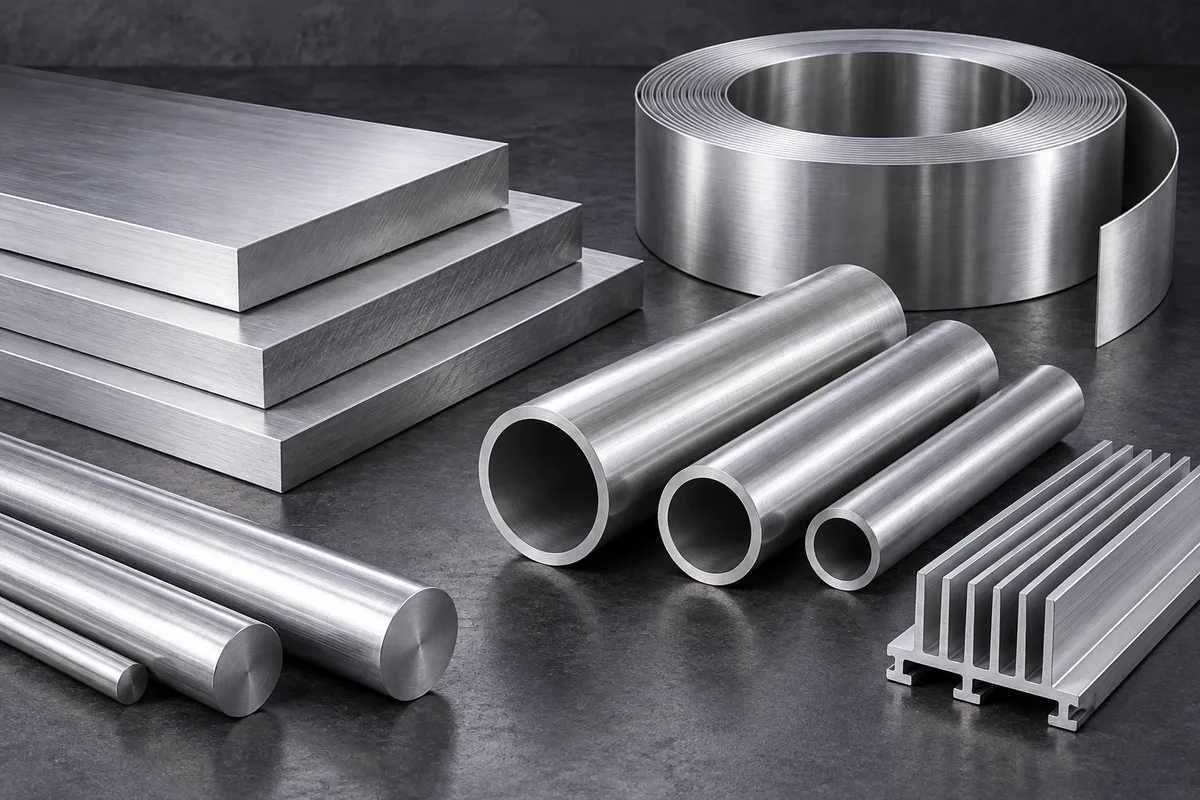
6061 wire is round (occasionally shaped) product under about 9.5 mm (0.375 in) diameter, produced by drawing extruded or rolled redraw rod through a series of dies. Larger sizes are classed as rod. Because the alloy hardens by solution treatment and ageing, the same chemistry can be delivered soft for heading and forming, or fully aged for strength.
In aircraft, the heavy-duty structural rivets are 2117, 2017, 2024 and 7050 alloys. 6061 wire fills the gap below them: rivets and pins for secondary structure and interiors, cold-headed screws and studs, clevis pins, small springs and clips, antenna and sensor elements, cable-tie and safety-clip blanks, and turned parts made on sliding-head lathes from straightened lengths. On satellites and launch vehicles it is used for brackets, standoffs and fasteners where a predictable, weldable, non-magnetic alloy is wanted.
The three AMS documents divide the alloy by temper: AMS 4115 covers annealed material, AMS 4116 the solution-treated and naturally aged T4 condition and AMS 4117 the fully aged T6 / T651 condition. Commercial and defence orders often use ASTM B211 for drawn wire or ASTM B316 for rivet and cold-heading wire, with aerospace inspection added.
Limits are the registered Aluminum Association values. ASTM B211, B316, the AMS 4115 – 4117 family and EN 573-3 (EN AW-6061, AlMg1SiCu) follow the same range. Every lot ships with a certificate reporting the measured analysis.
| Element | Minimum | Maximum | Role in the alloy |
|---|---|---|---|
| Silicon (Si) | 0.40 | 0.80 | Combines with Mg to form the strengthening Mg2Si phase |
| Iron (Fe) | — | 0.70 | Impurity; kept low for ductility |
| Copper (Cu) | 0.15 | 0.40 | Adds strength after ageing |
| Manganese (Mn) | — | 0.15 | Grain control |
| Magnesium (Mg) | 0.80 | 1.20 | Main strengthening element with Si |
| Chromium (Cr) | 0.04 | 0.35 | Controls recrystallisation; improves stress-corrosion resistance |
| Zinc (Zn) | — | 0.25 | Impurity |
| Titanium (Ti) | — | 0.15 | Grain refiner |
| Others, each / total | — | 0.05 / 0.15 | |
| Aluminium (Al) | Remainder | About 95.8 – 98.6 % |
The chromium minimum is often left off simplified tables. It matters for wire: chromium keeps the grain fine during solution treatment, which helps the heads of cold-formed rivets stay free of orange-peel surface.
Typical values show what well-processed wire usually achieves; specified limits are what ASTM B211 guarantees and what designs should be based on. Thin wire generally tests at the upper end of the range because drawing and quench are more uniform in small sections.
| Temper | Typical tensile | Typical yield (0.2 %) | Typical elongation | Brinell hardness |
|---|---|---|---|---|
| O (annealed) | 125 MPa / 18 ksi | 55 MPa / 8 ksi | 25 – 30 % | 30 HB |
| T4 | 241 MPa / 35 ksi | 145 MPa / 21 ksi | 22 % | 65 HB |
| T6 | 310 MPa / 45 ksi | 276 MPa / 40 ksi | 12 % | 95 HB |
| Temper (ASTM B211 wire) | Tensile strength | Yield strength (0.2 %) |
|---|---|---|
| O | ≤ 152 MPa (22 ksi) maximum | — |
| T4 | ≥ 207 MPa (30 ksi) | ≥ 110 MPa (16 ksi) |
| T6 | ≥ 290 MPa (42 ksi) | ≥ 241 MPa (35 ksi) |
Elongation is often not specified for small-diameter wire because the gauge length is impractical; bend, wrap or heading tests are used instead. Check the order specification for the test method that applies.
Fully annealed and soft. Used for wire that will be headed, coiled into springs or bent tightly, then heat-treated by the parts maker to T4 or T6.
Solution treated and naturally aged. Ductile enough for heading and riveting, yet about twice the strength of O. Parts can be artificially aged to T6 after forming.
Solution treated and artificially aged for full strength. The usual choice for pins, machined parts and wire used as supplied without further forming.
Tempers listed in ASTM B211 in which wire is cold-drawn after heat treatment for higher strength. Used for some high-strength pins and fastener stock; confirm availability by size.
ASTM B316 adds surface and heading-test requirements for wire destined for rivets and cold-formed fasteners.
6061 is not used as welding filler because it cracks when fused alone. To weld 6061, use ER4043 or ER5356 filler wire instead.
The aerospace documents cover bars, rods and wire together, so a single specification governs the wire and any larger rod made from the same lot. Legacy drawings may still quote QQ-A-225/8, the cancelled federal standard for 6061 bar, rod and wire; ASTM B211 and the AMS documents replace it for new work.
| System | Designation / standard | Scope |
|---|---|---|
| SAE AMS | AMS 4115 | 6061-O bars, rods and wire |
| SAE AMS | AMS 4116 | 6061-T4 bars, rods and wire, cold finished |
| SAE AMS | AMS 4117 | 6061-T6 / T651 rolled or cold-finished bars, rods, wire and flash-welded rings |
| ASTM | ASTM B211 | Rolled or cold-finished bar, rod and wire |
| ASTM | ASTM B316 | Rivet and cold-heading wire and rod |
| ASTM | ASTM B221 | Extruded wire and rod (redraw stock) |
| UNS | A96061 | — |
| European | EN AW-6061 (AlMg1SiCu); EN 1301-2 for drawn wire | Drawn wire mechanical properties |
| Japan | A6061W | JIS H4040 |
Tell us whether the wire will be headed, machined, coiled or used straight; that decides the temper, surface condition and put-up.
Weight per kilometre is π/4 × d² × 2.70 kg, with d in millimetres. Values for common diameters:
| Diameter (mm) | kg per km | Metres per kg | Diameter (in) |
|---|---|---|---|
| 0.5 | 0.53 | 1886.3 | 0.020 |
| 0.8 | 1.36 | 736.8 | 0.031 |
| 1 | 2.12 | 471.6 | 0.039 |
| 1.2 | 3.05 | 327.5 | 0.047 |
| 1.6 | 5.43 | 184.2 | 0.063 |
| 2 | 8.48 | 117.9 | 0.079 |
| 2.5 | 13.25 | 75.5 | 0.098 |
| 3 | 19.09 | 52.4 | 0.118 |
| 3.2 | 21.71 | 46.1 | 0.126 |
| 4 | 33.93 | 29.5 | 0.157 |
| 4.8 | 48.86 | 20.5 | 0.189 |
| 5 | 53.01 | 18.9 | 0.197 |
| 6 | 76.34 | 13.1 | 0.236 |
| 6.35 | 85.51 | 11.7 | 0.250 |
| 8 | 135.72 | 7.4 | 0.315 |
| 9.5 | 191.38 | 5.2 | 0.374 |
Diameter tolerances for drawn wire follow ANSI H35.2 as referenced by ASTM B211 and B316, or EN 1301-3 for European orders. For wire under a few millimetres the tolerance is a few hundredths of a millimetre, so cold-heading and automatic lathe users should state any tighter band they need.
A typical example is a cabin interior panel: the panel frames are 6061 extrusions, and the pins that hold the hinges are turned from 6061-T6 wire so that anodising produces the same colour and both parts behave the same in service.
| Property | 6061-T6 | 2117-T4 (AD rivet) | 5056-O | 7050-T73 |
|---|---|---|---|---|
| Typical tensile strength | 310 MPa | 295 MPa | 290 MPa | About 500 MPa |
| Typical shear strength | 207 MPa | 195 MPa | 180 MPa | About 285 MPa |
| Heat treatable | Yes | Yes | No | Yes |
| Corrosion resistance | Good | Fair | Very good | Good (T73) |
| Typical aerospace role | Secondary pins, rivets, wire forms | General aircraft rivets | Rivets for magnesium and Al-Mg parts | High-strength structural rivets |
Choose 2117 when an aircraft rivet standard calls for "AD" rivets, 5056 when fastening magnesium or 5xxx parts, and 7050 for highly loaded structure. 6061 is the logical choice when the wire part should match surrounding 6061 material or must be welded or anodised with it.
They cover the same 6061 alloy in different tempers: AMS 4115 for annealed (O) material, AMS 4116 for T4 and AMS 4117 for T6 / T651. All three include bars, rods and wire, so the temper you need decides which document to quote.
No. 6061 cracks when it solidifies without dilution by a filler of different chemistry. Use ER4043 or ER5356 filler wire to weld 6061 parts.
O or T4. O gives the easiest heading; T4 heads well and can be artificially aged to T6 afterwards for full strength. T6 wire is too hard for severe heading.
Typical tensile strength is about 310 MPa (45 ksi) and yield about 276 MPa (40 ksi). ASTM B211 guarantees at least 290 MPa tensile and 241 MPa yield for T6 wire.
In ASTM terms wire is under 9.5 mm (0.375 in). Larger diameters are supplied as rod or bar to the same AMS documents.
Yes. Metline supplies 6061 wire on spools, in coils or as straightened lengths with an EN 10204 3.1 mill certificate, shipped worldwide.
Send the diameter, temper, specification, put-up and quantity. We will reply with availability, certification and a delivered price.





