Bending
O tube bends to small radii with a mandrel or by hand bender. Harder tempers need larger radii; check ovality after bending against the line drawing.



5251 tube is drawn from a 2 % magnesium aluminium alloy that bends, flares and welds easily while resisting corrosion, which is why British aircraft standards adopted it for low-pressure fluid lines as BS L56. Metline supplies 5251 seamless drawn tube in O, H22, H32 and H14 tempers, in straight lengths or coils, certified to BS L56 or EN 754, to buyers worldwide.
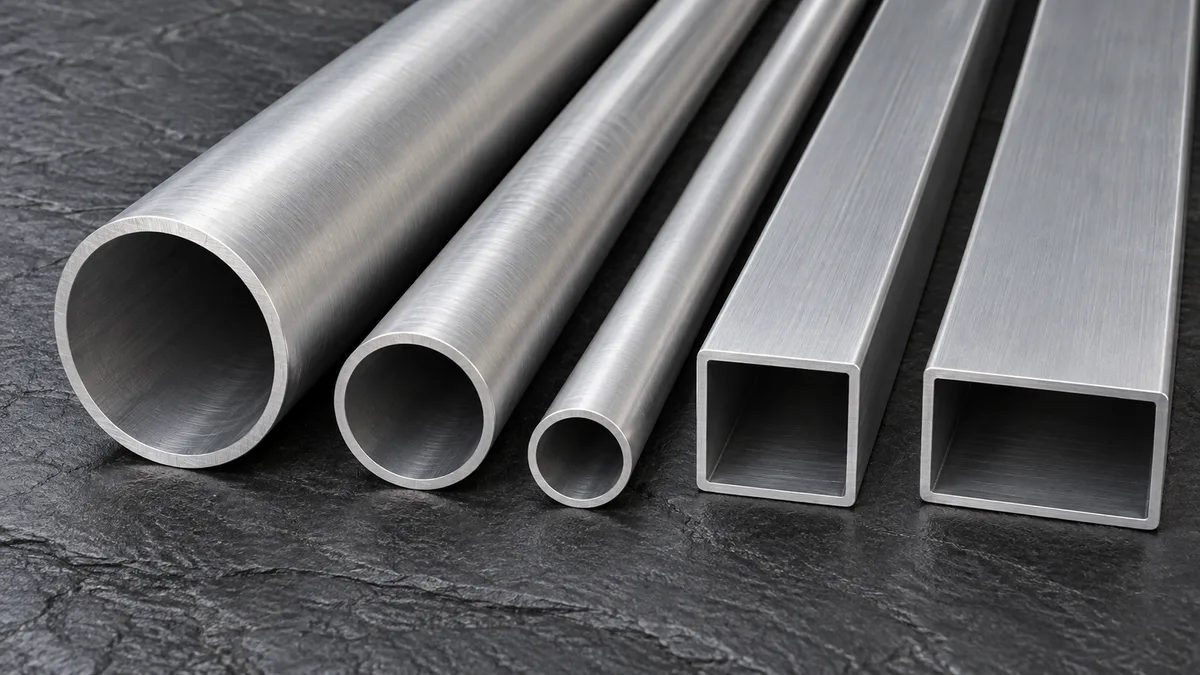
Aircraft fluid systems need tube that can be bent to tight radii, flared or beaded at the ends, joined by welding or fittings, and left in service for decades without corrosion. 5251 meets those needs at moderate pressure, and it has been the standard British choice for that work through the L56 specification.
Typical uses are low- and medium-pressure fuel, oil, vent, drain and coolant lines, pneumatic and instrument lines, breather pipes and small air ducts. Higher-pressure hydraulic lines normally use 6061-T6, 5052 or titanium and stainless tube, so 5251 is chosen where formability and corrosion resistance matter more than burst pressure.
L56 tube is drawn and hydraulically tested, so every length has been pressure-proved before delivery. Annealed tube is easiest to bend on the aircraft; H22 and H32 give extra stiffness for straight runs and supports.
Limits are those of EN 573-3 for EN AW-5251. The British L56 specification allows a slightly different set of limits for minor elements (for example a combined Mn + Cr maximum), so the certificate is issued against whichever document the order names.
| Element | Minimum | Maximum | Role in the alloy |
|---|---|---|---|
| Silicon (Si) | — | 0.40 | Impurity |
| Iron (Fe) | — | 0.50 | Impurity; affects grain size and surface |
| Copper (Cu) | — | 0.15 | Kept low to protect corrosion resistance |
| Manganese (Mn) | 0.10 | 0.50 | Adds strength and refines grain |
| Magnesium (Mg) | 1.7 | 2.4 | Main strengthening element (solid solution) |
| Chromium (Cr) | — | 0.15 | Grain control |
| Zinc (Zn) | — | 0.15 | Impurity |
| Titanium (Ti) | — | 0.15 | Grain refiner |
| Others, each / total | — | 0.05 / 0.15 | |
| Aluminium (Al) | Remainder | About 96.3 – 98.2 % |
| Temper | Tensile strength Rm | 0.2 % proof stress (min) | Typical use |
|---|---|---|---|
| O | 160 – 200 MPa (indicative) | About 60 MPa | Lines bent and flared during installation |
| H22 / H32 | About 190 – 230 MPa | About 120 MPa | General lines with moderate bends |
| H14 | About 210 – 250 MPa | About 170 MPa | Straight runs, supports and stiffer lines |
Tube values follow the limits of the governing tube specification (BS L56 or EN 754-2) and vary with wall thickness. Use these figures for comparison only and design to the certified minimums.
Weight per metre is π × (OD − t) × t × 2.69 ÷ 1000 kg, with sizes in millimetres.
| OD × wall (mm) | kg per metre | kg per 3 m length |
|---|---|---|
| 4 × 0.8 | 0.022 | 0.06 |
| 6 × 0.8 | 0.035 | 0.11 |
| 6 × 1 | 0.042 | 0.13 |
| 8 × 1 | 0.059 | 0.18 |
| 10 × 1 | 0.076 | 0.23 |
| 12 × 1 | 0.093 | 0.28 |
| 12 × 1.5 | 0.133 | 0.40 |
| 16 × 1.5 | 0.184 | 0.55 |
| 20 × 1.5 | 0.235 | 0.70 |
| 25 × 1.6 | 0.316 | 0.95 |
| 25 × 2 | 0.389 | 1.17 |
| 32 × 2 | 0.507 | 1.52 |
| 40 × 2.5 | 0.792 | 2.38 |
| 50 × 3 | 1.192 | 3.57 |
O tube bends to small radii with a mandrel or by hand bender. Harder tempers need larger radii; check ovality after bending against the line drawing.
O and H22 accept 37° and 74° flares and beads for hose clamps. Inspect flares for splits on the first articles.
TIG welds well with ER5356 or ER5183. 5251 is not normally torch brazed because magnesium makes flux brazing difficult.
Lines for fuel and oxygen-compatible systems need cleaning and capping to the system specification; state this on the order.
| Property | 3003 tube | 5251 tube | 5052 tube | 6061-T6 tube |
|---|---|---|---|---|
| Relative strength | Low | Medium | Medium | High |
| Ease of bending and flaring | Excellent | Very good | Very good | Fair |
| Corrosion resistance | Good | Very good | Very good | Good |
| Typical aircraft use | Drain and vent lines | Fuel, oil and air lines | Fuel and oil lines (US drawings) | Hydraulic and structural tube |
On US drawings the equivalent role is usually filled by 5052-O tube to AMS 4069 or ASTM B210. Substitution between 5251 and 5052 needs approval from the design authority.
L56 is the British aerospace specification for drawn, hydraulically tested tube in the 2 % magnesium alloy that corresponds to 5251. It is widely used for low- and medium-pressure fluid lines.
It suits low and moderate pressures. High-pressure hydraulic systems generally use 6061-T6, titanium or stainless tube, sized to the system pressure rating.
O (annealed) tube gives the tightest bends and best flares. H22 or H32 is used where a stiffer line is wanted and the bends are gentle.
Small diameters in the O temper can be supplied in coils; larger and harder tubes are supplied in straight lengths.
ER5356 is the usual choice; ER5183 is an alternative. Avoid 4xxx silicon fillers on magnesium alloys.
Send the specification, OD, wall, temper, length and quantity. We will reply with availability, certification and a delivered price.





