O (L80)
Fully annealed. Best for deep drawing, spinning, panel beating and tight bends. Parts gain some strength from the forming itself.



5251 is a medium-strength aluminium alloy with about 2 % magnesium, long used in the UK and Europe for formed and welded aircraft sheet-metal parts. It is the alloy behind the British aerospace sheet specifications L80 (annealed) and L81 (hard tempers). Metline supplies 5251 sheet and plate in O, H22, H24, H26 and related tempers to BS L80, L81 and EN 485, cut to size and certified, to customers worldwide.
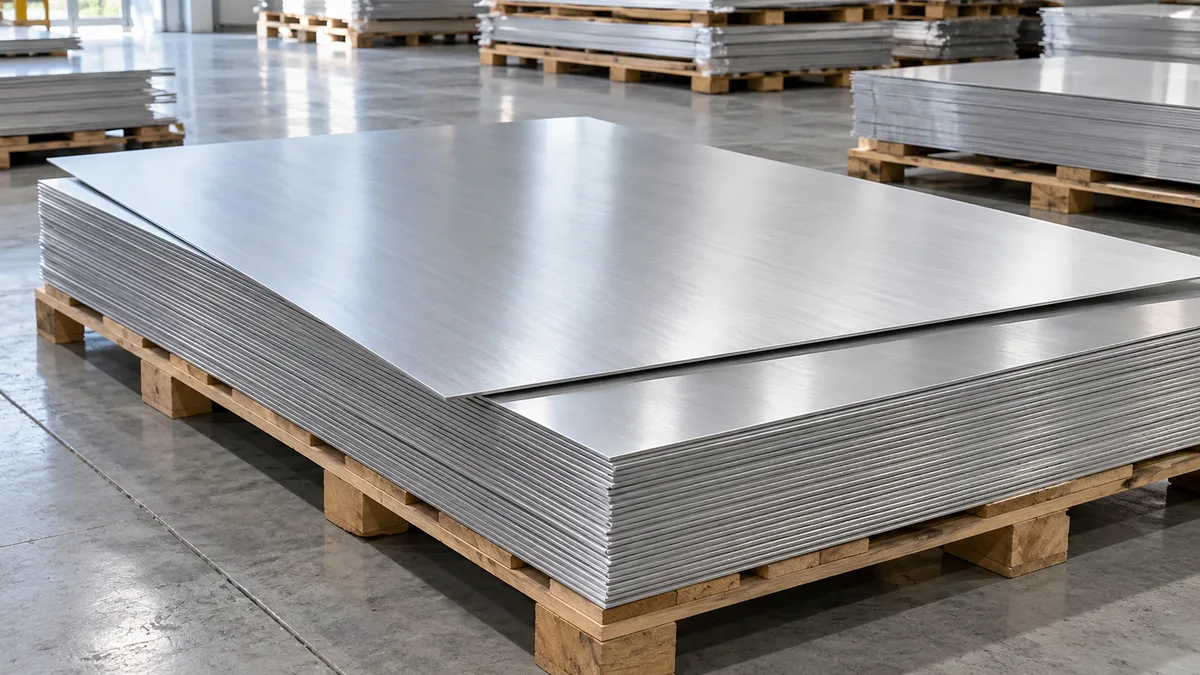
5251 (EN AW-5251, AlMg2) was one of the most common non-heat-treatable sheet alloys in British aircraft and vehicle work, and it is still specified on many UK and European drawings. It is stronger than 3003 and pure aluminium, easier to form than 5052 or 5754, and welds without loss of corrosion resistance.
In aircraft and helicopters, 5251 sheet goes into secondary parts that are folded, beaten, spun or welded: cowling liners, ducting, fairings and access panels in non-structural areas, fuel and oil tank shells, brackets, cable-trough covers, cabin trim panels and equipment boxes. It also appears in ground support equipment and in the restoration of older British aircraft, where the original drawings call L80 or L81.
Because 5251 work-hardens quickly, the annealed L80 condition is used for parts that must be formed heavily, while L81 in H16 or H26 gives the stiffer sheet wanted for flat panels and covers. Neither can be strengthened by heat treatment, so the temper must be chosen before forming.
Limits below are those of EN 573-3 for EN AW-5251, which the BS L-series sheet specifications broadly follow. Older British documents allow slightly different limits for minor elements, so the governing specification on your drawing takes precedence.
| Element | Minimum | Maximum | Role in the alloy |
|---|---|---|---|
| Silicon (Si) | — | 0.40 | Impurity |
| Iron (Fe) | — | 0.50 | Impurity; affects grain size and surface |
| Copper (Cu) | — | 0.15 | Kept low to protect corrosion resistance |
| Manganese (Mn) | 0.10 | 0.50 | Adds strength and refines grain |
| Magnesium (Mg) | 1.7 | 2.4 | Main strengthening element (solid solution) |
| Chromium (Cr) | — | 0.15 | Grain control |
| Zinc (Zn) | — | 0.15 | Impurity |
| Titanium (Ti) | — | 0.15 | Grain refiner |
| Others, each / total | — | 0.05 / 0.15 | |
| Aluminium (Al) | Remainder | About 96.3 – 98.2 % |
Some data sheets wrongly give 5251 a magnesium range of 2.2 – 2.8 % with high chromium; those are 5052 limits. Genuine 5251 contains 1.7 – 2.4 % magnesium and a managed manganese addition.
Values are the EN 485-2 limits for thin sheet (roughly 0.5 – 3 mm). Thicker bands have slightly different elongation limits. L80 and L81 certificates report results against the British specification, which are close to these values.
| Temper | Tensile strength Rm | 0.2 % proof stress Rp0.2 (min) | Typical hardness |
|---|---|---|---|
| O / H111 (L80) | 160 – 200 MPa | 60 MPa | About 45 HB |
| H22 / H32 | 190 – 230 MPa | 120 MPa | About 58 HB |
| H24 / H34 | 210 – 250 MPa | 140 MPa | About 64 HB |
| H26 / H36 (L81) | 230 – 270 MPa | 170 MPa | About 69 HB |
| H14 | 210 – 250 MPa | 170 MPa | About 65 HB |
| H16 (L81) | 230 – 270 MPa | 200 MPa | About 70 HB |
Elongation falls as temper rises: annealed sheet typically gives well over 15 %, while H16 and H26 sheet may give only a few percent in thin gauges. Confirm exact minimums for your thickness on the certificate.
Fully annealed. Best for deep drawing, spinning, panel beating and tight bends. Parts gain some strength from the forming itself.
Strain-hardened then partly annealed to quarter-hard. Keeps more ductility than H12 at the same strength, so it folds well with modest bend radii.
Half-hard, partly annealed. A good compromise for brackets and covers that need some stiffness but still have bends.
Three-quarter-hard, partly annealed. Stiff, flat sheet for panels and covers with gentle bends only.
Strain-hardened only, without partial annealing. Slightly higher proof stress than H24 and H26 but less elongation.
Strain-hardened and stabilised. Similar strength to H22 and H24; often supplied when the order is written to EN or ASTM practice.
| System | Designation / standard | Scope |
|---|---|---|
| British aerospace | BS L80 | 5251-O sheet and strip |
| British aerospace | BS L81 | 5251 sheet and strip in H16 or H26 |
| European | EN AW-5251 (AlMg2), EN 485-1/-2/-4 | Sheet, strip and plate |
| Aerospace dimensions | EN 2071 | Dimensions for aerospace aluminium sheet 0.25 – 6 mm |
| Former British general | NS4 (BS 1470) | Older designation of 5251 sheet |
| German Werkstoff | 3.3525 | — |
| UNS | A95251 | — |
Weight of 5251 sheet is 2.69 kg per m² per millimetre of thickness: a 1250 × 2500 × 1.6 mm sheet weighs about 13.5 kg.
Work-hardens quickly. For deep or repeated forming, start in O and anneal between stages (about 340 – 360 °C). H22 bends readily with radii around 1 × thickness in thin sheet.
TIG and MIG weld well with ER5356 or ER5183 filler. Resistance spot and seam welding are also common. The heat-affected zone softens to near O values in hard tempers.
Takes sulphuric and chromic anodising and paint systems well. Chromate-free conversion coatings are used where aerospace programmes require them.
Very good in marine and industrial air. With magnesium below 3 %, 5251 is not prone to sensitisation, so warm service is acceptable.
| Property | 3003-H14 | 5251-H22 | 5052-H32 | 5754-H22 | 6061-T6 |
|---|---|---|---|---|---|
| Magnesium content | None (Mn alloy) | 1.7 – 2.4 % | 2.2 – 2.8 % | 2.6 – 3.6 % | 0.8 – 1.2 % |
| Min tensile strength (EN 485-2 sheet) | About 140 MPa | 190 MPa | 210 MPa | 220 MPa | 290 MPa |
| Heat treatable | No | No | No | No | Yes |
| Formability | Excellent | Very good | Very good | Good | Fair in T6 |
| Seawater resistance | Good | Very good | Very good | Very good | Good |
| Weldability | Excellent | Excellent | Excellent | Excellent | Good (HAZ softening) |
Choose 5251 when forming dominates and moderate strength is enough. Step up to 5052 or 5754 when a little more strength is needed, or to 6061 when the part will be heat treated.
Both are 5251 sheet. L80 is the annealed O condition for heavy forming; L81 covers the harder H16 and H26 tempers for flatter, stiffer parts.
No. They are similar Al-Mg alloys, but 5251 has less magnesium (1.7 – 2.4 % against 2.2 – 2.8 %) and uses manganese rather than chromium. 5052 is a little stronger; 5251 is slightly more formable.
No. Strength comes from cold work. Heat treatment can only anneal it or partly anneal it to H2x tempers.
There is no exact ASTM-standard equivalent in common stock. 5052 is the closest widely available alloy in the US, though its properties and composition differ and a substitution needs design approval.
No. With magnesium below 3 % it does not form continuous grain-boundary precipitates in normal service, so it can be used at moderately elevated temperatures.
Send the specification, temper, thickness, size and quantity. We will reply with availability, certification and a delivered price.





