O
Fully annealed. Lowest strength, highest ductility. Order it for rod that will be bent, rolled, headed or swaged cold.



5086 aluminium round bar is a weldable, seawater-resistant Al-Mg alloy with about 4 % magnesium: a little lower in strength than 5083, but easier to extrude and more forgiving in service. Metline supplies extruded and cold-drawn 5086 rod in O, H111, H112 and H32 tempers to ASTM B221, EN 755-2 and EN 754-2, cut to length and certified, to customers worldwide.
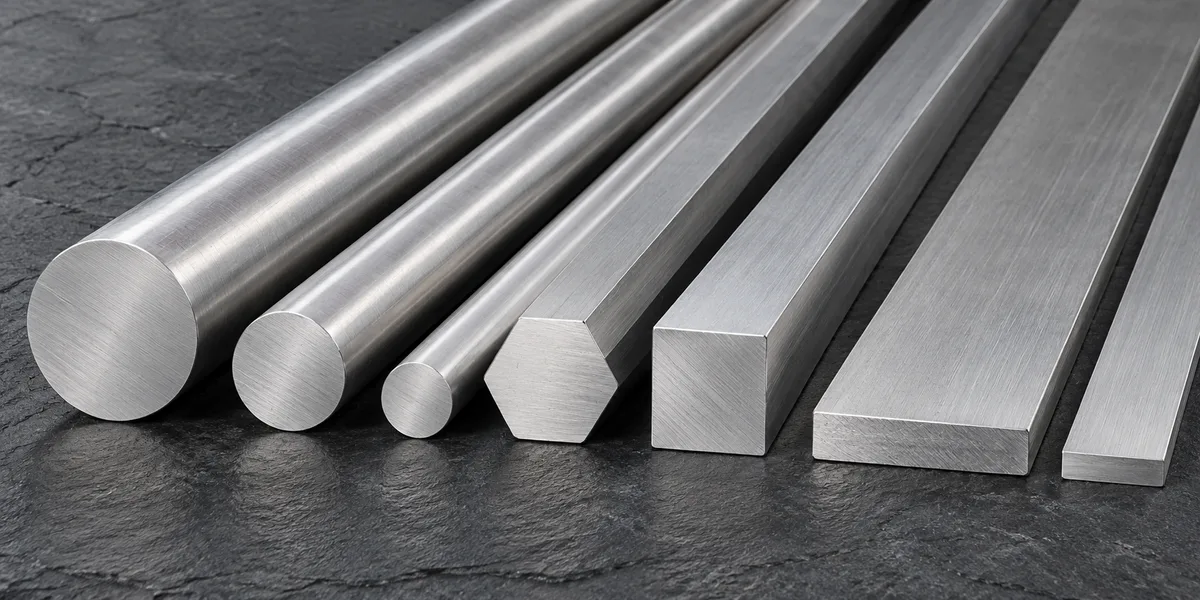
5086 sits between 5052 and 5083 in the aluminium-magnesium family. Its 3.5 – 4.5 % magnesium gives clearly more strength than 5052 and corrosion resistance in seawater on a par with 5083, while the slightly lower magnesium makes it easier to extrude and draw into rod and less prone to sensitisation after long exposure to warm conditions.
Like every 5xxx alloy, 5086 is non-heat-treatable. Strength comes from magnesium dissolved in the aluminium and from cold work, so there is no T6 temper and, importantly, welding does not wipe out a heat-treated condition the way it does in 6061 or 6082. A welded 5086 joint keeps roughly the strength of annealed parent metal, which is why naval architects and pressure-equipment designers rely on it.
In bar form, 5086 is mostly used for parts that are machined and then welded into a 5xxx structure, or that must survive salt spray without a coating: marine shafts and pins, deck hardware, flange and fitting blanks, cryogenic supports and the brackets that join a welded aluminium hull or tank to its fittings.
Limits follow the Aluminum Association registration and EN 573-3 (EN AW-5086, AlMg4). Each lot ships with a certificate reporting the actual analysis.
| Element | Minimum | Maximum | Effect |
|---|---|---|---|
| Magnesium (Mg) | 3.5 | 4.5 | Solid-solution strengthening and corrosion resistance |
| Manganese (Mn) | 0.20 | 0.7 | Strength and grain control |
| Chromium (Cr) | 0.05 | 0.25 | Resistance to stress corrosion; grain control |
| Silicon (Si) | — | 0.40 | Impurity |
| Iron (Fe) | — | 0.50 | Impurity |
| Copper (Cu) | — | 0.10 | Kept low for seawater resistance |
| Zinc (Zn) | — | 0.25 | Impurity |
| Titanium (Ti) | — | 0.15 | Grain refiner |
| Others, each / total | — | 0.05 / 0.15 | |
| Aluminium (Al) | Remainder | About 93.0 – 96.3 % |
Bar is produced either by extrusion (EN 755-2, ASTM B221) or by extrusion followed by cold drawing (EN 754-2). The route decides which property table applies, so state it on the order if it matters to you.
| Route, temper and basis | Diameter | Tensile strength | Yield (0.2 %) | Elongation A |
|---|---|---|---|---|
| Extruded O / H111, EN 755-2 min. | ≤ 200 mm | 240 – 320 MPa | ≥ 95 MPa | ≥ 18 % |
| Extruded H112 / F, EN 755-2 min. | ≤ 250 mm | ≥ 240 MPa | ≥ 95 MPa | ≥ 12 % |
| Drawn O / H111, EN 754-2 min. | ≤ 80 mm | 240 – 320 MPa | ≥ 95 MPa | ≥ 16 % |
| Drawn H12 / H22 / H32, EN 754-2 min. | ≤ 30 mm | ≥ 270 MPa | ≥ 190 MPa | ≥ 5 % |
| Extruded O, ASTM B221 min. | all listed | 240 MPa / 35 ksi (max. 315 MPa) | 95 MPa / 14 ksi | 14 % |
| Extruded H111, ASTM B221 min. | all listed | 248 MPa / 36 ksi | 145 MPa / 21 ksi | 12 % |
| Extruded H112, ASTM B221 min. | all listed | 240 MPa / 35 ksi | 95 MPa / 14 ksi | 12 % |
Values are specified minimums summarised from EN 755-2, EN 754-2 and ASTM B221; the standards split them further by size, and the applicable figures are printed on the mill certificate. Typical properties for 5086-O are about 262 MPa tensile and 117 MPa yield; for H32 about 290 MPa and 207 MPa.
Fully annealed. Lowest strength, highest ductility. Order it for rod that will be bent, rolled, headed or swaged cold.
Annealed and then given a small amount of strain, usually from straightening. Higher guaranteed yield than O in ASTM B221 and the common marine bar temper.
As-extruded, with properties guaranteed by test. The economical choice for larger diameters and for parts that will be machined all over.
Strain-hardened by drawing and stabilised. Gives about double the yield of O temper in small diameters; stabilising reduces age-softening at room temperature.
Quarter-hard drawn tempers with or without partial anneal. Used for small-diameter rod where some strength and some formability are both needed.
As fabricated with no guaranteed properties. Acceptable only when the bar will be fully re-processed or properties do not matter.
| Route | Typical sizes | Strengths | When to choose it |
|---|---|---|---|
| Extruded (EN 755, ASTM B221) | about 10 – 250 mm | Economical, wide size range, consistent properties along the length | Most marine and fabrication work, parts machined all over |
| Cold drawn (EN 754, ASTM B211-type) | about 6 – 80 mm | Closer diameter tolerance, brighter surface, higher strength in H tempers | Turned parts, fasteners, pins and shafts where finish matters |
| Forged round | larger diameters | Refined grain, good through-thickness properties | Highly loaded parts, very large rounds, ultrasonic-critical parts |
| Peeled / turned | any size from extruded stock | Close tolerance and clean surface | Precision blanks and bar for automatic lathes |
For most buyers, extruded H112 or H111 bar is the right starting point. Drawn rod costs more per kilogram but can save machining time on small precision parts. Very large rounds are sometimes supplied as cast and machined bar; that is not the same as wrought bar, and the properties must be agreed in writing.
| System | Designation | Bar and rod standard |
|---|---|---|
| Aluminum Association / ASTM | 5086 | ASTM B221 (extruded), ASME SB-221 |
| UNS | A95086 | — |
| European (EN) | EN AW-5086 / EN AW-AlMg4 | EN 755-2, EN 754-2, EN 573-3 |
| German Werkstoff | 3.3545 | DIN EN 754 / 755 |
| ISO | AlMg4 | ISO 6362 |
| Japan (JIS) | A5086 | JIS H4040 (bar), JIS H4000 (plate) |
| China (GB) | 5086 | GB/T 3191 |
Older national names you may still see on drawings include NF A-G4MC (France) and L-3322 (Spain). For ships and offshore units, the rules of the classification society (DNV, ABS, LR, BV, NK, KR, CCS and others) apply on top of the material standard. If your drawing requires class-approved bar, tell us the society and survey level so we can confirm what can be supplied for that order.
At 2.66 g/cm³, a 5086 round bar weighs 0.002089 × d² kg per metre (d in mm). Values are theoretical and ignore tolerance; use the bar weight calculator for other sizes.
| Diameter (mm) | Approx. inch | kg per metre | kg per 3 m bar | lb per foot |
|---|---|---|---|---|
| 6 | 0.24 | 0.075 | 0.23 | 0.051 |
| 10 | 0.39 | 0.209 | 0.63 | 0.140 |
| 12 | 0.47 | 0.301 | 0.90 | 0.202 |
| 16 | 0.63 | 0.535 | 1.60 | 0.359 |
| 20 | 0.79 | 0.836 | 2.51 | 0.562 |
| 25 | 0.98 | 1.31 | 3.92 | 0.877 |
| 30 | 1.18 | 1.88 | 5.64 | 1.263 |
| 40 | 1.57 | 3.34 | 10.03 | 2.246 |
| 50 | 1.97 | 5.22 | 15.67 | 3.510 |
| 60 | 2.36 | 7.52 | 22.56 | 5.054 |
| 70 | 2.76 | 10.24 | 30.71 | 6.879 |
| 80 | 3.15 | 13.37 | 40.11 | 8.985 |
| 100 | 3.94 | 20.89 | 62.67 | 14.039 |
| 120 | 4.72 | 30.08 | 90.25 | 20.215 |
| 150 | 5.91 | 47.01 | 141.0 | 31.587 |
| 180 | 7.09 | 67.69 | 203.1 | 45.485 |
| 200 | 7.87 | 83.57 | 250.7 | 56.154 |
| 250 | 9.84 | 130.57 | 391.7 | 87.741 |
Imperial sizes, as commonly ordered in North America:
| Diameter (in) | Diameter (mm) | lb per foot | kg per metre |
|---|---|---|---|
| 1/4 | 6.35 | 0.057 | 0.084 |
| 3/8 | 9.52 | 0.127 | 0.190 |
| 1/2 | 12.70 | 0.226 | 0.337 |
| 5/8 | 15.88 | 0.354 | 0.527 |
| 3/4 | 19.05 | 0.509 | 0.758 |
| 7/8 | 22.22 | 0.693 | 1.03 |
| 1 | 25.40 | 0.906 | 1.35 |
| 1-1/4 | 31.75 | 1.415 | 2.11 |
| 1-1/2 | 38.10 | 2.038 | 3.03 |
| 1-3/4 | 44.45 | 2.774 | 4.13 |
| 2 | 50.80 | 3.623 | 5.39 |
| 2-1/2 | 63.50 | 5.661 | 8.42 |
| 3 | 76.20 | 8.151 | 12.13 |
| 3-1/2 | 88.90 | 11.095 | 16.51 |
| 4 | 101.60 | 14.491 | 21.57 |
| 5 | 127.00 | 22.643 | 33.70 |
| 6 | 152.40 | 32.606 | 48.52 |
| 7 | 177.80 | 44.380 | 66.04 |
| 8 | 203.20 | 57.965 | 86.26 |
One thing to watch: 5xxx alloys with more than about 3 % magnesium can become sensitised if held for long periods at roughly 65 – 200 °C, making them vulnerable to intergranular corrosion. 5086 is less susceptible than 5083 or 5456, but the same rule of thumb applies: keep sustained service temperatures below about 65 °C and avoid long hot holds during fabrication.
Soft tempers are gummy. Use sharp, polished carbide tools with high positive rake, high cutting speed and generous coolant, and use chip breakers on turning tools. Drawn H32 rod machines more cleanly than O.
MIG and TIG weld readily. Use ER5356 or ER5183 filler; ER5183 gives the higher joint strength. Do not use Al-Si fillers (4043, 4047) on 5086.
O and H111 bend, roll and head cold. Allow larger radii in H32. Hot working is possible but avoid long exposure in the sensitising range.
Saw, waterjet and laser cutting all work; sawing is the usual way to cut bar to length.
Uncoated performance in seawater is excellent. Isolate from stainless steel and copper alloys with insulating washers or sleeves.
Takes a protective anodic film; appearance is slightly greyer than 6xxx alloys, so it is rarely chosen for decorative anodising.
| Comparison | What changes | Practical choice |
|---|---|---|
| 5086 vs 5052 | 5086 has more Mg, so higher strength; both resist seawater well | 5086 for structural marine parts; 5052 for light fittings and formed parts |
| 5086 vs 5083 | 5083 is about 10 – 15 % stronger; 5086 is easier to extrude and less sensitive to sensitisation | 5083 for maximum welded strength; 5086 for bar, extrusions and warmer service |
| 5086 vs 6061 | 6061-T6 has a much higher yield and machines better, but loses strength when welded | 5086 for welded, wet service; 6061 for machined parts kept above the waterline |
| 5086 vs 5456 | 5456 is stronger but more prone to stress corrosion and harder to weld well | 5086 unless the design needs the extra strength and controls exposure |
| 5086 vs 6063 | 6063 is an architectural extrusion alloy with lower strength | 5086 for marine and higher-strength parts |
No. 5083 has more magnesium and is roughly 10 – 15 % stronger in comparable tempers. 5086 is chosen when slightly lower strength is acceptable and easier extrusion, better formability or lower sensitisation risk is worth more.
Yes, by MIG or TIG with ER5356 or ER5183 filler. Because 5086 is not heat-treated, the weld zone keeps close to the strength of annealed parent metal, which makes it well suited to welded marine structures.
No. It is a non-heat-treatable alloy. Strength is increased by cold work (H32, H34 tempers) and reduced by annealing to O. Thermal treatments above about 65 °C for long periods should be avoided because of sensitisation.
About 0.906 lb per foot, or 1.35 kg per metre, using a density of 2.66 g/cm³. A 12 ft bar weighs roughly 10.9 lb.
H112 or H111 extruded bar suits most machined parts. Choose drawn H32 for small-diameter pins and shafts needing more strength, and O when the rod will be bent or headed.
ASTM B221 (and ASME SB-221) for extruded bar in North America; EN 755-2 for extruded and EN 754-2 for drawn bar in Europe; GB/T 3191 in China; JIS H4040 in Japan. Classification-society rules apply on top for ship work.
Send diameter, temper, production route, length and quantity. We will confirm availability, certification and a delivered price.





