Welding
TIG and MIG with ER5183 filler to match strength. Clean oxide and hydrocarbons immediately before welding to avoid porosity, which matters for leak-tight cryogenic lines.



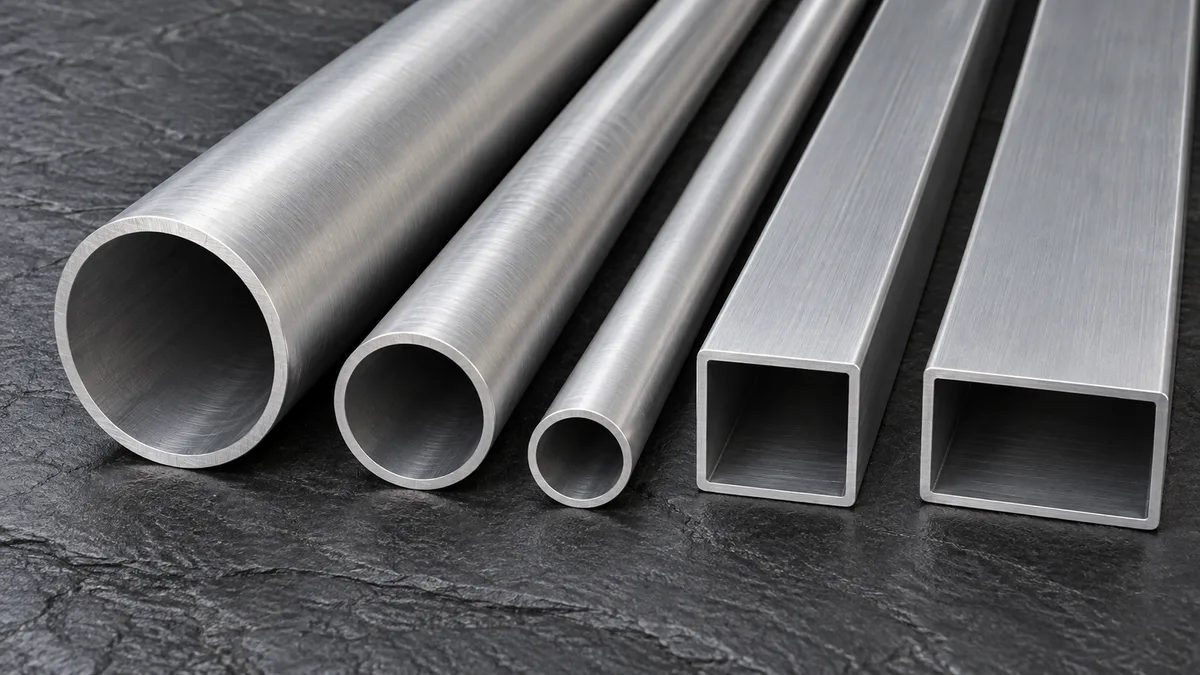
5083 tube and pipe combine the highest strength of the non-heat-treatable aluminium alloys with excellent weldability, seawater resistance and toughness at cryogenic temperatures. In aerospace programmes it is used mainly for cryogenic propellant and liquid-gas lines, launch-site and test-stand piping, and welded ground-equipment frames. Metline supplies seamless 5083 tube and pipe in O, H111 and H112 to ASTM B241 and B221, worldwide.
5083 has about 4.4 % magnesium and 0.7 % manganese. It is not heat treatable, so welded joints do not lose the large share of strength that 6061-T6 loses, and its strength and toughness both increase as temperature drops toward −196 °C and below.
That combination makes 5083 a cryogenic and welded-structure alloy rather than an aircraft fluid-line alloy. On aircraft, fuel and oil lines use 5052-O or 6061-T6 and hydraulic pressure lines use 6061-T6, 2024-T3, titanium or steel. 5083 tube and pipe find their aerospace roles on the ground: transfer lines and vent stacks for liquid oxygen, liquid nitrogen and liquefied natural gas at launch sites and test stands, welded frames and handrails for ground support equipment, and piping in corrosive coastal installations.
The same properties make 5083 pipe a standard choice for LNG and industrial gas plants, shipbuilding and offshore platforms. Buyers in aerospace often share suppliers and specifications with those sectors, so ASTM B241 pipe schedules dominate orders.
| Element | Minimum | Maximum | Role in the alloy |
|---|---|---|---|
| Silicon (Si) | — | 0.40 | Impurity |
| Iron (Fe) | — | 0.40 | Impurity |
| Copper (Cu) | — | 0.10 | Kept low for seawater resistance |
| Manganese (Mn) | 0.40 | 1.0 | Adds strength and refines grain |
| Magnesium (Mg) | 4.0 | 4.9 | Main strengthening element |
| Chromium (Cr) | 0.05 | 0.25 | Grain control, stress-corrosion resistance |
| Zinc (Zn) | — | 0.25 | Impurity |
| Titanium (Ti) | — | 0.15 | Grain refiner in the cast ingot |
| Others, each / total | — | 0.05 / 0.15 | |
| Aluminium (Al) | Remainder | About 92.4 – 95.6 % |
Registered Aluminum Association limits, followed by ASTM B241, B221 and EN 573-3 (EN AW-5083).
ASTM B241 and B221 set the following minimums for seamless pipe and extruded tube. EN 755-2 limits are similar. Drawn tube in strain-hardened tempers (H32, H34) can reach higher strength in thin walls, but those tempers are rarely used for pipe.
| Temper | Tensile strength | Yield strength (0.2 %) | Elongation (min) |
|---|---|---|---|
| O | 270 – 350 MPa (39 – 51 ksi) | ≥ 110 MPa (16 ksi) | About 12 – 14 % |
| H111 | ≥ 275 MPa (40 ksi) | ≥ 165 MPa (24 ksi) | About 12 % |
| H112 | ≥ 270 MPa (39 ksi) | ≥ 110 MPa (16 ksi) | About 12 % |
| Property (O temper) | Room temperature | At −196 °C (typical) |
|---|---|---|
| Tensile strength | About 290 MPa | About 400 MPa |
| Yield strength | About 145 MPa | About 165 MPa |
| Elongation | About 22 % | Similar or higher |
Low-temperature values are typical published figures (ASM) and show the trend; design values come from the governing pressure code.
Most orders cite ASTM B241 (seamless pipe and seamless extruded tube) or B221 (extruded tube). Older drawings may call QQ-A-200/4 for 5083 extrusions. Some sources list AMS 4086 for 5083 tube; AMS 4086 actually covers 2024-T3 hydraulic tubing, so confirm the alloy if you see that reference.
| Specification | Scope |
|---|---|
| ASTM B241 / ASME SB-241 | Seamless pipe and seamless extruded tube |
| ASTM B221 / ASME SB-221 | Extruded tube, bars and profiles |
| ASTM B210 | Drawn seamless tube, where the size calls for drawing |
| ASME B31.3 | Process piping code used for cryogenic and gas lines |
| EN 755-2 / EN 754-2 | Extruded and drawn tube, EN AW-5083 |
| ISO 6362-2 | Extruded tube mechanical properties |
| UNS / Werkstoff | A95083 / 3.3547 |
Pipe dimensions follow ASME B36.10. Weights below are calculated for 5083 at 2.66 g/cm³; use the tube weight calculator for other sizes.
| NPS | OD (in / mm) | Sch 40 wall (in / mm) | Sch 40 kg/m | Sch 80 wall (in / mm) | Sch 80 kg/m |
|---|---|---|---|---|---|
| 1/4 | 0.540 / 13.7 | 0.088 / 2.24 | 0.21 | 0.119 / 3.02 | 0.27 |
| 3/8 | 0.675 / 17.1 | 0.091 / 2.31 | 0.29 | 0.126 / 3.20 | 0.37 |
| 1/2 | 0.840 / 21.3 | 0.109 / 2.77 | 0.43 | 0.147 / 3.73 | 0.55 |
| 3/4 | 1.050 / 26.7 | 0.113 / 2.87 | 0.57 | 0.154 / 3.91 | 0.74 |
| 1 | 1.315 / 33.4 | 0.133 / 3.38 | 0.85 | 0.179 / 4.55 | 1.10 |
| 1-1/4 | 1.660 / 42.2 | 0.140 / 3.56 | 1.15 | 0.191 / 4.85 | 1.51 |
| 1-1/2 | 1.900 / 48.3 | 0.145 / 3.68 | 1.37 | 0.200 / 5.08 | 1.83 |
| 2 | 2.375 / 60.3 | 0.154 / 3.91 | 1.84 | 0.218 / 5.54 | 2.54 |
| 2-1/2 | 2.875 / 73.0 | 0.203 / 5.16 | 2.92 | 0.276 / 7.01 | 3.87 |
| 3 | 3.500 / 88.9 | 0.216 / 5.49 | 3.82 | 0.300 / 7.62 | 5.18 |
| 4 | 4.500 / 114.3 | 0.237 / 6.02 | 5.45 | 0.337 / 8.56 | 7.56 |
| 6 | 6.625 / 168.3 | 0.280 / 7.11 | 9.58 | 0.432 / 10.97 | 14.42 |
| 8 | 8.625 / 219.1 | 0.322 / 8.18 | 14.41 | 0.500 / 12.70 | 21.90 |
| 10 | 10.750 / 273.1 | 0.365 / 9.27 | 20.44 | 0.594 / 15.09 | 32.52 |
TIG and MIG with ER5183 filler to match strength. Clean oxide and hydrocarbons immediately before welding to avoid porosity, which matters for leak-tight cryogenic lines.
O and H111 bend well with mandrel support; allow larger radii than for 5052 because of higher strength and springback.
Avoid sustained service above about 65 °C, where sensitisation can cause intergranular and stress corrosion. This rules 5083 out of hot-gas and engine-bay piping.
Lines for oxygen service must be cleaned and certified to the oxygen-cleanliness standard of the system.
Hydrostatic or pneumatic pressure tests and NDT of welds per the piping code.
Excellent in marine air; isolate from copper and stainless parts in wet service.
A typical example is a liquid-nitrogen transfer line at a rocket test stand: Schedule 40 5083-O pipe, TIG welded with ER5183, cleaned and pressure tested, with stainless transition joints at the valve skids.
| Property | 5083-O | 5052-O | 6061-T6 | 304 stainless |
|---|---|---|---|---|
| Typical tensile strength | 290 MPa | 193 MPa | 310 MPa | 515 MPa min |
| Welded strength retained | High | High | Reduced in HAZ | High |
| Cryogenic toughness | Excellent | Excellent | Good | Excellent |
| Density | 2.66 g/cm³ | 2.68 g/cm³ | 2.70 g/cm³ | 8.0 g/cm³ |
| Service above 65 °C | Avoid | Acceptable | Acceptable | Acceptable |
Rarely. Aircraft lines use 5052-O, 6061-T6 or 2024-T3. 5083 tube is used mainly for cryogenic, launch-site and ground-equipment piping.
It becomes stronger and stays tough at very low temperature, welds without major strength loss and resists corrosion, so it is standard for LNG and industrial-gas lines.
ER5183 is the usual choice for full strength; ER5356 for lower-stress joints.
Seamless 5083 pipe is commonly supplied in Schedule 10, 40, 80 and 160 to ASME B36.10 dimensions.
Avoid sustained temperatures above about 65 °C; sensitisation can lead to intergranular and stress-corrosion cracking.
Yes. Metline supplies 5083 tube and pipe worldwide with EN 10204 3.1 certificates and export packing.
Send size, schedule, temper and quantity. We will reply with availability, certification and a delivered price.





