5052-O
Fully annealed. Lowest strength and highest ductility; chosen when the bar will be upset, bent, spun or cold headed into a fitting.



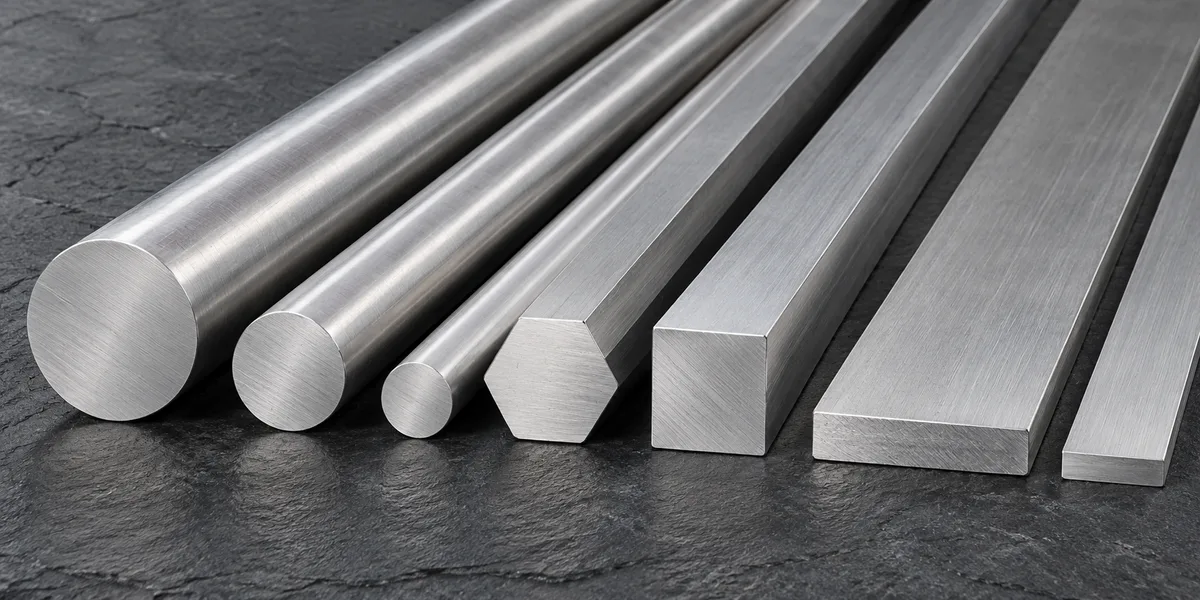
5052 bar is a non-heat-treatable aluminium-magnesium alloy chosen for aircraft and ground-equipment parts that need good corrosion resistance, weldability and moderate strength rather than the high strength of 2024 or 7075. Metline supplies 5052 round, square, hex and flat bar in O, H111, H112, H32 and F tempers, certified to AMS 4114, ASTM B211 or ASTM B221, to buyers worldwide.
5052 is the strongest of the commonly stocked alloys that cannot be heat treated. About 2.5 % magnesium in solid solution gives it roughly twice the strength of 3003, while 0.25 % chromium keeps the grain fine and protects against stress-corrosion cracking.
Aircraft designers rarely use 5052 bar for primary load paths; those go to 2024, 7075 and 7050. Its place is in the many parts where corrosion resistance and weldability matter more than peak strength: fittings and bosses welded into 5052 fuel and oil tanks, brackets and spacers for fluid lines, machined connectors for ducting, bushings in marine-exposed areas, and fixtures and ground support equipment that stand outdoors on flight lines and carrier decks.
Because 5052 gains strength only from cold work, bar is normally supplied in the as-extruded or annealed condition (H112, F or O) or with a light cold-finishing pass (H32). The alloy keeps those properties after welding much better than heat-treatable grades, which is the main reason it is chosen for welded tank and duct assemblies.
Limits are the registered Aluminum Association values, followed by ASTM B211, B221, AMS 4114 and EN 573-3 (EN AW-5052, AlMg2.5). The certificate supplied with each lot reports the actual analysis.
| Element | Minimum | Maximum | Role in the alloy |
|---|---|---|---|
| Silicon (Si) | — | 0.25 | Impurity; kept low for ductility |
| Iron (Fe) | — | 0.40 | Impurity; affects grain size and finish |
| Copper (Cu) | — | 0.10 | Kept low to protect corrosion resistance |
| Manganese (Mn) | — | 0.10 | Residual only |
| Magnesium (Mg) | 2.2 | 2.8 | Main strengthening element (solid solution) |
| Chromium (Cr) | 0.15 | 0.35 | Grain control; improves stress-corrosion resistance |
| Zinc (Zn) | — | 0.10 | Impurity |
| Others, each / total | — | 0.05 / 0.15 | |
| Aluminium (Al) | Remainder | About 96.1 – 97.7 % |
5052 has no registered nickel or titanium limit beyond "others"; values sometimes shown for these elements are not part of the standard composition.
The first table gives specified minimums for extruded bar to ASTM B221 and EN 755-2, which is what you design to. The second gives typical values that describe what well-made material usually achieves, useful for comparing tempers.
| Temper (extruded bar) | Tensile strength | Yield strength (0.2 %) | Elongation (min) |
|---|---|---|---|
| O / H111 | 170 – 240 MPa (25 – 35 ksi) | ≥ 70 MPa (10 ksi) | About 14 – 17 % |
| H112 | ≥ 170 MPa (25 ksi) | ≥ 70 MPa (10 ksi) | About 12 – 15 % |
| F (as fabricated) | No limits | No limits | No limits |
| Temper | Typical tensile | Typical yield | Typical elongation | Brinell hardness |
|---|---|---|---|---|
| O | 193 MPa / 28 ksi | 90 MPa / 13 ksi | 25 – 30 % | 47 HB |
| H32 | 228 MPa / 33 ksi | 193 MPa / 28 ksi | 12 – 18 % | 60 HB |
| H34 | 262 MPa / 38 ksi | 214 MPa / 31 ksi | 10 – 14 % | 68 HB |
| H38 | 290 MPa / 42 ksi | 255 MPa / 37 ksi | 7 – 8 % | 77 HB |
Cold-finished bar to ASTM B211 is also produced in H32 to H38; minimums rise with each step of strain hardening. Confirm the exact values for your size band on the mill certificate.
Fully annealed. Lowest strength and highest ductility; chosen when the bar will be upset, bent, spun or cold headed into a fitting.
Annealed and then lightly strain-hardened by straightening. Properties are close to O, with slightly better straightness for machining.
As extruded with controlled properties. The most common condition for larger extruded rounds, squares and flats that will be machined.
Strain-hardened and stabilised to quarter-hard. Better strength and machined finish than O, with good residual ductility.
As fabricated, with no guaranteed mechanical properties. AMS 4114 covers rolled or cold-finished 5052 bar and rod in this condition.
5052 cannot be hardened by solution treatment and ageing. Stabilising (H3x) only prevents age-softening; strength comes from cold work.
Most aerospace orders for 5052 bar are written to AMS 4114 or to ASTM B211 / B221 with aerospace inspection added. Legacy drawings may still call QQ-A-225/7, which has been superseded by ASTM B211 and AMS 4114 for new work. Tell us which document and revision is on your drawing.
| System | Designation / standard | Scope |
|---|---|---|
| SAE AMS | AMS 4114 | 5052-F bars and rods, rolled or cold-finished |
| ASTM | ASTM B211 | Cold-finished bar, rod and wire |
| ASTM / ASME | ASTM B221 (ASME SB-221) | Extruded bar, rod, wire, profiles and tube |
| US Federal (legacy) | QQ-A-225/7 | 5052 bar, rod and wire; cancelled for new design |
| UNS | A95052 | — |
| European | EN AW-5052 (AlMg2.5), EN 754 / EN 755 | Drawn and extruded bar |
| German Werkstoff | 3.3523 | — |
| ISO | AlMg2.5 | ISO 6362 (extruded products) |
| Japan | A5052BD / A5052BE | JIS H4040 (drawn / extruded bar) |
Cold-finished bar holds tighter diameter tolerances than extruded bar; specify which you need when the bar will be fed through a bar feeder.
Round bar weight per metre is π/4 × d² × 2.68 ÷ 1000 kg, with d in millimetres. The table gives quick values; the bar weight calculator handles other shapes.
| Diameter (mm) | kg per metre | kg per 3 m bar | Diameter (in) |
|---|---|---|---|
| 6 | 0.076 | 0.23 | 0.24 |
| 10 | 0.210 | 0.63 | 0.39 |
| 12 | 0.303 | 0.91 | 0.47 |
| 16 | 0.539 | 1.62 | 0.63 |
| 20 | 0.842 | 2.53 | 0.79 |
| 25 | 1.316 | 3.95 | 0.98 |
| 30 | 1.894 | 5.68 | 1.18 |
| 40 | 3.368 | 10.10 | 1.57 |
| 50 | 5.262 | 15.79 | 1.97 |
| 60 | 7.578 | 22.73 | 2.36 |
| 80 | 13.471 | 40.41 | 3.15 |
| 100 | 21.049 | 63.15 | 3.94 |
| 120 | 30.310 | 90.93 | 4.72 |
| 150 | 47.360 | 142.08 | 5.91 |
| 200 | 84.195 | 252.58 | 7.87 |
Softer tempers are gummy and can form built-up edge. Use sharp, polished carbide or HSS tools with high positive rake, generous chip room and plenty of coolant. H32 and harder tempers give a cleaner finish than O.
Excellent with TIG or MIG. ER5356 filler is the usual choice for strength and colour match; ER5554 or ER5654 suit some service conditions. In O and H112 the weld zone keeps almost the base strength; in H32 the heat-affected zone softens to near O values.
O and H111 bar can be bent, upset and cold headed. Allow larger radii for H32 and above, and anneal between heavy forming operations.
Takes clear and coloured sulphuric anodising well; chromic and boric-sulphuric processes are used where aerospace specifications require them.
Resists seawater spray and industrial atmospheres. Isolate from carbon fibre and stainless fasteners with sealant or primer to avoid galvanic attack.
Unlike 5083, 5052 has too little magnesium to suffer sensitisation in normal service, so it is acceptable for warm locations near engines and heat exchangers below about 150 °C.
A typical example is a welded auxiliary fuel tank: the shell is 5052-H32 sheet, the filler and drain bosses are machined from 5052-H112 round bar, and everything is joined with ER5356 so the whole assembly has uniform corrosion behaviour.
| Property | 5052-H112 | 6061-T6 | 5083-H112 | 2024-T351 |
|---|---|---|---|---|
| Typical tensile strength | 195 – 230 MPa | 310 MPa | 300 MPa | 470 MPa |
| Heat treatable | No | Yes | No | Yes |
| Weldability | Excellent | Good (HAZ loss) | Excellent | Poor |
| Seawater corrosion | Very good | Good | Excellent | Poor (needs cladding or coating) |
| Machinability | Fair | Very good | Fair | Very good |
| Service above 65 °C | Acceptable | Acceptable | Avoid (sensitisation) | Acceptable |
Choose 6061 when you need more strength and easy machining with acceptable weldability. Move to 5083 when the part must be stronger yet stay non-heat-treatable, provided it runs cool. Use 2024 or 7075 only when strength dominates and the part will not be welded.
Generally not. Primary structure uses heat-treatable 2xxx and 7xxx alloys. 5052 bar is used for welded tank fittings, fluid-line hardware, ducting parts, interior hardware and ground equipment where corrosion resistance and weldability matter more than strength.
AMS 4114 covers rolled or cold-finished 5052 bar and rod in the F condition. ASTM B211 (cold-finished) and ASTM B221 (extruded) are also widely used, often with added aerospace inspection requirements.
No. 5052 is strengthened only by cold work. Heating can anneal it to the soft O temper or stabilise a strain-hardened temper, but it cannot be solution treated and aged like 6061 or 2024.
ER5356 is the most common choice and gives good strength and anodised colour match. ER5554 is used where the joint runs warm, and ER4043 is generally avoided on 5052 because of poor ductility in the weld.
O is fully annealed, with the lowest strength and best formability. H112 is the as-extruded condition with minimum tensile and yield values guaranteed; it is the usual choice for bar that will be machined.
Yes. Metline supplies 5052 bar cut to length or as full bars, with an EN 10204 3.1 mill certificate, to customers worldwide.
Send the shape, size, temper, specification and quantity. We will reply with availability, certification and a delivered price.





