T851
Solution treated, stretched 1.5 – 3 % and artificially aged. The standard plate temper for machined aerospace parts: full strength with low residual stress.



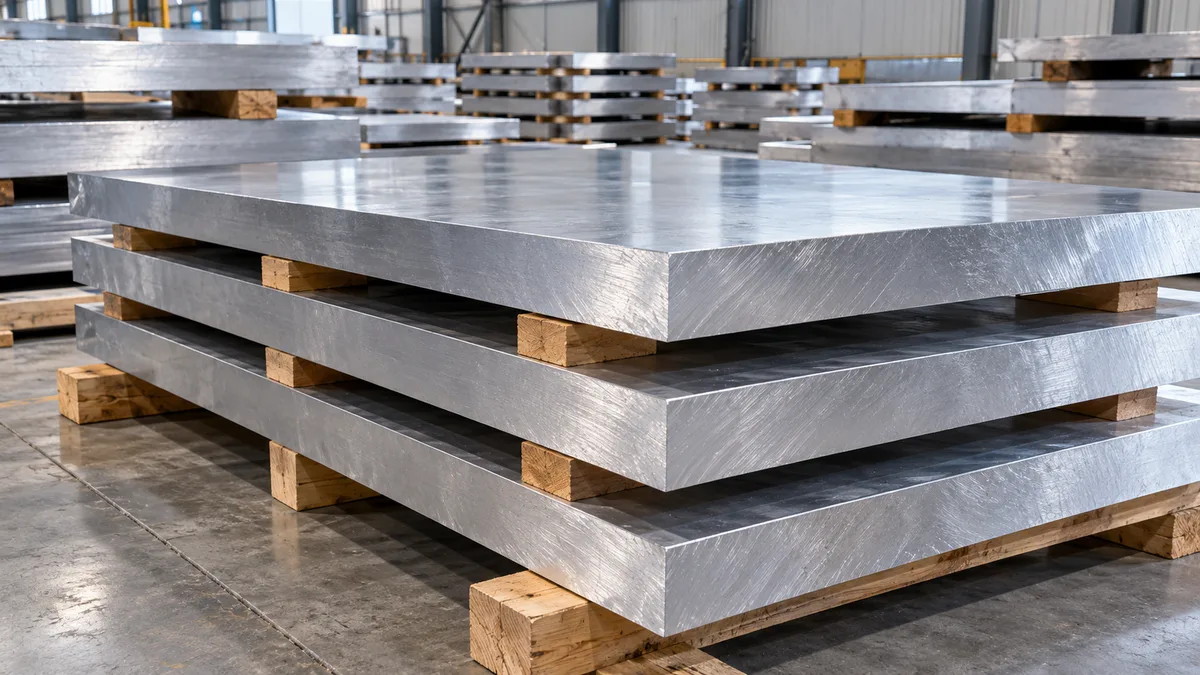
2618A sheet and plate is the heat-resistant aluminium chosen for skins, panels and machined parts that run at 120 – 250 °C, from supersonic airframes to engine nacelles and pistons cut from plate. Metline supplies 2618 and 2618A sheet and plate in T851, T651, T6 and O tempers to European and US aerospace specifications, cut to size and shipped worldwide.
2618A sheet was developed in the UK as RR58 and became famous as the skin and structural material of Concorde, whose surface reached roughly 100 – 125 °C during Mach 2 cruise. No ordinary airframe aluminium could hold its properties for tens of thousands of hours at that temperature without losing strength or creeping.
The secret is in the chemistry: about 1 % iron and 1 % nickel form heat-stable intermetallic particles, while copper and magnesium provide age-hardening. The result is a plate that keeps more of its strength after long exposure at temperature than 2024, 7075 or even 2014, and resists creep under sustained load.
Today 2618A plate is used less for skins and more for machined parts: engine-mount brackets, nacelle fittings, compressor housings, heat-shield supports, and blanks for pistons and impellers where forging is not justified. Stretched T851 or T651 plate stays flat when heavily machined, which matters for large parts with deep pockets.
| Element | 2618 (AA / ASTM) | 2618A (EN AW-2618A) | Role |
|---|---|---|---|
| Copper (Cu) | 1.9 – 2.7 | 1.8 – 2.7 | Precipitation strengthening with Mg |
| Magnesium (Mg) | 1.3 – 1.8 | 1.2 – 1.8 | Forms the S-phase (Al2CuMg) with copper |
| Iron (Fe) | 0.9 – 1.3 | 0.9 – 1.4 | With Ni forms heat-stable Al9FeNi particles |
| Nickel (Ni) | 0.9 – 1.2 | 0.8 – 1.4 | Elevated-temperature and creep strength |
| Silicon (Si) | 0.10 – 0.25 | 0.15 – 0.25 | Controlled addition |
| Titanium (Ti) | 0.04 – 0.10 | 0.20 max (Ti + Zr 0.25 max) | Grain refiner |
| Manganese (Mn) | — | 0.25 max | Impurity |
| Zinc (Zn) | 0.10 max | 0.15 max | Impurity |
| Others each / total | 0.05 / 0.15 | 0.05 / 0.15 | |
| Aluminium | Remainder | Remainder |
| Temper | Tensile strength | Yield strength | Elongation | Basis |
|---|---|---|---|---|
| T851 / T651 plate | ≈ 420 – 440 MPa | ≈ 350 – 410 MPa | ≈ 4 – 8 % | Typical, thickness-dependent |
| T6 sheet | ≈ 420 – 440 MPa | ≈ 350 – 370 MPa | ≈ 8 – 10 % | Typical |
| O (annealed) | ≈ 180 – 220 MPa | — | ≈ 15 % | Typical, for forming |
Specified minimums depend on thickness and direction and are given in the ordered specification; the certificate reports actual results. Short-transverse properties in thick plate are lower.
Retained strength at temperature is what justifies 2618A. Typical data for the closely related T61 temper:
| Test temperature | Tensile strength | Yield strength | Elongation |
|---|---|---|---|
| 24 °C | 440 MPa | 370 MPa | 10 % |
| 100 °C | 420 MPa | 350 MPa | 10 % |
| 150 °C | 345 MPa | 305 MPa | 14 % |
| 205 °C | 220 MPa | 180 MPa | 24 % |
| 260 °C | 90 MPa | 62 MPa | 50 % |
Typical values for 2618-T61 after 10,000 hours at the test temperature (ASM data). They show strength retention, not design minimums.
Solution treated, stretched 1.5 – 3 % and artificially aged. The standard plate temper for machined aerospace parts: full strength with low residual stress.
Equivalent stretched-and-aged condition under different specification naming; machines with minimal distortion.
Solution treated and aged without stretching. Normal for sheet and thin plate where residual stress is low.
Stretched and naturally aged. Sometimes supplied for parts that the user will age after forming or machining.
Heat treated by the user from O or F material, for parts formed in the soft condition first.
Annealed for forming. Strength is developed by full heat treatment after forming.
| Specification | Scope |
|---|---|
| DTD 5070 | UK aerospace specification for 2618A sheet and plate (RR58 family) |
| AIR 9048 (e.g. 9048.640) | French aerospace specification for 2618A (AU2GN) products |
| EN 2123 and related EN aerospace series | European aerospace-series documents quoted for 2618A products; confirm scope and revision |
| EN AW-2618A / Werkstoff 3.1924 | European composition designation (EN 573-3) |
| UNS A92618 | US designation for 2618 |
Because several of these documents are legacy or customer-controlled, always state the exact specification and revision on your enquiry; we confirm which can be certified before quoting.
Availability of 2618A plate is narrower than common aerospace grades; giving flexible sizes helps.
Plate weighs about 2.76 kg per square metre for every millimetre of thickness. A 1,000 × 2,000 × 25 mm plate weighs roughly 138 kg. Use the plate weight calculator for other sizes.
Machined parts and panels that operate at elevated temperatures, such as engine mounts, nacelle fittings, housings and supersonic airframe structure. It was the main structural alloy of Concorde.
They are close variants. 2618 is the US registration and 2618A the European one; 2618A allows slightly wider iron, nickel and titanium ranges. Mechanical properties are similar, and many programmes accept either, but the specification on your drawing decides which is certified.
T851 (or T651), which is stretched to relieve quench stresses and artificially aged. It gives full strength and keeps the plate stable during machining.
Not for structural joints. Like most high-strength 2xxx alloys it is prone to hot cracking; parts are bolted or riveted.
2024 is slightly stronger at room temperature and easier to find, but 2618A keeps more strength and resists creep above about 120 °C, so it is chosen for hot service.
Send the specification, temper, sizes and quantity. Our team will confirm availability and a delivered price.





