Forming
T3 foil bends readily around moderate radii. For tight shapes, form in the O or freshly quenched (W) condition and then age; parts left too long in W harden naturally and lose formability within hours.



2024 aerospace foil is thin-gauge 2024 aluminium, typically 0.1 to 0.5 mm, rolled from the classic high-strength Al-Cu-Mg airframe alloy and usually supplied in the T3 or O temper. It is used where a very thin layer must still carry real load: fibre-metal laminates, shims, doublers, bonded skins and fatigue test specimens. Metline supplies bare and Alclad 2024 foil and strip worldwide, cut to size and certified to the specification on your order.
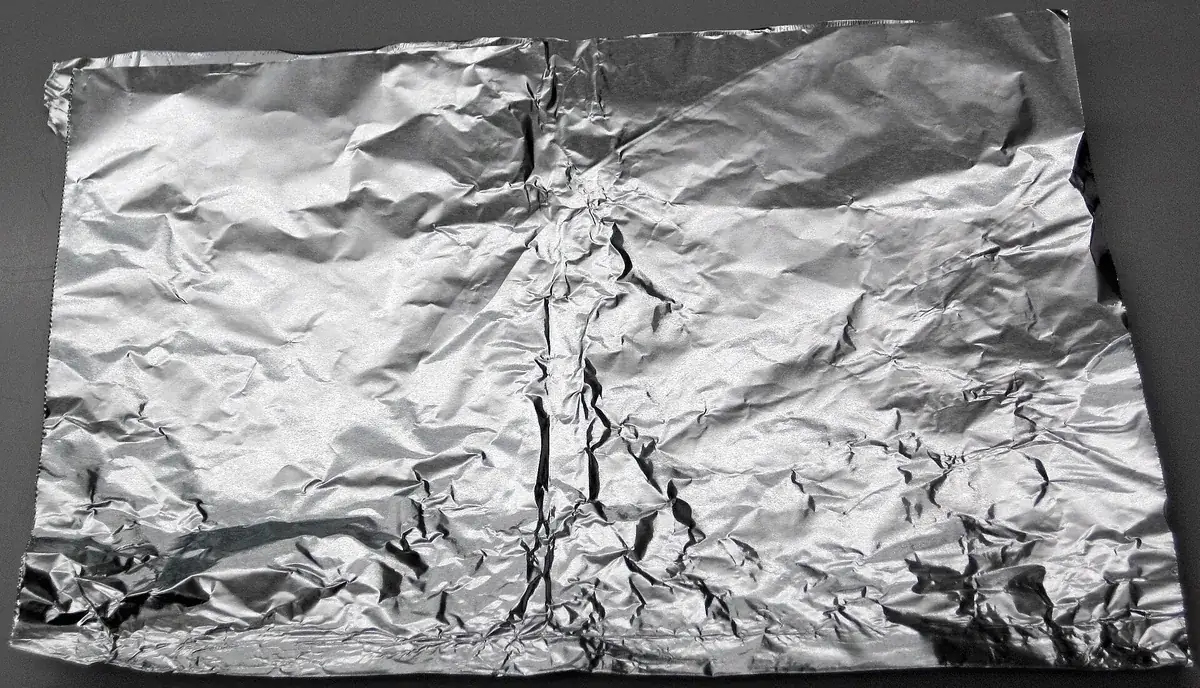
In aerospace purchasing, "2024 foil" rarely means kitchen-style foil below 0.2 mm. It usually refers to very thin 2024 sheet and strip, from about 0.1 mm up to roughly 0.5 mm, rolled to the same chemistry and heat-treatment rules as heavier 2024 aircraft sheet.
2024 contains around 4.4 % copper and 1.5 % magnesium. After solution heat treatment and natural ageing it reaches a tensile strength close to 480 MPa, which is roughly three times that of the 1xxx and 8xxx alloys used for packaging foil. That strength, combined with excellent fatigue crack growth resistance, is why 2024-T3 remains the standard fatigue-critical skin alloy decades after it was introduced.
At foil gauges, the alloy behaves differently from plate. Thin material cools almost instantly when quenched, so properties are uniform through the thickness, but it is also more sensitive to surface damage, handling kinks and corrosion, because a small pit consumes a larger share of the section. Most buyers therefore choose Alclad 2024 or specify careful surface protection and packing.
Limits are the registered Aluminum Association values for 2024, which ASTM B209, the AMS sheet specifications and EN 573-3 (EN AW-2024, AlCu4Mg1) all follow. Alclad product adds a thin cladding layer, normally 1230 or a similar high-purity alloy, on each face.
| Element | Minimum | Maximum | Effect |
|---|---|---|---|
| Silicon (Si) | — | 0.50 | Impurity; held low for toughness |
| Iron (Fe) | — | 0.50 | Impurity; forms coarse particles that reduce fatigue life |
| Copper (Cu) | 3.8 | 4.9 | Main strengthening element (Al2CuMg precipitates) |
| Manganese (Mn) | 0.30 | 0.9 | Grain control and some strength |
| Magnesium (Mg) | 1.2 | 1.8 | Works with Cu to give a strong natural-ageing response |
| Chromium (Cr) | — | 0.10 | Impurity |
| Zinc (Zn) | — | 0.25 | Impurity |
| Titanium (Ti) | — | 0.15 | Grain refiner |
| Others, each / total | — | 0.05 / 0.15 | |
| Aluminium (Al) | Remainder | About 90.7 – 94.7 % |
Values below are typical figures for bare thin sheet. Specified minimums depend on thickness band, cladding and the governing standard; Alclad material is roughly 5 – 8 % weaker because the soft cladding carries little load. Always design to the minimums on the certificate, not to typical values.
| Temper | Tensile strength (typ.) | Yield strength (typ.) | Elongation (typ.) | Typical use |
|---|---|---|---|---|
| O (annealed) | 185 MPa | 75 MPa | 20 % | Forming, then heat treatment by the user |
| T3 | 483 MPa | 345 MPa | 18 % | Standard fatigue-critical skin and laminate temper |
| T42 | about 470 MPa | about 325 MPa | about 19 % | Heat treated by the user from O or F |
| T81 | 485 MPa | 450 MPa | 6 % | Higher yield, better elevated-temperature stability |
Typical values from ASM and Aluminum Association data. T351 and T851 are plate tempers (stretched plate over about 6 mm) and do not normally apply to foil gauges; if your drawing calls them up for thin material, ask us to confirm the intended temper.
Thin 2024 material is ordered against the same documents as aircraft sheet. The specification decides temper, tolerance tables, cladding thickness and test frequency, so it should appear on every enquiry.
| Document | Scope |
|---|---|
| ASTM B209 / ASME SB-209 | General sheet and plate specification covering bare and Alclad 2024 in O, T3, T361, T4, T42, T81 and other tempers |
| AMS 4037 | 2024-T3 bare sheet and plate (aerospace) |
| AMS 4041 | Alclad 2024-T3 sheet and plate (aerospace) |
| AMS-QQ-A-250/4 and /5 | Former federal specifications for bare and Alclad 2024, still widely cited on drawings |
| EN 485 / EN 573-3 | European sheet and strip; EN AW-2024 composition |
| EN 4000-series (ASD-STAN) | European aerospace sheet standards, called up by some airframers |
Older drawings sometimes list a mixture of AMS and MIL numbers. Send the exact revision you need and we will confirm whether it can be certified as written.
Availability of very thin heat-treated gauges varies by mill run; tell us early if your project depends on a specific gauge.
Thickness tolerance matters more at foil gauges than anywhere else: a deviation of 0.01 mm is 4 % of a 0.25 mm sheet. For laminates and shims, state the tolerance you need rather than relying on the default standard tables.
T3 foil bends readily around moderate radii. For tight shapes, form in the O or freshly quenched (W) condition and then age; parts left too long in W harden naturally and lose formability within hours.
Laminates and bonded doublers depend on surface preparation. Phosphoric-acid or chromic-acid anodising, or approved sol-gel treatments, are normally applied before priming and bonding.
2024 is not considered fusion-weldable for structure: it is prone to hot cracking and loses strength. Join foil by bonding, riveting or, in some cases, friction stir or resistance methods qualified by the user.
Bare 2024 must be anodised, conversion coated or primed. Alclad material carries its own sacrificial layer, which is why it dominates for external skins.
Thin gauges kink and scratch easily. Specify interleaving or film, avoid sliding sheets across each other, and store indoors away from condensation.
Shear, slit or laser cut; avoid excessive heat input, which locally over-ages the alloy at the cut edge.
For honeycomb cores, buyers should note that aerospace honeycomb is normally made from 5052, 5056 or 3003 foil rather than 2024; see our aircraft honeycomb guide.
| Property | 2024-T3 | 7075-T6 | 5052-H38 | 1145-H19 |
|---|---|---|---|---|
| Typical tensile strength | 483 MPa | 572 MPa | 290 MPa | About 200 MPa |
| Fatigue crack growth resistance | Excellent | Fair | Good | Not structural |
| Corrosion resistance (bare) | Low | Low–fair | Very good | Excellent |
| Formability | Good | Poor | Good | Excellent |
| Typical use | Laminates, skins, shims | High-strength thin parts | Honeycomb, fuel-system parts | Capacitor, bonding, shielding foil |
Choose 2024-T3 when damage tolerance governs, 7075 when static strength is the priority and fatigue is less critical, and a 5xxx alloy when corrosion resistance or honeycomb fabrication matters more than strength.
Very thin heat-treated 2024 is a specialist product made in limited mill runs. Gauges around 0.2 – 0.5 mm are more commonly available. Tell us your gauge and tolerance early so we can confirm feasibility.
Alclad is the usual choice for parts exposed to the atmosphere, because the pure aluminium cladding protects the copper-bearing core. Bare material is chosen when the surface will be anodised and bonded, or when the slight strength loss from cladding is not acceptable.
Not for structural joints. 2024 cracks during fusion welding and loses strength in the heat-affected zone. Use adhesive bonding, riveting or a joining method qualified for your part.
T351 is a stretched plate temper. Thin sheet and foil are normally supplied as T3 or T42. We will confirm the equivalent temper with you before ordering.
Yes. Every lot carries an EN 10204 3.1 certificate with chemical analysis and mechanical results, traceable to the coil or sheet.
Send gauge, width, temper, cladding, quantity and specification. We will confirm what can be supplied and how it will be certified.






