T351
Solution treated, stretched 1 – 3 % and naturally aged. The standard cold-finished bar temper for machined parts.



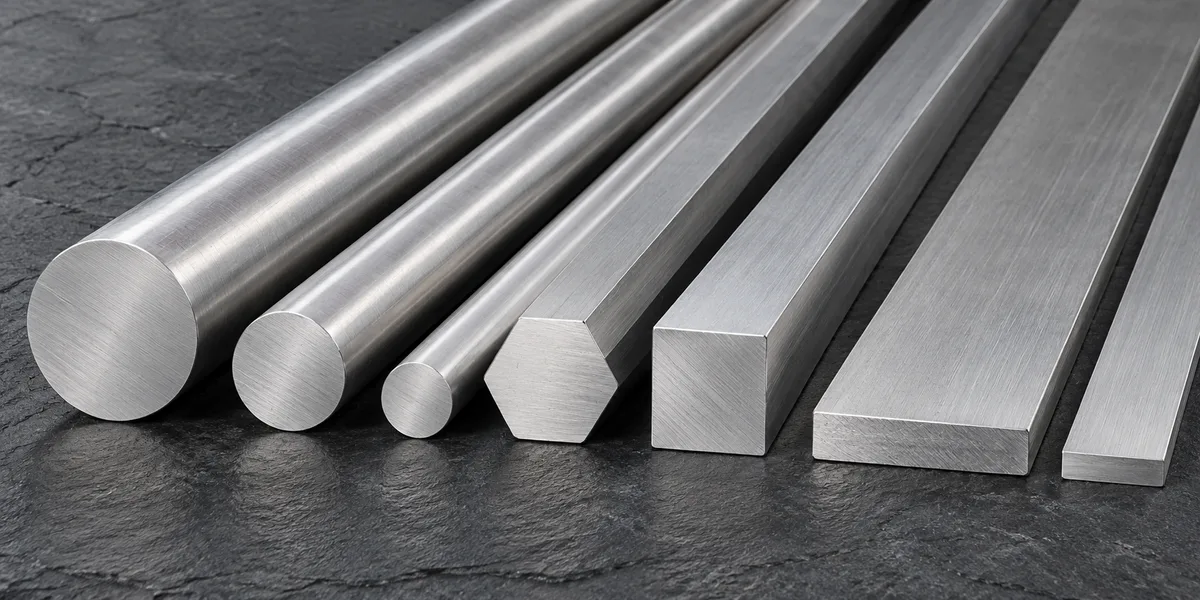
2024 rod and bar is the fatigue-resistant, high-strength aluminium machining stock of the aircraft industry: about 470 MPa typical tensile strength in T351, with good toughness and very good machinability. It is turned and milled into fittings, shafts, pins and fasteners. Metline supplies 2024 and its close equivalent 2A12 as cold-finished and extruded round, square, hexagon and flat bar, certified to AMS, ASTM and EN standards, worldwide.
2024 combines copper with a relatively high magnesium content (1.2 – 1.8 %). Natural ageing after solution treatment produces fine copper-magnesium precipitates that give high strength together with good toughness and fatigue resistance. That balance, rather than peak strength, is why 2024 is chosen for many airframe parts.
Bar is produced in two ways. Cold-finished bar (rolled or drawn) is held to close diameter tolerances and is usually supplied in T351 or T4, with T851 for parts that need higher yield strength or better stress-corrosion resistance. Extruded bar covers larger diameters and rectangular sections and is supplied in T3511 (stretched and straightened) or T3510.
Compared with 7075, 2024 is less strong but more damage tolerant: cracks grow more slowly under cyclic loads. Compared with 2014, it has lower yield strength but better fatigue performance. In practice, 2024-T351 bar is a common default for machined fittings, while 7075-T7351 is used where higher strength and stress-corrosion resistance are both needed.
| Element | 2024 (AA / ASTM, EN AW-2024) | 2A12 (GB, close equivalent) | Role |
|---|---|---|---|
| Copper (Cu) | 3.8 – 4.9 | 3.8 – 4.9 | Main strengthening element |
| Magnesium (Mg) | 1.2 – 1.8 | 1.2 – 1.8 | With Cu forms the Al2CuMg (S-phase) precipitates |
| Manganese (Mn) | 0.30 – 0.9 | 0.30 – 0.9 | Grain control, toughness |
| Silicon (Si) | 0.50 max | 0.50 max | Impurity |
| Iron (Fe) | 0.50 max | 0.50 max | Impurity; low Fe improves toughness |
| Chromium (Cr) | 0.10 max | — | Impurity |
| Nickel (Ni) | — | 0.10 max | Impurity |
| Zinc (Zn) | 0.25 max | 0.30 max | Impurity |
| Titanium (Ti) | 0.15 max | 0.15 max | Grain refiner |
| Others, each / total | 0.05 / 0.15 | 0.05 / 0.10 | |
| Aluminium (Al) | Remainder | Remainder | About 90.7 – 94.7 % |
Some product listings swap the manganese and magnesium ranges. In 2024, magnesium is 1.2 – 1.8 % and manganese 0.30 – 0.9 %.
Under ASTM B211, cold-finished 2024-T4 / T351 bar carries minimums of about 425 MPa (62 ksi) tensile and 290 MPa (42 ksi) yield in common diameters, and T851 about 455 MPa (66 ksi) tensile and 400 MPa (58 ksi) yield. Extruded T3511 bar follows ASTM B221 minimums that rise with section size.
| Temper | Tensile strength | Yield strength (0.2 %) | Elongation | Brinell hardness | Shear strength |
|---|---|---|---|---|---|
| O | 186 MPa / 27 ksi | 76 MPa / 11 ksi | 20 % | 47 HB | 125 MPa |
| T3 | 483 MPa / 70 ksi | 345 MPa / 50 ksi | 18 % | 120 HB | 283 MPa |
| T4, T351 | 469 MPa / 68 ksi | 324 MPa / 47 ksi | 19 – 20 % | 120 HB | 283 MPa |
| T6 | 476 MPa / 69 ksi | 393 MPa / 57 ksi | 10 % | 125 HB | 283 MPa |
| T81, T851 | 483 MPa / 70 ksi | 448 MPa / 65 ksi | 6 % | 128 HB | 296 MPa |
Solution treated, stretched 1 – 3 % and naturally aged. The standard cold-finished bar temper for machined parts.
Solution treated and naturally aged without stretching. Used for smaller bar and wire.
Solution treated, cold worked and naturally aged; drawn bar with good strength and close tolerances.
Extruded bar stretched after quenching, with or without minor straightening.
T351 bar artificially aged. Higher yield strength, lower elongation and much better stress-corrosion resistance; also better for service around 100 – 150 °C.
Annealed stock for forging or forming before heat treatment.
| System | Designation |
|---|---|
| Aluminum Association / UNS | 2024 / A92024 |
| European (EN) | EN AW-2024 / AlCu4Mg1 |
| German Werkstoff / DIN | 3.1355 / AlCuMg2 |
| ISO | AlCu4Mg1 |
| France (old NF) | AU4G1 |
| Japan (JIS) | A2024 |
| China (GB) | 2A12 (close equivalent) |
2024 round bar weighs about 0.00218 × d² kg per metre (d in mm, density 2.78 g/cm³). See the bar weight calculator for other shapes.
| Diameter (mm) | kg per metre | 3 m bar (kg) | 6 m bar (kg) |
|---|---|---|---|
| 6 | 0.079 | 0.24 | 0.47 |
| 10 | 0.218 | 0.66 | 1.31 |
| 12 | 0.314 | 0.94 | 1.89 |
| 16 | 0.559 | 1.68 | 3.35 |
| 20 | 0.873 | 2.62 | 5.24 |
| 25 | 1.36 | 4.09 | 8.19 |
| 30 | 1.97 | 5.90 | 11.79 |
| 40 | 3.49 | 10.48 | 20.96 |
| 50 | 5.46 | 16.38 | 32.75 |
| 60 | 7.86 | 23.58 | 47.16 |
| 80 | 13.97 | 41.92 | 83.84 |
| 100 | 21.83 | 65.50 | 131.00 |
| 150 | 49.13 | 147.38 | 294.76 |
| 200 | 87.34 | 262.01 | 524.02 |
| 250 | 136.46 | 409.39 | 818.78 |
| 300 | 196.51 | 589.52 | 1179.04 |
| 400 | 349.35 | 1048.04 | 2096.07 |
Cold-finished bar follows ANSI H35.2 (ASTM/AMS) or EN 754-3 tolerances; extruded bar follows ANSI H35.2 or EN 755-3. Aerospace bar above about 12 mm is often ultrasonically inspected to AMS-STD-2154 or ASTM B594, class as specified.
Good to very good in T351 and T851; chips are less brittle than 2011 but break well with chip-breaker inserts.
Mechanical fastening; 2024 is not fusion-welded in structure.
Sulphuric or hard anodising, conversion coatings and primers. Protect all machined faces.
T3/T351 are susceptible in the short-transverse direction of thick bar; T851 is much more resistant.
| Property | 2024-T351 | 2014-T651 | 2017A-T451 | 7075-T651 |
|---|---|---|---|---|
| Typical tensile strength | ~469 MPa | ~483 MPa | ~425 MPa | ~572 MPa |
| Typical yield strength | ~324 MPa | ~414 MPa | ~275 MPa | ~503 MPa |
| Fatigue performance | Very good | Fair | Good | Fair |
| Machinability | Good | Very good | Very good | Very good |
| Relative cost | Moderate | Moderate | Lower | Higher |
2A12 is the Chinese GB designation with essentially the same composition. It is a close equivalent, but aerospace orders should state the designation and standard required by the drawing.
T851 is T351 bar that has been artificially aged. It has higher yield strength and much better stress-corrosion resistance, but lower elongation.
7075 is stronger; 2024 has better fatigue crack-growth resistance and toughness. The choice depends on whether static strength or damage tolerance governs.
Not by fusion welding for structural parts. Use mechanical fastening.
Extruded round bar is available up to about 420 mm diameter; larger sections are produced as forgings.
Send size, temper, specification and quantity, and we will confirm availability and a delivered price.





