Forming
L17 (O) bends flat and spins well; L16 H24 bends to small radii without cracking.



1200 is 99.0 % commercially pure aluminium, the grade behind the British aerospace sheet specifications L16 (H14 / H24) and L17 (O). It is used for formed, lightly loaded aircraft parts: ducts, fairing closures, shims, liners and cover plates. Metline supplies 1200 and 1200A sheet and plate in O, H14 and H24, certified and cut to size, worldwide.
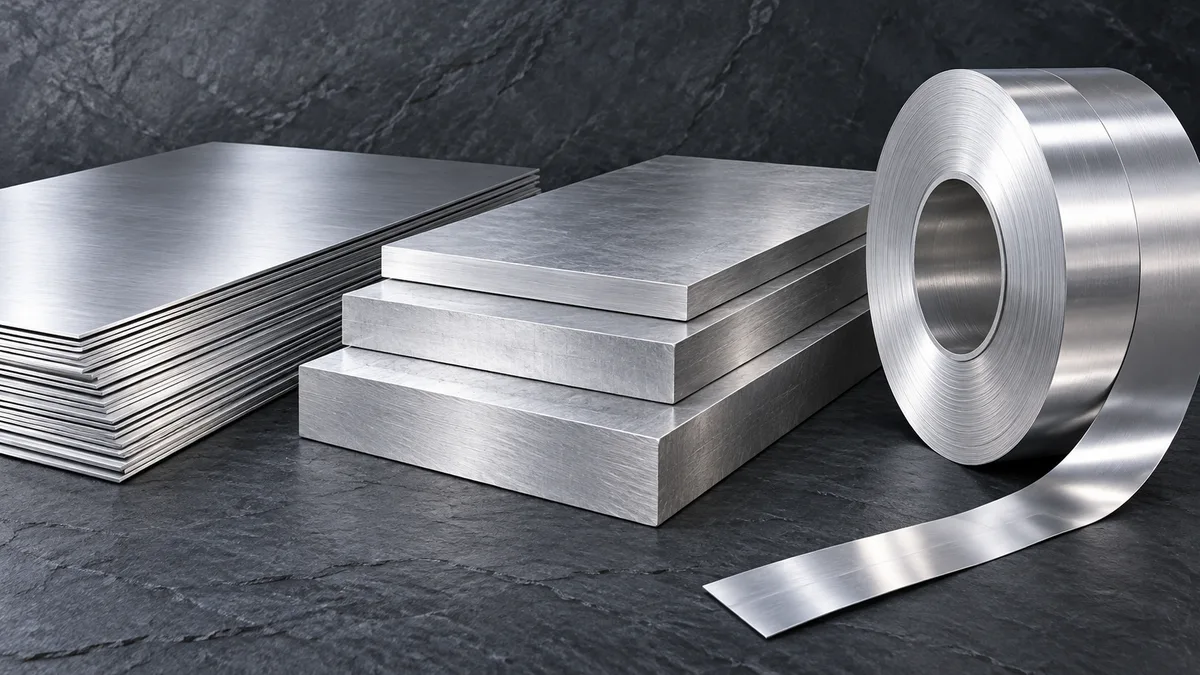
In UK and European aerospace practice, 1200 plays the role that 1100 plays in US specifications: the soft, weldable, corrosion-resistant sheet for parts that are formed rather than loaded.
The L-series specifications call it up in two conditions. L17 is the annealed O temper, used for spinning, deep drawing and tight bends. L16 covers the strain-hardened H14 and H24 tempers, used for flat or lightly formed parts that must keep their shape. 1200 is slightly stronger than 1050A because it allows more iron and silicon, and its corrosion resistance and weldability are still excellent.
Typical parts include air and ventilation ducting, fairing closures and access covers, shims and packers, liners, heat shields and interior panels. For load-bearing skins and structure, use clad 2014A, 2024 or 7075 instead.
The older British designation 1C (BS 1470) also refers to this material and still appears on legacy drawings.
| Element | Limit (wt %) |
|---|---|
| Silicon + iron (Si + Fe) | 1.00 max combined |
| Copper (Cu) | 0.05 max |
| Manganese (Mn) | 0.05 max |
| Zinc (Zn) | 0.10 max |
| Titanium (Ti) | 0.05 max |
| Others, each / total | 0.05 / 0.15 max |
| Aluminium (Al) | 99.00 min |
1200A is the related EN AW grade (EN 573-3). Aluminium content is the same 99.0 % minimum, but the limits on a few impurity elements are slightly wider. For aerospace orders, the specification on the drawing (L16, L17 or EN AW-1200) decides which limits apply, and the certificate states them.
| Temper | Specification | Rm (MPa) | Rp0.2 min (MPa) | Elongation |
|---|---|---|---|---|
| O / H111 | BS L17, EN 485-2 | 75 – 105 | 25 | High; about 20 – 30 % or more by thickness |
| H14 | BS L16, EN 485-2 | 115 – 155 | 95 | About 2 – 5 % |
| H24 | BS L16, EN 485-2 | 115 – 155 | 90 | About 3 – 7 % |
Values summarised from EN 485-2 for the common sheet thickness bands. The L-series specifications set their own limits, which the certificate reports.
H24 has the same strength range as H14 but more elongation, because it is hardened further and then partially annealed. For sheet that is bent after delivery, H24 is usually the better choice.
| System | Designation / document |
|---|---|
| British aerospace | BS L16 (H14, H24), BS L17 (O) |
| British general (withdrawn) | 1C, BS 1470 |
| European | EN AW-1200 / EN AW-1200A; EN 573-3, EN 485-2, EN 485-4 |
| Aerospace dimensions | EN 2071 (sheet 0.25 – 6 mm) |
| UNS / ISO | A91200 / Al99.0 |
| Nearest US grade | 1100 (AMS 4001, ASTM B209), which also requires copper |
L17 (O) bends flat and spins well; L16 H24 bends to small radii without cracking.
TIG and MIG with 1100 or 4043 filler; heat-affected zone softens to O.
Anodises cleanly; chromate-free conversion coating and paint as required.
Both are 1200 sheet. L17 is the annealed O temper for forming; L16 covers the half-hard H14 and H24 tempers.
Very close, but not identical. 1100 requires 0.05 – 0.20 % copper; 1200 limits copper to 0.05 %. Substitute only if the drawing allows it.
It is the related EN AW grade with slightly wider limits on some impurity elements; aluminium is still 99.0 % minimum.
No. Strength comes only from cold work (H tempers); heat treatment only anneals it.
O (L17) for severe forming; H24 when you also need some stiffness.
Send the thickness, size, temper and quantity. We reply with availability, certification and a delivered price.





