Thin wall (≤ 1.5 mm)
Light frames, shelving, displays, furniture and trim. Easy to cut and bend; prone to denting and limited for threaded fixings.



Aluminium square tube is an extruded hollow section with four equal sides, used wherever a frame needs stiffness in both directions at a third of the weight of steel. Most square tube is 6063-T5/T52 for architectural and light framing work or 6061-T6 and 6082-T6 for load-bearing structures. This guide gives the common metric and inch sizes with calculated weights and section properties, explains how to choose alloy and wall thickness, and lists what to put in an enquiry.
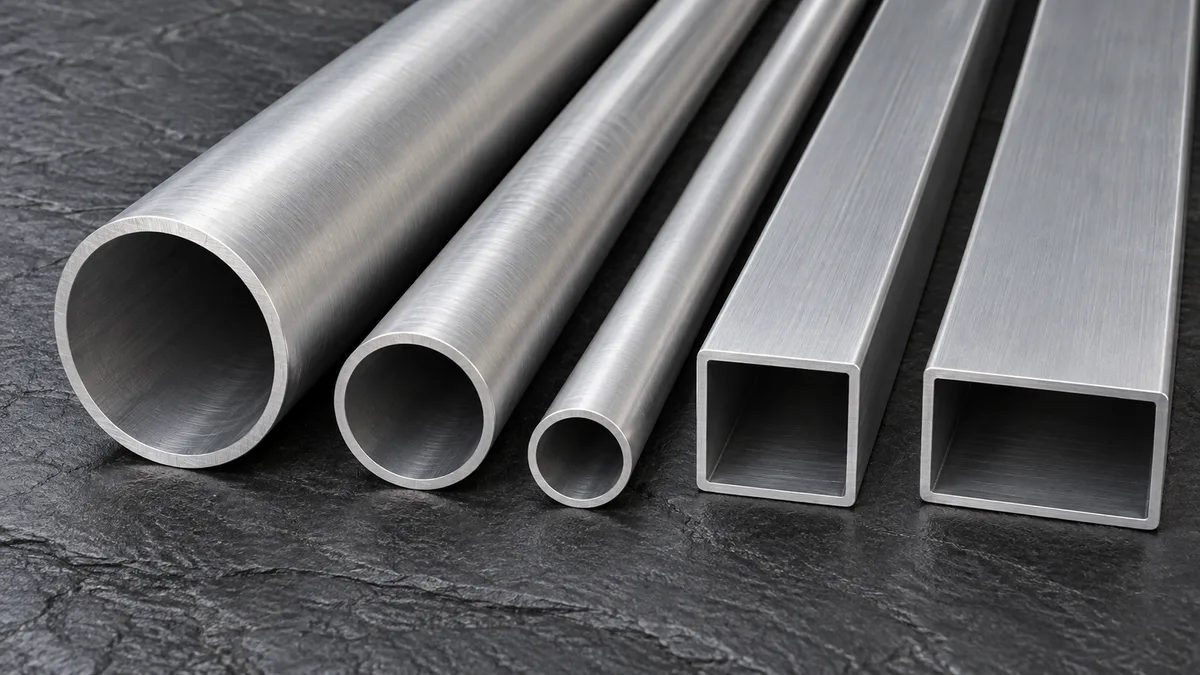
Square tube (also called square tubing, square hollow section, SHS or box section) is a closed profile with equal outside width and height. Because the material sits far from the neutral axis on all four faces, it resists bending and twisting much better than a solid bar or an open angle of the same weight.
Almost all aluminium square tube is extruded: a heated billet is pushed through a porthole or bridge die, the metal splits around a mandrel and rejoins inside the die to form the hollow. This produces fine longitudinal seam welds that are metallurgically sound and fully acceptable for structural use under ASTM B221 and EN 755. Where a design or code calls for a tube with no seam, for example some pressure or hydraulic applications, seamless tube is extruded over a piercing mandrel or drawn, which costs more and limits the size range.
Square tube is described by outside width × outside width × wall thickness, for example 50 × 50 × 3 mm or 2 × 2 × 1/8 in. Corners may be sharp (a small outside radius only) or radiused. Sharp-corner tube is common in architectural and furniture work; generous radii improve metal flow, reduce stress concentration and are typical of heavier structural sections.
Six alloys cover nearly every square tube requirement. The first decision is whether the tube is mainly structural (choose 6061, 6082 or 6005A) or mainly appearance-led (choose 6063 or 6060). The values below are typical properties for extrusions; design to the specified minimums in ASTM B221 or EN 755-2, which depend on wall thickness and are reported on the mill certificate.
| Alloy & temper | Typical tensile strength | Typical yield strength | Character | Typical uses |
|---|---|---|---|---|
| 6063-T5 / T52 | 185 MPa / 27 ksi | 145 MPa / 21 ksi | Very smooth surface, best anodising response, easy to bend | Railings, partitions, display and furniture frames, trim |
| 6063-T6 | 240 MPa / 35 ksi | 215 MPa / 31 ksi | Higher strength while keeping 6063 finish | Architectural framing that carries moderate loads |
| 6060-T6 / T66 | 190 – 215 MPa | 150 – 160 MPa | European architectural alloy, close to 6063 | Building and interior systems in EN markets |
| 6061-T6 | 310 MPa / 45 ksi | 276 MPa / 40 ksi | Structural workhorse, machines well, weldable | Machine frames, trailers, platforms, marine fittings |
| 6082-T6 | 310 – 340 MPa | 260 – 300 MPa | European structural alloy, slightly stronger than 6061 in thick walls | Structures, transport, scaffolding-type frames |
| 6005A-T6 | 270 – 285 MPa | 225 – 240 MPa | Good strength in thin, complex hollows | Rail and vehicle structures, solar mounting |
Specified minimums for 6061-T6 extruded tube in ASTM B221 are 260 MPa (38 ksi) tensile and 240 MPa (35 ksi) yield, which is why some catalogues quote 35 ksi rather than the typical 40 ksi.
Stronger aerospace alloys are also extruded as square tube. 2024-T3/T351 offers high fatigue strength and 7075-T6 the highest static strength, but both are poor for welding and less corrosion-resistant, so they are used only where a specification calls for them. 5052 and 3003 square tube exist in small sizes for marine trim and general fabrication where formability and corrosion resistance matter more than strength.
The table lists commonly extruded metric sizes. Weight, area, second moment of area (I) and elastic section modulus (Z) are calculated from the nominal sharp-corner section at a density of 2.70 g/cm³; corner radii reduce them slightly. Use them for estimating and for first-pass sizing, then confirm with the supplier's drawing for the exact die.
| Size B × B × t (mm) | Area (mm²) | Weight (kg/m) | I (cm⁴) | Z (cm³) |
|---|---|---|---|---|
| 15 × 15 × 1.5 | 81 | 0.219 | 0.25 | 0.33 |
| 20 × 20 × 1.5 | 111 | 0.300 | 0.64 | 0.64 |
| 20 × 20 × 2 | 144 | 0.389 | 0.79 | 0.79 |
| 25 × 25 × 1.5 | 141 | 0.381 | 1.30 | 1.04 |
| 25 × 25 × 2 | 184 | 0.497 | 1.63 | 1.31 |
| 25 × 25 × 3 | 264 | 0.713 | 2.17 | 1.74 |
| 30 × 30 × 2 | 224 | 0.605 | 2.94 | 1.96 |
| 30 × 30 × 3 | 324 | 0.875 | 3.99 | 2.66 |
| 40 × 40 × 2 | 304 | 0.821 | 7.34 | 3.67 |
| 40 × 40 × 3 | 444 | 1.199 | 10.20 | 5.10 |
| 40 × 40 × 4 | 576 | 1.555 | 12.60 | 6.30 |
| 50 × 50 × 2 | 384 | 1.037 | 14.77 | 5.91 |
| 50 × 50 × 3 | 564 | 1.523 | 20.85 | 8.34 |
| 50 × 50 × 4 | 736 | 1.987 | 26.15 | 10.46 |
| 50 × 50 × 5 | 900 | 2.430 | 30.75 | 12.30 |
| 60 × 60 × 3 | 684 | 1.847 | 37.14 | 12.38 |
| 60 × 60 × 4 | 896 | 2.419 | 47.07 | 15.69 |
| 60 × 60 × 5 | 1100 | 2.970 | 55.92 | 18.64 |
| 70 × 70 × 4 | 1056 | 2.851 | 76.95 | 21.98 |
| 80 × 80 × 3 | 924 | 2.495 | 91.45 | 22.86 |
| 80 × 80 × 4 | 1216 | 3.283 | 117.38 | 29.35 |
| 80 × 80 × 6 | 1776 | 4.795 | 163.16 | 40.79 |
| 100 × 100 × 3 | 1164 | 3.143 | 182.71 | 36.54 |
| 100 × 100 × 4 | 1536 | 4.147 | 236.34 | 47.27 |
| 100 × 100 × 6 | 2256 | 6.091 | 333.59 | 66.72 |
| 100 × 100 × 8 | 2944 | 7.949 | 418.44 | 83.69 |
| 120 × 120 × 5 | 2300 | 6.210 | 507.92 | 84.65 |
| 120 × 120 × 8 | 3584 | 9.677 | 753.12 | 125.52 |
| 150 × 150 × 6 | 3456 | 9.331 | 1196.47 | 159.53 |
| 150 × 150 × 10 | 5600 | 15.120 | 1838.67 | 245.16 |
| 200 × 200 × 8 | 6144 | 16.589 | 3781.43 | 378.14 |
| 200 × 200 × 12 | 9024 | 24.365 | 5337.40 | 533.74 |
Larger sections, 250 mm and above, are produced on large extrusion presses as custom profiles, often with internal webs or radiused corners. For quick weights of any size use the aluminium tube weight calculator.
North American buyers usually order square tubing in fractional inches, with the wall given as a fraction or gauge (1/16 in is close to 16 gauge, 1/8 in close to 10 gauge). Weights are calculated for sharp corners.
| Size (in) | Metric equivalent (mm) | Weight (kg/m) | Weight (lb/ft) |
|---|---|---|---|
| 1/2 × 1/2 × 1/16 | 12.7 × 12.7 × 1.59 | 0.191 | 0.128 |
| 3/4 × 3/4 × 1/16 | 19.05 × 19.05 × 1.59 | 0.300 | 0.201 |
| 3/4 × 3/4 × 1/8 | 19.05 × 19.05 × 3.18 | 0.545 | 0.366 |
| 1 × 1 × 1/16 | 25.4 × 25.4 × 1.59 | 0.409 | 0.275 |
| 1 × 1 × 1/8 | 25.4 × 25.4 × 3.18 | 0.763 | 0.513 |
| 1-1/4 × 1-1/4 × 1/8 | 31.75 × 31.75 × 3.18 | 0.981 | 0.659 |
| 1-1/2 × 1-1/2 × 1/8 | 38.1 × 38.1 × 3.18 | 1.199 | 0.806 |
| 1-1/2 × 1-1/2 × 1/4 | 38.1 × 38.1 × 6.35 | 2.177 | 1.463 |
| 1-3/4 × 1-3/4 × 1/8 | 44.45 × 44.45 × 3.18 | 1.417 | 0.952 |
| 2 × 2 × 1/8 | 50.8 × 50.8 × 3.18 | 1.635 | 1.099 |
| 2 × 2 × 3/16 | 50.8 × 50.8 × 4.76 | 2.367 | 1.590 |
| 2 × 2 × 1/4 | 50.8 × 50.8 × 6.35 | 3.048 | 2.048 |
| 2-1/2 × 2-1/2 × 1/8 | 63.5 × 63.5 × 3.18 | 2.072 | 1.392 |
| 3 × 3 × 1/8 | 76.2 × 76.2 × 3.18 | 2.508 | 1.685 |
| 3 × 3 × 1/4 | 76.2 × 76.2 × 6.35 | 4.790 | 3.219 |
| 4 × 4 × 1/8 | 101.6 × 101.6 × 3.18 | 3.380 | 2.271 |
| 4 × 4 × 1/4 | 101.6 × 101.6 × 6.35 | 6.532 | 4.389 |
| 6 × 6 × 1/4 | 152.4 × 152.4 × 6.35 | 10.016 | 6.731 |
| 6 × 6 × 1/2 | 152.4 × 152.4 × 12.7 | 19.161 | 12.876 |
| 8 × 8 × 1/2 | 203.2 × 203.2 × 12.7 | 26.129 | 17.558 |
Typical mill lengths are 6 m in metric markets and 20 ft or 24 ft in inch markets; shorter lengths such as 8 ft, 3 m or exact cut lengths are cut from these. Long lengths reduce joints in a frame but raise freight cost for container shipments, so confirm what fits the route.
For the same weight, a larger tube with a thinner wall is stiffer than a smaller tube with a thick wall, because stiffness rises with the cube of the width. That is why 50 × 50 × 2 mm (1.04 kg/m, I = 14.8 cm⁴) is about 45 % stiffer in bending than 40 × 40 × 3 mm (1.20 kg/m, I = 10.2 cm⁴), even though it is lighter. The limit is local buckling: very thin walls crumple or dent before the tube reaches its yield strength.
Light frames, shelving, displays, furniture and trim. Easy to cut and bend; prone to denting and limited for threaded fixings.
The general-purpose range: machine guards, workstations, gates, trailers, solar frames and platforms.
Load-bearing columns, structural frames and parts that are heavily machined, tapped or welded.
Square tube is supplied to the tolerance tables of the ordering standard unless the drawing tightens them. Outside width tolerance depends on size and on whether it is measured at the corners or mid-face; wall thickness tolerance is usually a percentage of nominal wall, and seamless tube is held tighter than porthole tube.
The as-extruded surface. Lowest cost and suitable for structures that are hidden, painted later or used outdoors where a natural grey patina is acceptable.
Clear, bronze, black or other colours, typically 10 – 25 µm for architectural work. Use 6063 or 6060 for the most even colour; 6061 anodises well but can look slightly less uniform.
Any RAL colour, including black square tubing for frames, gates and furniture. Gives a durable, thicker coating that hides minor extrusion lines.
Decorative finishes for visible interior work, display systems and furniture, usually protected by clear anodising or lacquer.
Saw cutting to length, mitre cuts, drilling, punching, slotting, tapping and CNC machining to drawing.
Square tube can be bent with mandrel support (form 6063 or 6061 in T4 or O temper for tight radii) and is readily TIG or MIG welded with ER4043 or ER5356 filler.
A typical light-industrial workstation, for example, is built from 40 × 40 × 3 mm 6061-T6 tube with bolted corner brackets, while a balustrade might use 50 × 50 × 2 mm 6063-T5 posts that are anodised after cutting.
| Property | Aluminium 6061-T6 square tube | Carbon steel square tube (e.g. S275 / A500) |
|---|---|---|
| Density | 2.70 g/cm³ | About 7.85 g/cm³ |
| Elastic modulus | About 69 GPa | About 200 – 210 GPa |
| Typical yield strength | 276 MPa (35 ksi specified minimum in ASTM B221) | About 275 – 345 MPa depending on grade |
| Corrosion protection | Natural oxide film; optional anodising or paint | Needs galvanising or paint |
| Machining and cutting | Fast, low tool wear | Slower, more tool wear |
| Weight for the same size | About 35 % | 100 % |
Because aluminium is about three times less stiff, a straight swap of the same size usually deflects about three times as much. Designers normally choose a larger or thicker aluminium section, which still ends up roughly half the weight of the steel member it replaces. The full life-cycle cost, including no painting or galvanising and lower transport and handling cost, is often lower than steel even though aluminium costs more per kilogram.
Among widely available grades, 7075-T6 is the strongest, followed by 2024-T3. For welded or general structural frames, 6061-T6 and 6082-T6 give the best balance of strength, weldability and corrosion resistance.
A 2 × 2 in tube with a 1/8 in wall weighs about 1.64 kg/m (1.10 lb/ft) with sharp corners. A metric 50 × 50 × 3 mm tube weighs about 1.52 kg/m.
Choose 6061-T6 when the tube carries significant load, is welded into a structure or is machined. Choose 6063-T5 or T52 when appearance, anodising quality or easy bending matter more than strength, such as railings, trim and furniture.
In aluminium the terms are used loosely. Square tube is ordered by outside size and wall thickness; "pipe" strictly refers to round pipe sized by nominal pipe size and schedule. Box section and square hollow section mean the same as square tube.
Yes. Use mandrel or roll bending with internal support to stop the faces collapsing, and keep the centreline radius generous; T6 tube needs a much larger radius than O or T4, so trial-bend a sample before production. For tight bends, form in O or T4 temper and age to T6 afterwards.
Yes. Metline can supply exact cut lengths, mitres, drilled holes and anodised or powder-coated finishes on request, with mill certificates for the material.
Send your size list, alloy, temper, lengths and finish. Our team will confirm availability and send a delivered price to anywhere in the world.





