L-shaped (angle) frame
A face of about 5 – 50 mm and a return leg that sits behind the glass. Simple, slim and used for framed bathroom mirrors bonded to a backing board.



Most aluminium mirror frames are extruded from 6063 for painted or matt finishes, or from 6463 when the frame must be bright-dipped to a chrome-like shine. This guide explains section types, glass-slot sizing, alloys, finishes and tolerances so that mirror and bathroom-furniture makers can specify the right profile. Metline supplies the extruded profiles and corner keys, cut and finished to order; it does not make finished mirrors.
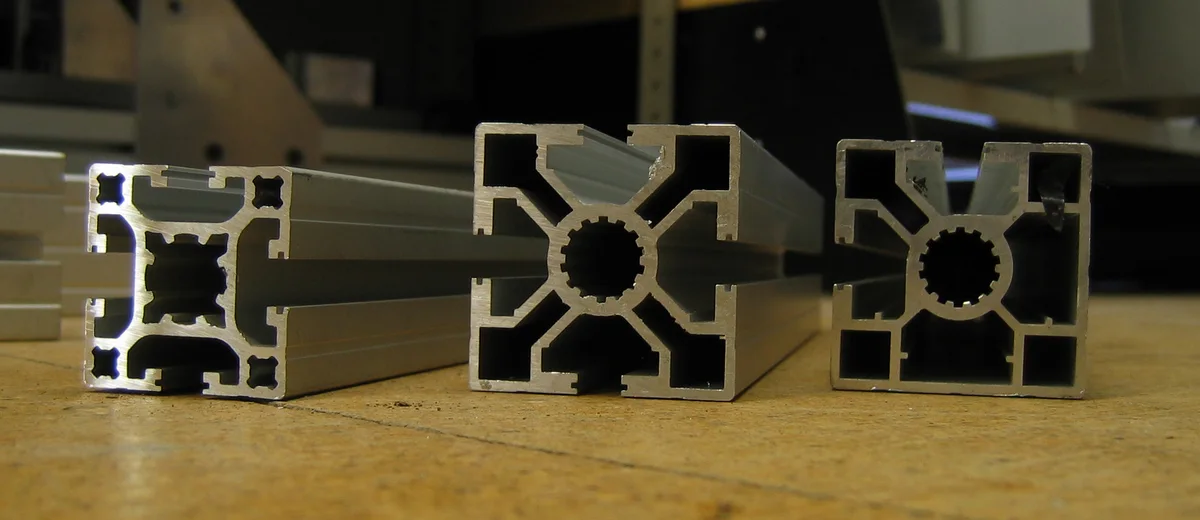
A mirror frame has three jobs: hold the glass securely, protect its silvered edge from moisture, and look good for years in a humid room. Extruded aluminium does all three better than most alternatives. It does not rot or swell like timber, it does not rust like mild steel, and an extrusion die can produce a slim face, a glass groove and a screw port in one profile.
Weight matters too. A frame for a large wall mirror in 6063 weighs roughly a third of the same section in steel, which eases hanging and lowers the load on wall fixings. Profiles can be cut and mitred on standard saws, joined with corner keys or welded, bent into curves and arches, and then anodised, bright-dipped or powder-coated in almost any colour.
The design challenge is surface quality. A mirror frame is looked at from close range under bright light, so die lines, streaks and uneven anodising show far more than they would on a window frame. Choosing the right alloy and finish route, and agreeing on what counts as a visible surface, prevents most rejections.
A face of about 5 – 50 mm and a return leg that sits behind the glass. Simple, slim and used for framed bathroom mirrors bonded to a backing board.
Glass sits in a slot, typically sized for 3 – 6 mm mirror plus a gasket or adhesive. Common on frameless-look and cabinet mirrors.
Hollow section with 20 – 100 mm depth for large floor-standing or wall mirrors; leaves room for LED strips, wiring and hanging rails.
Bent tube frames for round and oval mirrors; seamless or extruded tube with a slot milled or extruded in.
Straight profiles stretch- or roll-bent to a radius; the section must be designed to bend without distorting the glass slot.
Profiles with an extruded channel for an LED strip and a diffuser clip, used for illuminated bathroom and vanity mirrors.
All three are 6xxx Al-Mg-Si extrusion alloys. They extrude easily into thin, intricate sections and take an anodic finish well. The difference lies in how bright a surface they can reach.
| Alloy | Best for | Key point | Relative cost |
|---|---|---|---|
| 6063 | Powder coating, matt or satin anodising, brushed finishes | The general architectural extrusion alloy; good strength and very good surface for most finishes | Base |
| 6463 | Bright-dipped, chemically polished or electropolished chrome-look frames | Low iron and tight impurity limits give a clean, highly reflective surface after chemical brightening | Higher |
| 6060 | Small, thin-walled decorative sections | Slightly lower strength than 6063, very easy to extrude, good anodising response | Base |
| 6061 | Large or load-bearing frames, floor mirrors with long spans | Stronger but less bright after anodising; used where stiffness matters more than gloss | Higher |
| Element (wt %) | 6063 | 6463 |
|---|---|---|
| Silicon | 0.20 – 0.60 | 0.20 – 0.60 |
| Iron, max | 0.35 | 0.15 |
| Copper, max | 0.10 | 0.20 |
| Manganese, max | 0.10 | 0.05 |
| Magnesium | 0.45 – 0.90 | 0.45 – 0.90 |
| Chromium, max | 0.10 | — |
| Zinc, max | 0.10 | 0.05 |
Limits per the Aluminum Association registrations. The much lower iron limit of 6463 is what makes it suitable for bright finishing: iron-rich particles scatter light and dull a polished surface.
Mirror frames rarely carry high loads, but the profile must be stiff enough not to bow under the glass weight and strong enough for screw ports and hanging points. The minimum values below for 6063 extrusions come from ASTM B221; EN 755-2 gives similar figures.
| Temper | Min. tensile strength | Min. yield strength | Typical use |
|---|---|---|---|
| 6063-T5 | 150 MPa (22 ksi) | 110 MPa (16 ksi) | Most decorative frames; cooled at the press and aged |
| 6063-T6 | 205 MPa (30 ksi) | 170 MPa (25 ksi) | Large or deep frames, floor mirrors |
6463 reaches strengths in the same general range as 6063 in matching tempers; the mill certificate states the actual values for each lot.
Profiles are mechanically polished, chemically brightened and then anodised to seal the shine. Best on 6463. Gives a chrome-like silver, gold or rose-gold look without plating.
Clear, champagne, bronze, black and gold. A film of 10 – 15 µm suits dry interiors; 15 – 20 µm or more is advisable in bathrooms and humid rooms. Quality classes follow standards such as Qualanod and EN 12373.
Matt black, white and RAL colours, typically 60 – 120 µm. Very durable and hides minor die lines. Architectural powders to Qualicoat or AAMA 2603/2604 specifications.
Mechanical brushing before anodising gives a fine linear grain that hides fingerprints, popular for modern bathroom mirrors.
A sublimation print over a powder base reproduces timber looks without the moisture problems of real wood.
A thin, clear or coloured lacquer over anodising for extra protection of bright finishes.
Dimensional tolerances for 6060 and 6063 decorative sections are usually agreed to EN 755-9 or, where tighter control is needed, EN 12020-2 for precision profiles; ASTM B221 and ANSI H35.2 apply to US orders. For glass slots, specify the slot width as the glass thickness plus the gasket or adhesive allowance, and give a tolerance on the slot itself rather than on the whole profile.
For bathrooms, keep the mirror edge out of standing water, and choose a sealed finish (anodised 15 µm or more, or powder coating). Where frames contact other metals, isolate them to avoid galvanic corrosion.
6063-T5 is the usual choice for powder-coated, matt or satin-anodised frames. For a high-gloss, chrome-like finish choose 6463, whose low iron content allows chemical brightening without a cloudy surface.
Yes. Aluminium does not rot or rust. Specify anodising of at least 15 µm or architectural powder coating, seal the glass with neutral-cure silicone, and keep the frame out of standing water.
Yes, aluminium corner keys sized to the key channel in the profile can be supplied with the extrusions. Gaskets, sealants and glass are sourced by the frame maker.
Most U- and J-channels are designed for 3 – 6 mm mirror plus a gasket or adhesive allowance. The slot width is set when the die is designed, so tell us the glass thickness and glazing method.
Yes. Tubes and many open sections can be roll- or stretch-bent to a radius. The section must be designed for bending so the glass slot does not close or twist; send the radius with your drawing.
Only if no existing section matches your design. A new die is made to your drawing and then reused for repeat orders.
Send your section, alloy, finish and quantities. We will confirm the profile, finish and delivery to your factory.





