Frame and border profiles
The visible flange around a grille. Usually 6063-T5 with a 20 – 40 mm face, a return leg for mounting and grooves for corner keys. Wall thickness typically 1.0 – 1.6 mm.



Air outlet vents, return grilles, louvres and linear slot diffusers are built from extruded aluminium frames and blades, usually in 6063-T5 or 6060-T5. This guide covers the profile types, alloys and tempers, tolerances, finishes and what a grille fabricator should put on a drawing. Metline supplies the extruded sections and blade strip; the finished vents are made by HVAC manufacturers and fabricators.
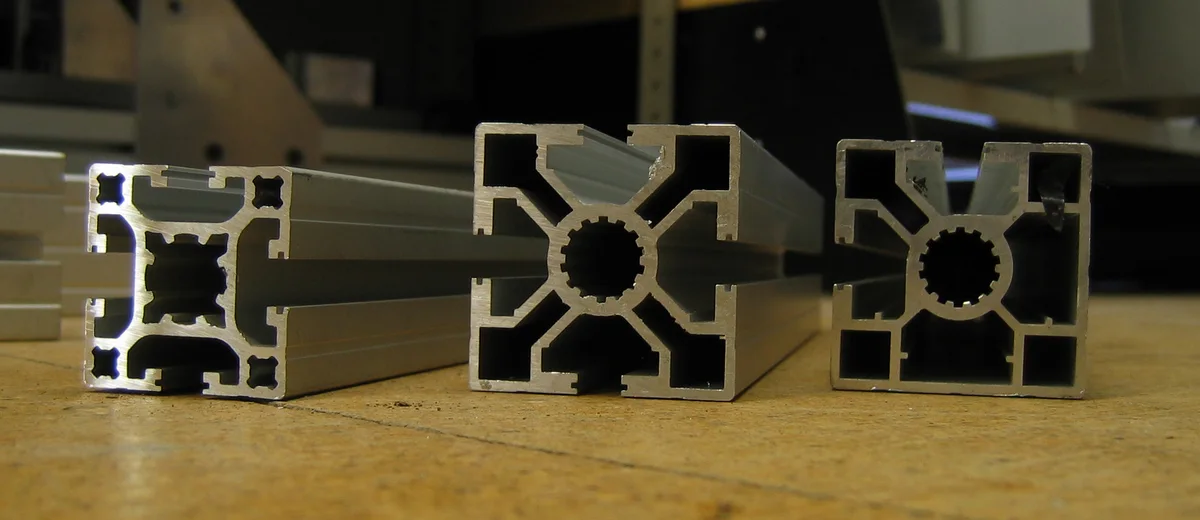
An air terminal device has a simple job: deliver or return air at the right velocity and direction without noise, drafts or visible streaking. Aluminium extrusion suits it because one die can produce a frame with a decorative face, a screw boss, a clip groove for a damper and a gasket channel in a single section, at low weight and with a surface that anodises or powder coats cleanly.
Compared with pressed steel grilles, aluminium vents do not rust in damp ceiling voids, bathrooms, kitchens or swimming-pool halls, and they weigh roughly a third as much for the same cross-section. Compared with plastic, they are stiffer, do not yellow, tolerate higher supply-air temperatures and meet fire-safety requirements without flame retardants. That is why the great majority of commercial supply diffusers, return grilles and external weather louvres use aluminium.
The extrusion itself is only part of the product. A grille maker cuts frames to length, mitres or notches the corners, punches blade pivot holes, inserts blades and springs, adds opposed-blade dampers and finishes the assembly. Profiles that arrive straight, with consistent wall thickness and a clean, uniform surface, make every one of these steps faster.
The visible flange around a grille. Usually 6063-T5 with a 20 – 40 mm face, a return leg for mounting and grooves for corner keys. Wall thickness typically 1.0 – 1.6 mm.
Aerofoil or flat blades set at 0° to 45° deflection. Extruded blades in 6063 give a stiff, rounded leading edge; roll-formed blades use 3003 or 1100 strip 0.5 – 1.5 mm thick.
Long multi-slot extrusions with internal channels for air-pattern controllers. They demand good straightness over 2 – 6 m lengths and accurate slot widths.
Deep, drainable blade profiles with rain-catching hooks for external walls and plant screens. Often 6063-T6 or 6061-T6 for longer spans and wind load.
Opposed-blade damper blades, linkage bars and intermediate mullions that keep wide grilles flat.
Small solid profiles cut into corner cleats, spring clips and fixing brackets.
Typical finished products that use these sections include single- and double-deflection supply grilles, egg-crate and perforated return grilles, square and round ceiling diffusers, swirl diffusers, jet nozzles for large halls, gravity (back-draught) louvres, continuous soffit vents and gable vents. Each product type pushes the profile design in a different direction, from slim decorative frames to deep structural louvre blades.
Almost all vent profiles use the 6xxx alloys that extrude easily into thin, intricate shapes. Strength demands are modest for indoor grilles, so the choice is usually driven by surface quality and finishing.
| Alloy / temper | Min. tensile strength | Min. 0.2 % proof | Why it is chosen |
|---|---|---|---|
| 6063-T5 | 175 MPa | 130 MPa | Standard for frames and blades; excellent surface for anodising |
| 6063-T6 | 215 MPa | 170 MPa | Stiffer blades, longer slot diffusers, external louvres |
| 6060-T5 | 160 MPa | 120 MPa | European alternative to 6063; very good surface finish |
| 6060-T6 | 190 MPa | 150 MPa | Where a little more strength is needed in 6060 |
| 6061-T6 | 260 MPa | 240 MPa | Structural louvre mullions and heavy-duty blades |
| 3003-H14 / 1100-H14 strip | ≈ 140 MPa / 110 MPa | — | Roll-formed blades and perforated faces |
Extrusion minimums summarised from EN 755-2 for walls up to about 3 – 5 mm; ASTM B221 values are similar. Thicker sections and other tempers have different limits, shown on the mill certificate.
6063 gives the brightest, most uniform anodised appearance and the best ability to fill fine features such as narrow slots and thin decorative ribs. It is the right default. Move to 6063-T6 when long blades sag between pivots or when a linear diffuser must stay straight across a wide ceiling, and to 6061-T6 or 6005A-T6 only for external louvres that carry wind load.
Vent profiles look simple but they are assembled from many parts, so small dimensional errors add up into visible gaps and loose blades. Standard tolerances for general extrusions are set by EN 755-9 or ANSI H35.2; for 6060 and 6063 precision profiles, EN 12020-2 gives tighter limits and is the better reference for decorative grille sections.
Mark decorative faces on the drawing as "significant surfaces". The extruder then orients the die and handling to protect those faces from die lines, scratches and handling marks, and the finisher knows where appearance is inspected.
| Finish | Typical specification | Where it fits |
|---|---|---|
| Powder coating | Polyester powder to Qualicoat or AAMA 2603/2604, 60 – 80 µm, RAL colours | Most commercial grilles; white RAL 9010/9016 is the common ceiling colour |
| Anodising | Clear or coloured anodic film, 10 – 20 µm, to EN ISO 7599 / Qualanod | Visible architectural diffusers, matt black slot diffusers |
| Electrophoretic coating | Clear or tinted lacquer over anodising | Humid interiors and pools where extra protection is wanted |
| Brushed or polished | Mechanical finish before anodising | Premium decorative grilles and kitchen hoods |
| Mill finish | As extruded | Concealed parts, dampers and parts painted after assembly |
Matt black inner parts, such as air-pattern controllers inside a slot diffuser, hide the slot visually so that only the air gap is seen. For external weather louvres in coastal sites, specify a seaside-class pretreatment and coating system rather than a standard interior powder.
6063-T5 is the standard alloy for frames and extruded blades because it extrudes into thin, detailed shapes and anodises or powder coats very evenly. 6060-T5 is a common European alternative, and roll-formed blades use 3003 or 1100 strip.
Frames are usually 1.0 – 1.6 mm thick and extruded blades about 0.8 – 1.5 mm. External weather louvre blades are heavier, often 1.5 – 2.5 mm, because they carry wind load and span further.
Powder coating is the most common choice for white ceiling grilles because it matches RAL colours. Anodising is preferred for exposed architectural diffusers and matt black inner parts. Both work well on 6063.
Yes. Send the section drawing with critical dimensions and finish. We confirm whether an existing die fits or a new die is needed, then supply samples for approval before production.
No. Metline supplies the aluminium extrusions, strip and sheet that HVAC manufacturers and fabricators use to build vents, grilles and diffusers.
General extrusions follow EN 755-9 or ANSI H35.2. Decorative 6060 and 6063 sections are better ordered to EN 12020-2 precision tolerances, with critical slot and groove widths marked on the drawing.
Send your profile drawing, alloy, finish and quantity. We will reply with die options, tolerances and a delivered price.





