Colour lacquer
A transparent tinted lacquer (gold, red, blue, green and so on) lets the metallic shine show through. Lacquer also protects the foil surface and must be formulated for direct food contact on the inner face.



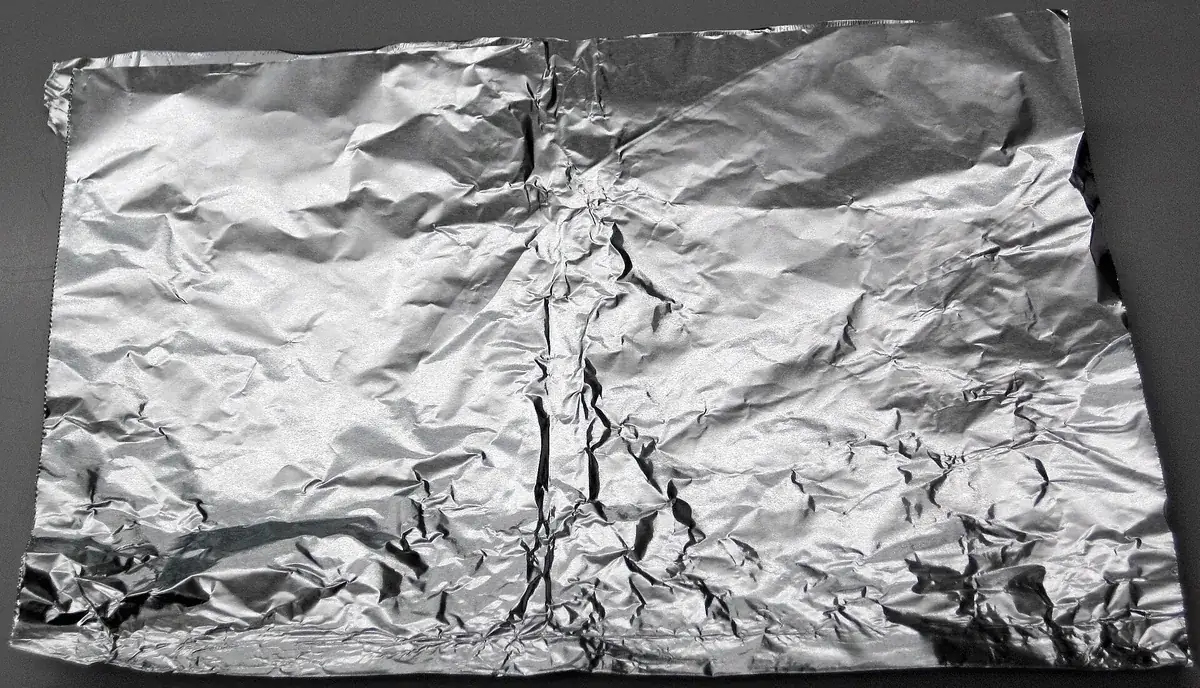
Chocolate foil is soft, fully annealed aluminium foil, usually 8011, 1235 or 8079 in O temper and 8 – 15 µm thick, that is lacquered, printed or embossed and wrapped directly around chocolates, pralines and seasonal figures. It holds a fold without springing back, blocks light, moisture and odours, and gives the bright metallic look that confectionery brands rely on. Metline supplies chocolate foil in reels to converters and confectioners worldwide.
Chocolate is sensitive to light, moisture, oxygen and foreign odours. Fat bloom, flavour loss and tainting from nearby products all shorten shelf life. A continuous aluminium layer is a near-total barrier to all of them, even at a thickness of around 10 µm.
Foil also has a property paper and plastic film lack: dead fold. Soft O-temper foil stays exactly where it is pressed, so it can be twist-wrapped around a praline, folded tightly around a bar or pressed onto a hollow figure without adhesive. That is why high-speed fold and twist wrapping machines are set up around foil, and why foil remains the default for Easter eggs, coins, Santas and individually wrapped chocolates.
Plain foil is often used under a paper band on bars, while coloured, printed or embossed foil is used as the visible outer wrap on pralines and seasonal products.
Which alloy? 1235 is a high-purity (99.35 % Al minimum) alloy that gives very good dead fold and a bright surface. 8011 and 8079 contain more iron and silicon, which raises strength and reduces pinholes at thin gauges, helping the foil survive high-speed wrapping. Many converters choose 8079 for the thinnest gauges, 8011 as the general-purpose grade and 1235 where maximum softness and brightness matter.
A transparent tinted lacquer (gold, red, blue, green and so on) lets the metallic shine show through. Lacquer also protects the foil surface and must be formulated for direct food contact on the inner face.
Gravure or flexo printing applies logos, seasonal designs or registered artwork. Printed foil needs register marks matched to the wrapping machine’s cut length.
Patterns rolled into the foil hide small creases, improve grip on wrapping machines and add texture. Logo embossing is used for premium lines.
An optional coating on one face allows sealing to paper bands or to itself for flow-wrap and lidding styles.
Foil laminated to thin paper gives a stiffer wrap for bars and tablets and a printable paper face.
Uncoated foil with one bright and one matt side, the most economical option for inner wraps.
| Property | Why it matters | What to ask for |
|---|---|---|
| Thickness tolerance | Variations change wrap tension and appearance | Average and local tolerance per EN 546-3 or as agreed |
| Pinholes | Unavoidable at very thin gauges; affect barrier and visual quality | Pinhole limit per m² for the gauge |
| Wettability and cleanliness | Residual rolling oil affects lacquer adhesion and odour | Surface cleanliness test result, odour-free foil |
| Lacquer adhesion and colour | Colour must match from reel to reel and not rub off | Colour standard, ΔE tolerance, rub test |
| Dead fold | Foil must stay in place after twist or fold wrapping | O temper with confirmed elongation |
| Reel quality | Telescoping, loose winding or too many joints stop machines | Maximum joints per reel, end-face flatness, core size |
Ask the supplier to run a sample reel on your wrapping machine before a full order. Machine speed, twist angle and ambient humidity all affect how a particular foil behaves, and a short trial avoids surprises.
Bare aluminium foil for food contact is controlled by composition limits, and coatings and inks by their own migration rules. In Europe the framework is Regulation (EC) No 1935/2004, with EN 602 setting the composition of aluminium for food-contact use; in the United States, coatings fall under FDA 21 CFR, for example 175.300 for resinous and polymeric coatings. For chocolate, the inner face is usually plain foil or a food-contact lacquer, and inks are applied to the outer face only.
When ordering, specify the market where the chocolate will be sold so the supplier can provide the appropriate declaration of compliance for the foil, lacquer and inks.
Most chocolate foil is 8 – 15 µm. Around 10 – 12 µm is typical for pralines and hollow figures; thicker gauges are used for coins and embossed foils that need extra body.
8011 is the general-purpose choice, 8079 suits the thinnest gauges where strength and low pinholes matter, and 1235 gives maximum softness and brightness. All are supplied in fully annealed O temper.
Yes, provided the lacquer on the food-contact side is formulated and declared for direct food contact, and inks are on the outside. Ask for a declaration of compliance for your market.
Yes. Send your artwork or logo, colour references and repeat length; printed and logo-embossed foil is produced to order on reels sized for your wrapping machine.
At thin gauges two foils are rolled together in the final pass. The faces in contact with the polished rolls come out bright and the faces in contact with each other come out matt. Both sides perform the same.
Tell us the alloy, gauge, width, colour or print and reel size, and our team will reply with options and a delivered price.






