Single-hole dies
One opening per die. Used for medium and large diameters, where the cross-section already takes a large share of the billet. The bar runs straight from the die centre, which gives very even flow and good roundness.



Extruded aluminium round bar is produced by forcing a hot billet through a solid die with a circular opening, so each diameter needs its own die (often called a mould). Choosing a diameter that extruders already hold dies for avoids a tooling charge and a die trial on the first order. This guide lists common metric and inch round bar sizes with their weights, explains how round bar dies work, and shows how alloy, press size and tolerance affect what can be supplied.
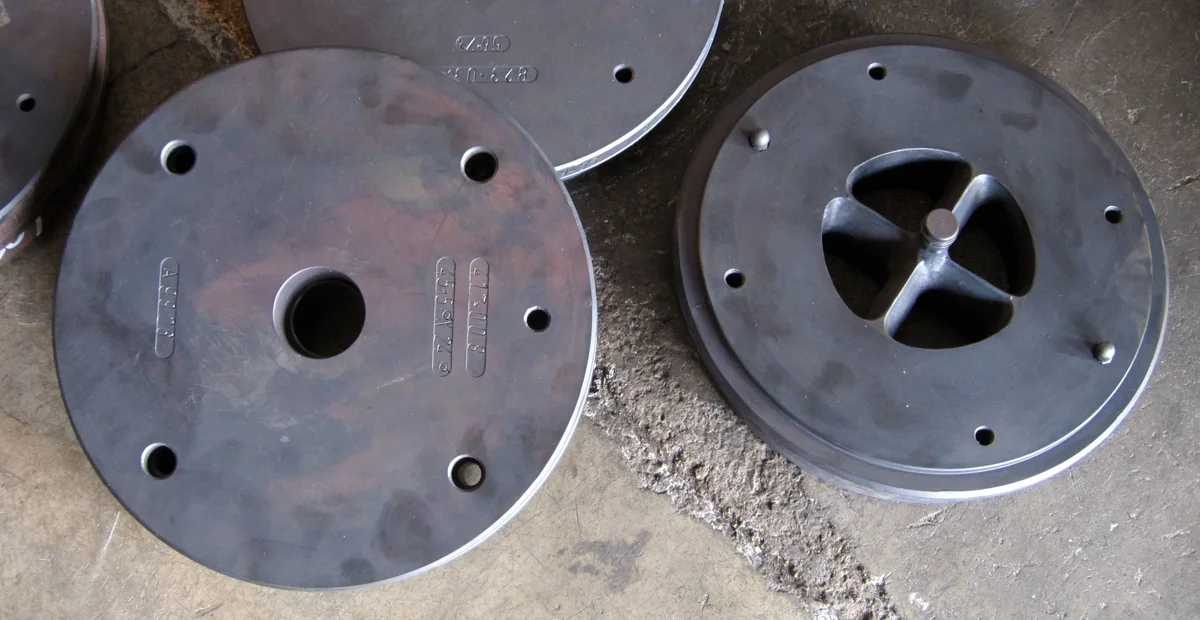
A round bar die is a disc of hardened hot-work tool steel, usually H13 (1.2344), with one or more circular openings machined through it. The opening has a short, polished "bearing" land that sizes the bar and a relieved back section that lets the bar leave without dragging. Because there is no mandrel or bridge, round bar dies are solid dies: the simplest and most robust type of extrusion tool.
Even a simple die has to be designed for the alloy and press, machined, hardened, nitrided and tried on the press before production metal is accepted. The first trial may show an oval bar, surface lines or uneven flow, and the bearing is then corrected. For that reason extruders keep libraries of existing round bar dies in the diameters the market uses most, and a buyer who picks one of those sizes can go straight to production.
When the diameter is new to the extruder, a one-time die charge is normally quoted and the die then stays available for repeat orders. Because round dies are inexpensive compared with complex hollow profile dies, the charge is rarely decisive for large orders, but it matters for samples and small batches, and the die trial adds time to the first delivery. Picking a standard diameter is therefore the simplest way to cut cost and lead time.
One opening per die. Used for medium and large diameters, where the cross-section already takes a large share of the billet. The bar runs straight from the die centre, which gives very even flow and good roundness.
Two, four, six or more openings in one die. Used for small rod, where a single opening would give an extrusion ratio too high for the press. The holes are arranged symmetrically so metal flows out of each one at the same speed.
The polished land that sizes the bar. Longer bearings slow metal flow and improve surface on soft alloys; shorter bearings suit hard alloys that need less friction.
H13 tool steel is hardened and then nitrided to give a hard, wear-resistant bearing surface. Dies are re-nitrided periodically during their life.
Container area divided by total die-opening area. Too high and the press stalls or the surface tears; too low and the bar may lack proper grain refinement. Die and press are matched to keep the ratio in a sensible range.
Small rods run on small presses with small billets; diameters above roughly 150 – 200 mm need large containers and high-tonnage presses, which fewer extruders have.
Hard alloys such as 2014, 2024 and 7075 need more pressure and run far slower than 6060 or 6063, so the same diameter may be extruded on a larger press or with fewer holes in the die. That is why a supplier may quote a common diameter quickly in 6082 but need a different die for 7075.
The diameters below are widely produced metric round bar sizes. Weights are theoretical: the first column uses 2.70 g/cm³ (6060, 6061, 6063, 6082), the second 2.81 g/cm³ (7075). For 2011 or 2024 use about 2.78 – 2.83 g/cm³, which is within 1 % of the 7075 column.
| Diameter (mm) | kg/m, 6xxx (2.70) | kg/m, 7075 (2.81) | lb/ft, 6xxx |
|---|---|---|---|
| 4 | 0.034 | 0.035 | 0.023 |
| 5 | 0.053 | 0.055 | 0.036 |
| 6 | 0.076 | 0.079 | 0.051 |
| 8 | 0.136 | 0.141 | 0.091 |
| 10 | 0.212 | 0.221 | 0.142 |
| 12 | 0.305 | 0.318 | 0.205 |
| 14 | 0.416 | 0.433 | 0.279 |
| 15 | 0.477 | 0.497 | 0.321 |
| 16 | 0.543 | 0.565 | 0.365 |
| 18 | 0.687 | 0.715 | 0.462 |
| 20 | 0.848 | 0.883 | 0.570 |
| 22 | 1.026 | 1.068 | 0.690 |
| 25 | 1.325 | 1.379 | 0.891 |
| 28 | 1.663 | 1.730 | 1.117 |
| 30 | 1.909 | 1.986 | 1.282 |
| 32 | 2.171 | 2.260 | 1.459 |
| 35 | 2.598 | 2.704 | 1.746 |
| 36 | 2.748 | 2.860 | 1.847 |
| 38 | 3.062 | 3.187 | 2.058 |
| 40 | 3.393 | 3.531 | 2.280 |
| 42 | 3.741 | 3.893 | 2.514 |
| 45 | 4.294 | 4.469 | 2.886 |
| 50 | 5.301 | 5.518 | 3.562 |
| Diameter (mm) | kg/m, 6xxx (2.70) | kg/m, 7075 (2.81) | lb/ft, 6xxx |
|---|---|---|---|
| 55 | 6.415 | 6.676 | 4.311 |
| 60 | 7.634 | 7.945 | 5.130 |
| 65 | 8.960 | 9.325 | 6.021 |
| 70 | 10.391 | 10.814 | 6.982 |
| 75 | 11.928 | 12.414 | 8.016 |
| 80 | 13.572 | 14.125 | 9.120 |
| 85 | 15.321 | 15.946 | 10.295 |
| 90 | 17.177 | 17.877 | 11.542 |
| 95 | 19.138 | 19.918 | 12.860 |
| 100 | 21.206 | 22.070 | 14.250 |
| 110 | 25.659 | 26.705 | 17.242 |
| 120 | 30.537 | 31.781 | 20.520 |
| 130 | 35.838 | 37.298 | 24.082 |
| 140 | 41.564 | 43.257 | 27.930 |
| 150 | 47.713 | 49.658 | 32.062 |
| 160 | 54.287 | 56.499 | 36.479 |
| 170 | 61.285 | 63.782 | 41.182 |
| 180 | 68.707 | 71.507 | 46.169 |
| 200 | 84.824 | 88.280 | 56.999 |
| 220 | 102.637 | 106.819 | 68.969 |
| 250 | 132.537 | 137.938 | 89.061 |
| 280 | 166.255 | 173.029 | 111.718 |
| 300 | 190.854 | 198.630 | 128.248 |
| 350 | 259.773 | 270.358 | 174.560 |
Whether a particular diameter runs from an existing die depends on the extruder, the alloy and the press; confirm at the enquiry stage. Above about 300 mm, round bar is more often forged or machined from cast log than extruded.
North American drawings call up fractional-inch rod, usually to ASTM B221 (extruded) or ASTM B211 (cold-finished). Many inch sizes are close to, but not the same as, metric ones: 1 in is 25.40 mm, not 25 mm. Order an inch bar from an inch die when it must fit an inch bore, bearing or collet.
| Diameter (in) | Diameter (mm) | lb/ft (0.0975 lb/in³) | kg/m |
|---|---|---|---|
| 1/4 | 6.35 | 0.057 | 0.085 |
| 5/16 | 7.94 | 0.090 | 0.134 |
| 3/8 | 9.52 | 0.129 | 0.192 |
| 1/2 | 12.70 | 0.230 | 0.342 |
| 9/16 | 14.29 | 0.291 | 0.433 |
| 5/8 | 15.88 | 0.359 | 0.534 |
| 3/4 | 19.05 | 0.517 | 0.769 |
| 7/8 | 22.22 | 0.704 | 1.047 |
| 1 | 25.40 | 0.919 | 1.367 |
| 1 1/8 | 28.57 | 1.163 | 1.731 |
| 1 1/4 | 31.75 | 1.436 | 2.137 |
| 1 3/8 | 34.92 | 1.737 | 2.585 |
| 1 1/2 | 38.10 | 2.068 | 3.077 |
| 1 5/8 | 41.27 | 2.427 | 3.611 |
| 1 3/4 | 44.45 | 2.814 | 4.188 |
| 2 | 50.80 | 3.676 | 5.470 |
| 2 1/4 | 57.15 | 4.652 | 6.923 |
| 2 1/2 | 63.50 | 5.743 | 8.547 |
| 2 3/4 | 69.85 | 6.949 | 10.342 |
| 3 | 76.20 | 8.270 | 12.307 |
| 3 1/4 | 82.55 | 9.706 | 14.444 |
| 3 1/2 | 88.90 | 11.257 | 16.752 |
| 3 3/4 | 95.25 | 12.922 | 19.230 |
| 4 | 101.60 | 14.703 | 21.880 |
| 4 1/2 | 114.30 | 18.608 | 27.692 |
| 5 | 127.00 | 22.973 | 34.187 |
| 5 1/2 | 139.70 | 27.797 | 41.367 |
| 6 | 152.40 | 33.081 | 49.230 |
| 6 1/2 | 165.10 | 38.824 | 57.777 |
| 7 | 177.80 | 45.027 | 67.007 |
| 8 | 203.20 | 58.811 | 87.520 |
Small differences between catalogue weights from different suppliers usually come from the density each one assumes. For freight planning, add packing weight and allow for the actual length tolerance. The aluminium bar weight calculator handles any diameter and length.
| Alloy | Usual tempers | Extrudability | Typical use of the bar |
|---|---|---|---|
| 6060 / 6063 | T5, T6, T66 | Excellent; fastest to extrude, best surface | Furniture, handrails, light machined parts, anodised components |
| 6061 | T6, T6511 | Good | General engineering and machined parts, especially to ASTM drawings |
| 6082 | T6, T6511 | Good | European structural and machined parts; slightly stronger than 6061 in heavy sections |
| 6005 / 6005A | T5, T6 | Very good | Structural rod, transport components |
| 6262 | T6, T6511, T9 | Good | Free-machining parts where 6061-like corrosion resistance is needed |
| 2011 / 2007 | T3, T4, T6, T4511 | Moderate | Free-cutting stock for automatic lathes |
| 2014 / 2014A | T4, T6, T6511 | Difficult | High-strength fittings and forging stock |
| 7075 | T6, T6511, T73 | Difficult; slow speeds | High-strength machined parts, aerospace and tooling |
| 5083 | O, H111, H112 | Moderate | Marine fittings and welded parts |
| 6101 | T6 | Very good | Electrical conductor rod and busbar |
Temper "51" suffixes (T6511, T4511) indicate the bar has been stretched after quenching to relieve stress and straighten it, which matters for bars that will be machined heavily. Very large diameters may be supplied as T6 without stretching if the press stretcher cannot handle the section; check this for parts that must stay straight after machining.
Extruded round bar is supplied to the tolerance tables of the ordering standard. Tolerances widen as the diameter grows and are tighter for the softer, easy-to-extrude alloys.
If you need tolerances tighter than extruded bar can hold, for example h9 or h11 fits for direct use in bearings or collets, specify cold-finished or precision-ground bar rather than a new extrusion die. See our precision ground bar guide.
Every diameter needs its own die. If no die exists, one has to be made and trialled, which adds a one-time tooling charge and time to the first order. Standard diameters run from dies the extruder already holds.
Diameters up to about 300 – 350 mm are extruded on large presses, though only some presses can handle them. Larger bars are usually forged or machined from cast billet.
Only if the dimension allows it. A 25 mm bar is 0.4 mm smaller than a 1 in bar, so it will not fit a 1 in bore or collet. Order the inch size from an inch die when fit matters, or machine down from the next larger metric bar.
They assume different densities. 6xxx alloys are about 2.70 g/cm³, 2011 and 2024 about 2.78 – 2.83 g/cm³ and 7075 about 2.81 g/cm³, so weight per metre varies by up to about 4 % for the same size.
For parts that will be machined, yes. If the bar surface is used as-supplied in a bearing or collet fit, choose cold-finished (ASTM B211, EN 754-3) or precision-ground bar for tighter tolerance and a better surface.
Almost all wrought alloys: 6060, 6063, 6061, 6082 and 6005 extrude most easily; 2011, 2014, 2024 and 7075 need slower speeds and more pressure; 5083 and 6101 are also produced as round bar for marine and electrical use.
Send diameter, alloy, temper, length and quantity. We will confirm the size, tolerance, certification and a delivered price.






