Raised (standard) expanded metal
Supplied as it leaves the press, with strands and bonds set at an angle to the sheet plane. Strongest for its weight and naturally slip-resistant. Used for walkways, guards, fencing and partitions.



Aluminium expanded metal is a one-piece mesh made by slitting and stretching aluminium sheet or coil into a pattern of diamond-shaped openings, with no material removed and no welds. It is lighter than the sheet it came from, rigid, slip-resistant in its raised form and does not rust. This guide explains how it is made and specified, which alloys to choose, how to calculate weight, and where it is used.
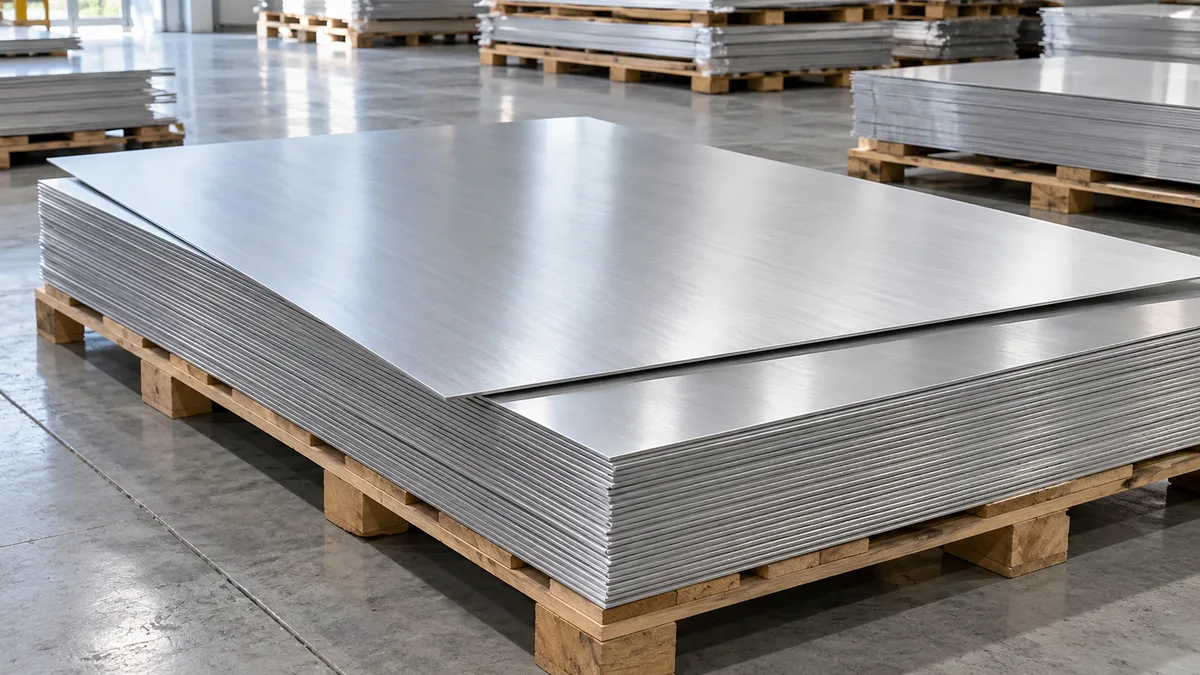
Expanded metal starts as solid sheet or coil. An expanding press cuts a row of short, staggered slits and, in the same stroke, pulls the metal forward so the slits open into diamonds. The strands and the bonds (the nodes where strands meet) remain one continuous piece of metal. Because nothing is punched out, almost all of the feedstock ends up in the finished mesh.
Compared with perforated sheet, expanded metal gives a larger open area for the weight, more stiffness from the angled strands, and natural grip when left in the raised condition. Compared with woven or welded wire mesh, it has no joints to loosen or break, and the strands cannot unravel when the mesh is cut. These qualities explain why the same basic product turns up in facade screens, walkways, machine guards, grease filters, plaster lath and electronic shielding.
Aluminium versions add corrosion resistance without galvanising, low weight (about one third that of steel mesh with the same pattern), high thermal and electrical conductivity and an excellent base for anodising and powder coating. Metline supplies aluminium coil and sheet for expanded metal production, and expanded aluminium mesh in sheets, coils and cut panels to buyers worldwide.
Expanded metal has its own vocabulary, standardised in North America by the Expanded Metal Manufacturers Association (EMMA, part of NAAMM) in its EMMA 557 standard. Understanding these terms avoids most ordering errors.
| Term | Meaning | Why it matters |
|---|---|---|
| SWD – short way of the design | Distance from the centre of one bond to the centre of the next across the short diagonal of the diamond | With strand size, controls weight and strength |
| LWD – long way of the design | Same measurement across the long diagonal | Usually about 2 to 2.5 times the SWD for standard patterns |
| SWO / LWO – short and long way of opening | The clear opening inside the diamond, measured inside the strands | Determines what passes through: air, light, particles, fingers |
| Strand width (SW) | Width of metal fed forward per stroke, which becomes the strand width | Wider strands give more weight, strength and less open area |
| Strand thickness (T) | Thickness of the strand, usually close to the base sheet thickness | Main driver of load capacity |
| Bond | The double-thickness node where two strands meet | Gives stiffness; in raised mesh the bonds tilt and create grip |
| Open area | Percentage of the surface that is open | Ventilation, light transmission, drainage and weight |
Patterns are often written as SWO × LWO × T × SW in millimetres, for example 3.2 × 5.0 × 1.5 × 0.7, or in North America by SWD and base gauge, for example "3/4 in, 0.050 in". Because suppliers use different conventions, always state which dimensions you are quoting, and whether they are nominal design dimensions or measured openings. EMMA 557 allows a tolerance of about ±10 % on weights and design dimensions for standard mesh, tighter for load-bearing grating.
Supplied as it leaves the press, with strands and bonds set at an angle to the sheet plane. Strongest for its weight and naturally slip-resistant. Used for walkways, guards, fencing and partitions.
Raised mesh passed through a cold-rolling mill to flatten the strands into one plane. Smooth to touch, easier to paint and frame, slightly longer in the LWD direction and thinner overall. Used for facades, ceilings, shelving and decorative panels.
Heavy-gauge mesh from thick plate, typically 3 – 6 mm, for platforms, catwalks and stair treads where loads must be carried between supports. Usually 5052 or 6061 alloy.
Very fine mesh from foil and thin strip (about 0.05 – 0.3 mm) with openings below 1 – 2 mm. Used for filtration, battery current collectors, EMI shielding and lightning-strike protection layers in composite parts.
Large or decorative patterns, including hexagonal, scale and custom shapes, made for facades, sunscreens, ceilings and interior features. Often anodised or PVDF coated.
Light diamond mesh used as a substrate for plaster, render and fireproofing; the open diamonds key the coating mechanically.
The alloy must stretch without tearing at the bonds, yet give the finished mesh enough strength and the right surface for its finish. Non-heat-treatable alloys in quarter-hard to half-hard tempers are the usual choice.
| Alloy and temper | Typical tensile strength | Character | Best for |
|---|---|---|---|
| 1050 / 1100 (O, H14) | 90 – 125 MPa (H14) | Highest ductility, conductivity and corrosion resistance; low strength | Micro mesh, filters, lath, electrical shielding |
| 3003-H14 | About 150 MPa | The general-purpose expanded metal alloy: expands cleanly, moderate strength, good corrosion resistance | Guards, screens, grease filters, decorative panels |
| 5005-H34 | About 160 MPa | Similar strength to 3003 with a better, more uniform anodised appearance | Anodised facade and interior mesh |
| 5052-H32 | About 230 MPa | Higher strength and fatigue resistance; excellent in marine atmospheres | Walkways, grating, marine and coastal installations |
| 6061-T6 | About 310 MPa | Heat-treated; strongest option but less ductile, so patterns must be chosen with care | Heavy grating and structural mesh |
Typical values for the base sheet (Aluminum Association / ASM). Expanding cold-works the bonds, so the mesh behaves as a structure rather than a sheet; load tables from the mesh supplier, not sheet properties, should be used for design.
Base sheet and coil for expanded metal is usually ordered to ASTM B209 or EN 485 / EN 573-3. If the mesh will be anodised, specify an anodising-quality alloy such as 5005 and keep the whole project on material from one source, because the anodised tone varies with composition.
Because the press feeds forward one strand width per stroke and each stroke produces half a diamond, the weight of expanded metal per square metre (measured flat on plan) can be estimated from the pattern alone:
| SWD (mm) | Strand width (mm) | Strand thickness (mm) | Approx. weight (kg/m²) |
|---|---|---|---|
| 3.2 | 0.7 | 1.5 | 1.77 |
| 6 | 0.8 | 0.8 | 0.58 |
| 10 | 1.2 | 1 | 0.65 |
| 12.7 | 1.5 | 1.5 | 0.96 |
| 19 | 2 | 1.6 | 0.91 |
| 25.4 | 2.5 | 2 | 1.06 |
| 25.4 | 3.2 | 3 | 2.04 |
| 32 | 4 | 4 | 2.70 |
| 50.8 | 4.7 | 4 | 2.00 |
Calculated from geometry at a density of 2.70 g/cm³. Actual weight varies with the expanding process and within the tolerance of the standard; flattening does not change weight per unit length of strand but changes overall dimensions slightly.
Pattern choice affects strength in each direction. Expanded metal is stiffer along the LWD than across it, so in walkways and spans the LWD normally runs between the supports. State the LWD direction on the drawing for any load-bearing or framed panel.
Expanding also changes the dimensions of the sheet. A given width of feedstock produces mesh of roughly the same width in the LWD direction, but the length grows several times in the SWD direction, depending on the ratio of SWD to strand width. This is why expanded mesh covers a much larger area than the sheet it was made from, and why ordering by finished area rather than by feedstock weight is normal practice. Flattening then adds a few per cent to the LWD length and reduces the overall thickness.
Shearing, laser, waterjet and plasma all work. Cuts through the bonds leave a stronger, neater edge than cuts through the strands.
Edges are often captured in aluminium angle, U-channel or tube frames, or folded edging strips, which stiffen the panel and remove sharp ends.
Flattened mesh in soft tempers can be folded and curved; raised mesh can be rolled into curves for facades and guards.
TIG or MIG with 4043 or 5356 filler joins mesh to frames; low heat input avoids burning through thin strands.
Gives a hard, durable metallic finish. Use 5005 or anodising-quality 3003 for consistent colour on visible facades.
Powder is economical in any RAL colour; PVDF gives the best colour retention for coastal and high-UV facades. Mesh is best coated after cutting to protect edges.
| Sector | Typical product | What the mesh does |
|---|---|---|
| Architecture and facades | Flattened or architectural mesh, anodised or PVDF | Sun screening, visual screening, rainscreen and car-park facades |
| Interiors | Flattened decorative mesh | Ceilings, partitions, stair infill, retail displays |
| Industrial access | 5052 or 6061 raised mesh and grating | Walkways, platforms and stair treads that drain and grip |
| Machine and equipment guarding | 3003 raised mesh in frames | Visible, ventilated guards and enclosures |
| HVAC and kitchens | 1100 or 3003 mesh | Grease filters, air filter supports, vent covers |
| Electronics and batteries | Micro expanded foil | EMI shielding, current collectors, heat spreading |
| Aerospace composites | Micro expanded aluminium foil | Lightning-strike protection layers in composite skins |
| Marine and transport | 5052 mesh | Deck walkways, trailer floors, ventilation grilles |
| Security and fencing | Raised mesh panels | Perimeter fencing and partitions that resist climbing and cutting |
Aluminium is not always the right choice. For heavy vehicular loads or high-security barriers, steel expanded metal or bar grating carries more load at lower cost; for very fine filtration, woven wire mesh gives more precise openings. Aluminium wins where weight, corrosion resistance and appearance matter.
Raised expanded metal is supplied as expanded, with the strands angled out of plane; it is stronger for its weight and slip-resistant. Flattened expanded metal is cold-rolled after expanding so the surface is smooth and flat, which suits painting, framing and decorative use.
3003-H14 is the general-purpose choice. Use 5052-H32 for higher strength and marine environments, 5005 for consistent anodised facades, 1100 or 1050 for micro mesh and filters, and 6061-T6 for heavy grating.
Multiply 2 × strand width × strand thickness × 2.70 and divide by the SWD, all in millimetres, to get kg/m². For example, a 12.7 mm SWD pattern with 1.5 × 1.5 mm strands weighs about 0.96 kg/m².
For the same weight and open area, expanded metal is usually stiffer, because the angled strands and bonds act like a truss and no material is removed. Perforated sheet gives a flatter, more uniform surface and more precise hole sizes.
Yes. Both finishes are common. Anodising suits 5005 and anodising-quality 3003; powder coating and PVDF work on all common alloys and are best applied after cutting so the edges are protected.
Very little. The sheet is slit and stretched, not punched, so nearly all the feedstock becomes mesh, and the finished mesh covers a larger area than the original sheet.
Tell us the pattern, alloy, size, finish and quantity. We will confirm options, documents and a delivered price anywhere in the world.





