Moisture stability
The core and metal faces do not absorb water, so sink cabinets, vanity units and laundry furniture do not swell at the edges or around hinge holes.



Aluminium foam furniture panels are sandwich boards with a porous aluminium core and metal, laminate or veneer faces, made to replace MDF, plywood and particleboard in cabinets, wardrobes and interior doors. They do not swell in wet kitchens and bathrooms, have a non-combustible core, contain no formaldehyde-based resin in the core and are lighter than wood boards of the same thickness. This guide compares builds, weights and costs and explains how to machine and fit hardware to them.
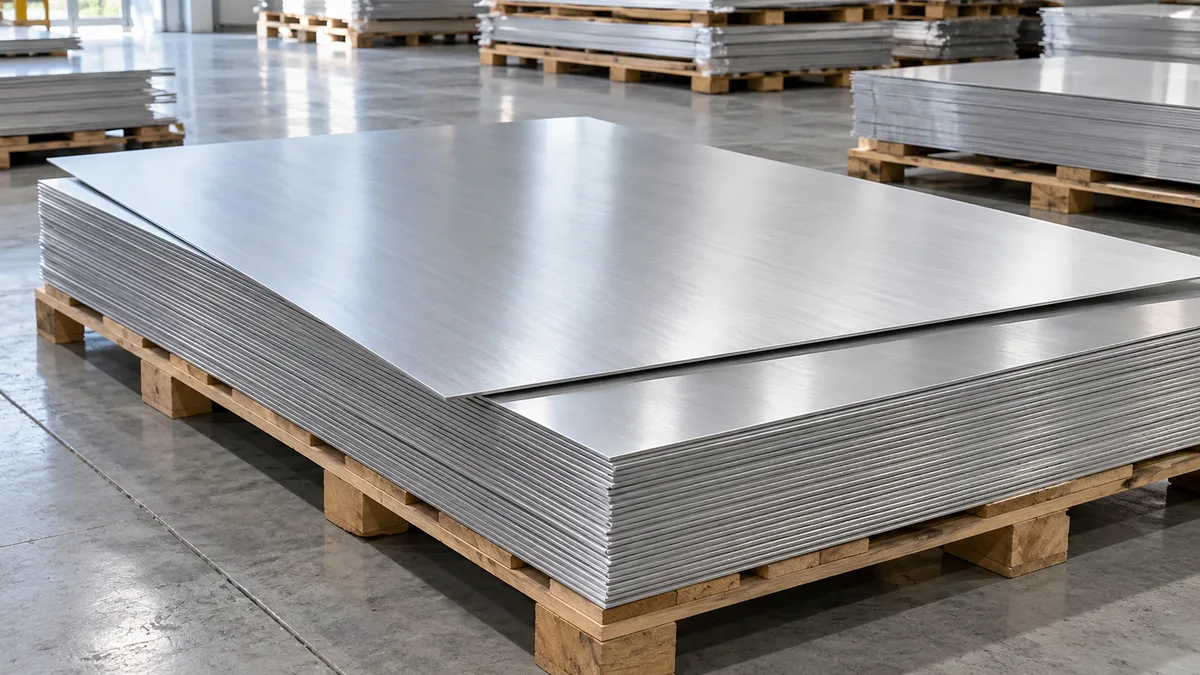
An aluminium foam furniture panel is a three- or five-layer sandwich: a slab of closed-cell aluminium foam in the middle, bonded on each side to a facing such as thin aluminium sheet, a thin marine-grade plywood layer, PVC or PET film, high-pressure laminate or a wood veneer. The faces carry bending loads and provide the decorative surface; the foam core keeps them apart, resists crushing and damps vibration.
It is worth being precise about what this product is not. It is not an aluminium composite panel (ACP) for facades, which has a thin polymer or mineral core. It is not a polymer-core panel with an XPS, PET or PU foam centre. And it is not an unfaced decorative foam plate where the pores are the finish. The furniture panel described here uses a metal foam core with a conventional furniture face, so it can be handled like a board in a cabinet workshop.
Metline supplies foam core panels and finished foam sandwich boards, together with aluminium facing sheet and coil and extruded edge and handle profiles, to furniture makers, kitchen and wardrobe manufacturers and fit-out contractors worldwide.
| Total thickness | Example build A | Example build B | Typical use |
|---|---|---|---|
| 9 mm | 0.2 mm Al sheet + 8 mm foam + 1.0 mm Al sheet | 0.5 mm Al + 8 mm foam + 0.5 mm Al | Thin doors, backs, drawer bottoms, panels in mobile furniture |
| 12 mm | PVC film + 3 mm marine ply + 8 mm foam + 0.2 mm Al | PVC film + 0.5 mm Al + 11 mm foam + 0.5 mm Al | General carcass panels, shelves, wall panels |
| 18 mm | Veneer + 3 mm marine ply + 10 mm foam + 3 mm marine ply + veneer | Veneer + 0.5 mm Al + 16 mm foam + 0.5 mm Al | Direct replacement for 18 mm MDF or plywood in carcasses and doors |
All-metal faces give the highest moisture resistance and a fully non-combustible build apart from the adhesive and decorative layer. Builds with a thin plywood layer under the decorative face behave more like conventional board in the workshop, accepting staples, edge banding and veneers easily, at the cost of some moisture and fire performance. Choose the build by the room, the fire requirement and the finishing process.
Builds shown are typical examples; layer thicknesses, core density, cell size and facings are set per project. Maximum sheet size and thickness tolerance are confirmed against drawings.
Weight depends on core density and face thickness, so a single "percent lighter" figure is misleading. The table calculates the areal weight of common 18 mm boards from their layer thicknesses and nominal densities (adhesive and decorative layers excluded, which typically add a few hundred grams per square metre).
| 18 mm board | Weight (kg/m²) | Weight of a 600 × 2400 mm wardrobe door (kg) |
|---|---|---|
| 18 mm MDF (about 720 kg/m³) | 13.0 | 18.7 |
| 18 mm birch plywood (about 650 kg/m³) | 11.7 | 16.8 |
| 18 mm particleboard (about 650 kg/m³) | 11.7 | 16.8 |
| 18 mm foam panel: 0.5 Al + 17 mm foam at 0.40 g/cm³ + 0.5 Al | 9.5 | 13.7 |
| 18 mm foam panel: 0.5 Al + 17 mm foam at 0.25 g/cm³ + 0.5 Al | 7.0 | 10.0 |
| 18 mm aluminium honeycomb panel: 0.5 Al faces, core about 0.05 g/cm³ | 3.6 | 5.1 |
With a medium-density core, an aluminium foam board is roughly a third lighter than MDF; with a low-density core it approaches half the weight. Aluminium honeycomb panels are lighter still, which is why they suit very large doors and wall panels. Foam is chosen over honeycomb when acoustic damping, edge machinability and core continuity (no hollow cells at cut edges) matter more than minimum mass.
The core and metal faces do not absorb water, so sink cabinets, vanity units and laundry furniture do not swell at the edges or around hinge holes.
The foam itself does not burn. Hotels, hospitals, ships and public buildings often require low-combustibility furniture; the panel class depends on the full build and is confirmed by test.
Wood-based boards are bonded with resins regulated under schemes such as CARB Phase 2, EPA TSCA Title VI and E1/E0 classes. A metal-core panel has no such resin; check the adhesive and decorative layers separately.
Lighter carcasses and doors cut freight cost, ease installation of tall wardrobes and reduce load on hinges and runners.
The porous metal core damps knocks and rattles, so doors close with a solid sound rather than the hollow note of honeycomb panels.
Metal layers are recyclable, panels do not rot or attract insects, and they hold their flatness over years of use.
| Criterion | Aluminium foam panel | Aluminium honeycomb panel | Polymer foam core panel | MDF / plywood |
|---|---|---|---|---|
| Weight | Light to medium | Lightest | Very light | Heavy |
| Stiffness on large doors | Good | Excellent | Moderate | Good |
| Edge machining and banding | Good; solid-looking core | Needs edge filler or profile | Good | Excellent |
| Screw holding | Needs inserts or profiles | Needs inserts | Poor without inserts | Good |
| Moisture resistance | Excellent | Excellent | Good | Poor to moderate |
| Core combustibility | Non-combustible | Non-combustible core | Combustible | Combustible |
| Sound damping | Very good | Moderate | Moderate | Good |
| Relative cost | Highest | Medium | Low | Lowest |
A practical rule: use honeycomb for very large, flat doors where cost and weight dominate; use polymer-core board for lightweight products with no fire requirement; and use aluminium foam where fire margin, moisture resistance, damping and a premium metal edge justify the higher price. See aluminium honeycomb panels for the alternative.
For handles, grip rails and edge trims, extruded profiles are usually the neatest solution; see cabinet handle aluminium profiles and aluminium cabinet materials.
Tall carcasses and doors that stay flat; lighter doors put less strain on hinges.
Sink and vanity units where water and steam damage wood-based boards.
Quiet, stable doors; see the foam door panel guide for full door leaves.
Furniture where low-combustibility materials are specified.
Weight-sensitive, moisture-exposed furniture with fire requirements.
Cleanable, wood-free carcasses that resist moisture and disinfectants.
MDF weighs about 13 kg/m². An 18 mm foam panel with 0.5 mm aluminium faces weighs roughly 7 – 10 kg/m² depending on core density, so it is about a third to a half lighter.
No. "Foam core aluminium panels" usually means aluminium faces on a polymer foam core. Aluminium foam panels have a metal foam core, which does not burn and is more rigid.
Through solid inserts, anchors designed for sandwich panels, or aluminium edge profiles. Standard wood screws driven only into foam do not hold reliably.
The metal foam core is non-combustible. The fire class of the complete panel depends on adhesives and decorative faces and must be confirmed by test for the chosen build.
Higher cost than wood boards and honeycomb, the need for inserts for screws, and tooling suited to metal. They are best used where moisture, fire or acoustic performance justify the premium.
The metal core contains no formaldehyde-based resin. Emissions depend only on the adhesives and decorative layers, which can be specified as low- or no-formaldehyde products.
Send the build, sizes and finish you need. We will recommend a panel and arrange samples for trials.





