U channel
Flanges usually equal in height to or taller than the width; square inside corners. Used for edging panels and glass, cable runs and light frames.



Aluminium channel is an extruded profile with a web and two flanges, made mostly in 6061-T6 for structural work and 6063-T5 or T6 for architectural and light-duty uses. This guide explains every common channel shape, compares the alloys, gives calculated size, weight and stiffness tables in metric and inch sizes, and sets out the standards, tolerances and ordering details you need to choose the right channel.
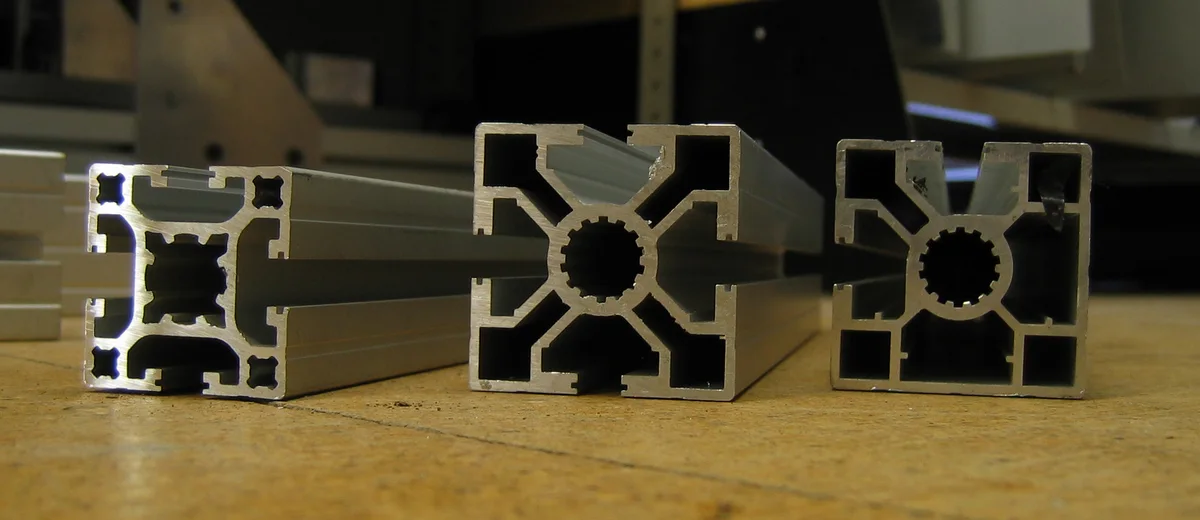
A channel is a profile made of a flat web with a flange along each edge, giving a U or C cross-section. It is one of the most useful shapes in engineering: it carries bending loads efficiently about its strong axis, provides a flat back for bolting to walls and frames, and its open side can hold a panel, a sheet of glass, a cable or a sliding part.
Aluminium channel is almost always extruded. Heated billet is pushed through a steel die shaped like the channel cross-section, then quenched, stretched to straighten it and aged to the required temper. Extrusion produces sharp or radiused corners, thin or thick walls and features such as screw ports and grooves that would be impossible to roll in steel. A smaller share of light-gauge channel is roll-formed from coil, which suits thin, uniform-wall shapes made in very long runs.
Compared with steel channel of the same size, aluminium channel weighs about one third as much, does not rust and needs no painting, and can be cut and drilled with woodworking-grade tools. It is about one third as stiff, so a direct swap of section sizes increases deflection; where stiffness governs, a deeper aluminium channel is used.
Flanges usually equal in height to or taller than the width; square inside corners. Used for edging panels and glass, cable runs and light frames.
Wider web with shorter flanges, often with radiused inside corners and sometimes tapered flanges. The standard structural channel for beams, frames and trailers.
One flange longer than the other. Caps panel edges and trims siding, cladding and soffits.
A channel with an extra leg, used for soffit and fascia trims and to support panels at corners.
Two channels back to back sharing one web. Joins two panels edge to edge in partitions, signs and glazing.
A raised channel with outward flanges; used as furring for cladding, stiffeners on panels and roof battens.
Channel with inturned lips that hold spring nuts, for adjustable support of pipes, cable trays and equipment.
Not true channels but often bought alongside them for flashing, girts and panel connections.
Any of the above with added screw ports, gasket grooves, snap features or uneven walls, extruded from a dedicated die.
U versus C: in everyday use the names overlap. Most suppliers call a channel "U" when it has square inside corners and relatively tall flanges, and "C" when it has a broad web, shorter flanges and radiused corners intended for structural loads. Always confirm with a drawing rather than relying on the name.
| Family | Typical alloy | Shape features | Main uses |
|---|---|---|---|
| Aluminum Association (AA) standard channel | 6061-T6 | Flat (non-tapered) flanges with root fillets; designated by depth and weight per foot | Structural frames, bridges, platforms |
| American Standard channel | 6061-T6 | Tapered inner flanges, similar to steel C channels | Direct replacement of steel channel in North American designs |
| Sharp-corner (architectural) channel | 6063-T5 / T52 / T6 | Uniform wall, square inside and outside corners | Trims, edging, glazing, shopfitting, DIY |
| Metric structural channel | 6060-T6, 6063-T6, 6082-T6 | Uniform or radiused wall in metric sizes to EN 755 | European frames, machinery and construction |
| Custom channel | Any extrudable alloy | Drawing-specific | Systems where one profile replaces several parts |
Structural channels to ASTM B308 (6061-T6 standard structural profiles) come with published section properties in the Aluminum Association's Aluminum Design Manual, which makes design checks straightforward. For sharp-corner and metric channels, section properties can be calculated directly from the geometry, as in the tables below.
| Alloy / temper | Tensile strength min | Yield strength min | Character | Typical channel use |
|---|---|---|---|---|
| 6061-T6 | 260 MPa (38 ksi) | 240 MPa (35 ksi) | High strength, good weldability and machinability | Structural frames, trailers, platforms, machine bases |
| 6063-T5 (≤ 12.5 mm) | 150 MPa (22 ksi) | 110 MPa (16 ksi) | Best surface finish and anodising response | Trim, glazing channel, decorative and light frames |
| 6063-T6 | 205 MPa (30 ksi) | 170 MPa (25 ksi) | Higher strength version of 6063 | Architectural channels carrying moderate loads |
| 6082-T6 (5 – 25 mm wall) | 310 MPa | 260 MPa | European structural alloy, similar role to 6061 | Heavy-duty frames, cranes, transport |
| 6060-T6 | About 190 MPa (wall ≤ 3 mm) | About 150 MPa | Very extrudable, fine finish | Architectural and light structural channel in Europe |
6061 and 6063 minimums from ASTM B221 / B308; 6082 and 6060 from EN 755-2, where values depend on wall thickness. Typical properties are higher: about 310 MPa tensile for 6061-T6 and 186 MPa for 6063-T5.
Other alloys appear for specific needs: 5083 and 5086 extruded channel for marine structures where welded strength and seawater resistance matter; 2024 and 7075 channel for aerospace parts and highly loaded fittings, accepting poorer corrosion resistance and weldability. These are less widely stocked and usually ordered to a specification.
The tables below are calculated for sharp-corner channels with uniform wall thickness, using a density of 2.70 g/cm³ (0.0975 lb/in³). A × B × t means overall depth (web) × flange width × wall thickness. Real extrusions with radiused corners or tapered flanges differ slightly; the mill or supplier drawing gives exact values. Ix is the second moment of area about the strong (horizontal) axis, which controls bending stiffness when the channel stands upright.
| A × B × t (mm) | Area (mm²) | kg per metre | kg per 6 m length | Ix (cm⁴) |
|---|---|---|---|---|
| 20 × 20 × 2 | 112 | 0.302 | 1.81 | 0.72 |
| 25 × 25 × 2 | 142 | 0.383 | 2.30 | 1.48 |
| 30 × 15 × 2 | 112 | 0.302 | 1.81 | 1.47 |
| 30 × 30 × 3 | 252 | 0.680 | 4.08 | 3.64 |
| 40 × 20 × 2 | 152 | 0.410 | 2.46 | 3.67 |
| 40 × 40 × 3 | 342 | 0.923 | 5.54 | 9.21 |
| 50 × 25 × 3 | 282 | 0.761 | 4.57 | 10.4 |
| 50 × 50 × 4 | 568 | 1.53 | 9.20 | 23.7 |
| 60 × 30 × 3 | 342 | 0.923 | 5.54 | 18.6 |
| 80 × 40 × 4 | 608 | 1.64 | 9.85 | 58.7 |
| 100 × 50 × 5 | 950 | 2.56 | 15.39 | 143.3 |
| 120 × 60 × 6 | 1368 | 3.69 | 22.16 | 297.1 |
| 150 × 75 × 6 | 1728 | 4.67 | 27.99 | 598.2 |
| 200 × 75 × 8 | 2672 | 7.21 | 43.29 | 1521.9 |
Inch sizes, common in North America and for 6063 sharp-corner channel:
| A × B × t (in) | Area (in²) | lb per foot | lb per 20 ft | lb per 24 ft |
|---|---|---|---|---|
| 0.5 × 0.5 × 0.0625 | 0.086 | 0.101 | 2.01 | 2.41 |
| 0.75 × 0.75 × 0.125 | 0.250 | 0.292 | 5.85 | 7.02 |
| 1 × 0.5 × 0.125 | 0.219 | 0.256 | 5.12 | 6.14 |
| 1 × 1 × 0.125 | 0.344 | 0.402 | 8.04 | 9.65 |
| 1.5 × 0.75 × 0.125 | 0.344 | 0.402 | 8.04 | 9.65 |
| 1.5 × 1.5 × 0.125 | 0.531 | 0.622 | 12.43 | 14.92 |
| 2 × 1 × 0.125 | 0.469 | 0.548 | 10.97 | 13.16 |
| 2 × 2 × 0.25 | 1.375 | 1.609 | 32.18 | 38.61 |
| 3 × 1.5 × 0.1875 | 1.055 | 1.234 | 24.68 | 29.62 |
| 4 × 2 × 0.25 | 1.875 | 2.194 | 43.88 | 52.65 |
| 5 × 2 × 0.1875 | 1.617 | 1.892 | 37.84 | 45.41 |
| 6 × 3 × 0.25 | 2.875 | 3.364 | 67.28 | 80.73 |
For any other size, use the aluminium channel weight calculator.
| Standard | Covers |
|---|---|
| ASTM B221 / B221M | Extruded bars, rods, wire, profiles and tubes: chemistry and mechanical properties |
| ASTM B308 / B308M | 6061-T6 standard structural profiles, including AA and American Standard channels |
| ANSI H35.2 | Dimensional tolerances for aluminium mill products (used with ASTM orders) |
| EN 755-2 | Mechanical properties of extruded profiles (European orders) |
| EN 755-9 | Tolerances on dimensions and form for profiles in most alloys |
| EN 12020-2 | Tighter tolerances for precision profiles in 6060 and 6063 |
| EN 573-3 | Chemical composition of wrought alloys |
Tolerances cover not only depth, width and wall thickness but also straightness, twist, flatness of the web and the angle between web and flange. For long channels used as tracks or guides, straightness and twist often matter more than cross-section size, so state them on the order. Precision profiles to EN 12020-2 have roughly half the tolerance of EN 755-9 on many dimensions and are the usual choice for 6063 architectural channel.
Carbide-tipped circular saws with a negative hook angle give clean square cuts; mitre saws suit frame corners. Deburr cut ends before anodising or assembly.
6061-T6 machines cleanly with sharp tools and coolant; 6063 is softer and can be gummy, so use high rake angles. CNC machining adds slots, holes and notches to drawing.
MIG and TIG with ER4043 or ER5356 filler. Welding reduces strength next to the weld (6061-T6 heat-affected zone drops towards T4-level), so place welds away from peak stress or design to reduced values.
Channels can be bent on a profile bender. Bending about the weak axis or in O or T4 temper is easiest; tight radii in T6 risk cracking or flange buckling.
Clear, black, bronze or champagne. 6063 gives the most even appearance; specify 15 – 25 µm for outdoor exposure.
Any RAL colour, wood-grain transfer, brushing and polishing. Mill finish is normal for structural channel that will not be seen.
Joining aluminium channel to steel needs isolation (neoprene pads, plastic sleeves, coated or stainless fasteners) to prevent galvanic corrosion in damp conditions.
| Application area | Typical channel | Alloy |
|---|---|---|
| Structural frames, platforms, walkways | AA or American Standard C channel, metric structural channel | 6061-T6, 6082-T6 |
| Truck bodies, trailers and rail vehicles | C channel cross-members, rub rails, floor supports | 6061-T6, 6082-T6 |
| Machinery, conveyors and automation | Guide channels, covers, strut channel | 6061-T6, 6063-T6 |
| Glazing, partitions and shopfitting | U and H channel with gaskets | 6063-T5 / T6 |
| Cladding, roofing and siding | J, F, hat and Z channel | 6063, 6060 |
| Sliding doors, wardrobes and tracks | Top and bottom track channel | 6063-T5 |
| Electrical and LED lighting | Cable channel, LED strip channel with diffuser groove | 6063-T5 |
| Marine | Fender, rub-rail and deck channel | 6061-T6, 5083 |
A typical example: a box trailer floor uses 6061-T6 C channel cross-members at regular centres, bolted or welded to the main rails, with the extruded floor planks fixed on top. A shopfront uses 6063-T5 U channel with glazing gaskets to hold glass in a slim, anodised frame.
U channel usually has square inside corners and flanges as tall as or taller than the web is wide; C channel has a broad web, shorter flanges and often radiused corners for structural use. The terms overlap between suppliers, so specify dimensions or a drawing.
6061-T6. Its minimum yield strength is 240 MPa against 110 MPa for 6063-T5 and 170 MPa for 6063-T6. 6063 is chosen for better surface finish and anodising when loads are modest.
Weight equals cross-section area times 2.70 kg per metre for each 1,000 mm² of area. For example, a 50 × 25 × 3 mm sharp-corner channel weighs about 0.76 kg per metre; a 2 × 1 × 0.125 in channel about 0.55 lb per foot.
Often, with a weight saving of around 50 – 60 % for an equivalent design. Because aluminium is about one third as stiff, the aluminium channel normally needs to be deeper or thicker to keep deflection within limits.
Common mill lengths are around 3 to 6 metres (or 12, 20 and 24 feet in inch sizes), with longer lengths possible from the extrusion line. Cut-to-length supply is available on request.
Yes. A custom channel needs an extrusion die made to your drawing; after that, the profile can be produced in the alloy, temper, length and finish you specify.
Anodising of 15 – 25 µm or a durable architectural powder coating. 6063 gives the most uniform anodised appearance.
Send the shape, size, alloy, length and quantity. Metline will reply with availability, certification and a delivered price worldwide.





