Rolling
7xxx alloys work-harden quickly and are prone to edge cracking, so rolling down to 0.2 mm needs more passes and intermediate anneals than soft alloys.



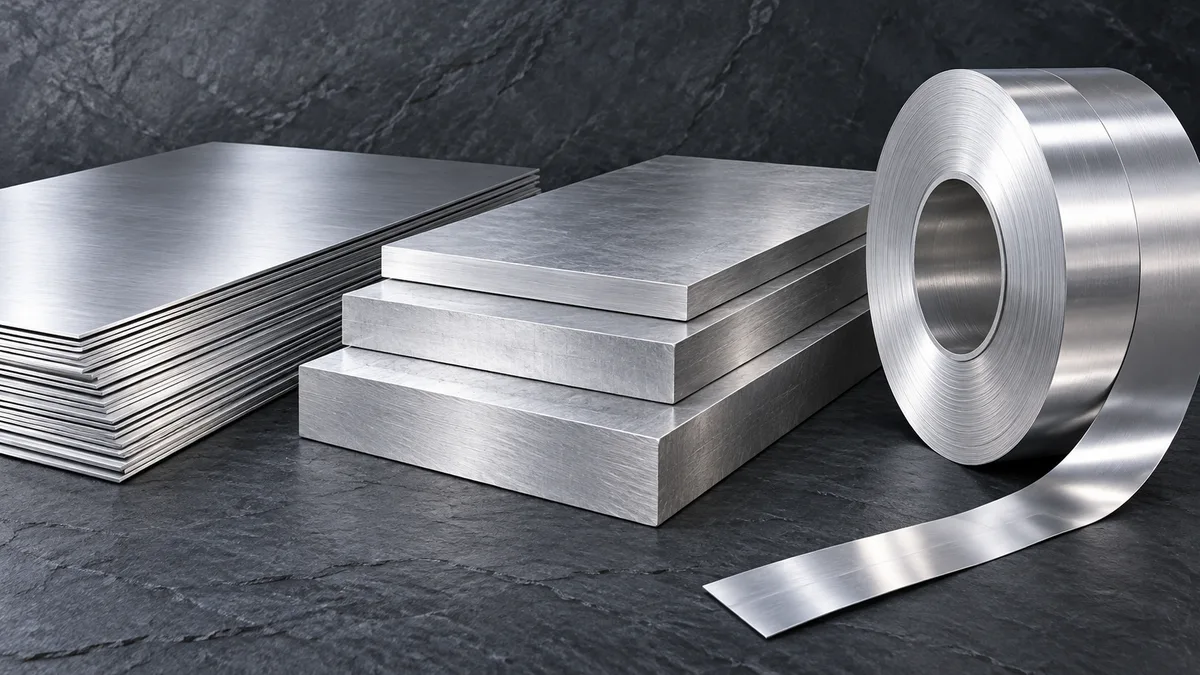
7-series (Al-Zn-Mg and Al-Zn-Mg-Cu) thin sheet in gauges of roughly 0.20 – 0.50 mm gives phones, tablets, laptops and wearables more strength per gram than any 5xxx or 6xxx sheet, so internal plates and frames can be thinner without bending or denting. The difficulty is getting high strength, enough elongation to bend without cracking, and flatness all at once in such thin gauges. This guide explains the alloys, the trade-offs and what to specify; Metline supplies 7-series sheet, strip and plate worldwide with certified test data.
Computers, communication devices and consumer electronics ("3C") keep getting thinner while battery size and screen area grow. The structure left to hold everything together is a set of thin internal plates, brackets and frames, and those parts must resist bending in a pocket, survive drops and keep their shape under heat.
The 7xxx series contains zinc and magnesium (and in the strongest grades, copper) and responds strongly to precipitation hardening. In the T6 temper, 7075 sheet is roughly twice as strong as 6061-T6 and about two and a half times as strong as 5052-H32, at a density of only about 2.8 g/cm³. For a plate that must not yield when a device is flexed, that strength allows a large reduction in thickness, or more stiffness and dent resistance at the same thickness.
Aluminium also has properties that matter specifically in electronics. It is non-magnetic, so it does not disturb compasses, wireless charging coils or magnetic attachments. It conducts heat several times better than stainless steel, helping spread heat from processors and batteries. And it is far lighter than steel for the same stiffness-to-weight design.
| Alloy | System | Character | Typical use in devices |
|---|---|---|---|
| 7075 | Al-Zn-Mg-Cu | Highest common strength; copper reduces anodised appearance and weldability | Internal plates, brackets, structural frames |
| 7021 | Al-Zn-Mg (low Cu) | High strength with better anodising response than 7075 | Cosmetic frames and housings needing high strength |
| 7003 | Al-Zn-Mg (low Cu) | Good extrudability and anodising; moderate-high strength | Frames, extruded and machined parts |
| 7050 / 7055 family | Al-Zn-Mg-Cu-Zr | Very high strength and better toughness in thick sections | Mainly plate and extrusions, rarely thin sheet |
7075 composition limits (Aluminum Association) are zinc 5.1 – 6.1 %, magnesium 2.1 – 2.9 %, copper 1.2 – 2.0 % and chromium 0.18 – 0.28 %, with silicon ≤ 0.40 % and iron ≤ 0.50 %. Lower-copper 7xxx grades trade some strength for brighter, more uniform anodising and better resistance to some forms of corrosion.
Published typical values for 7075-T6 are about 572 MPa tensile and 503 MPa yield with around 11 % elongation, measured on thicker sheet. In very thin gauges, the specified minimums in ASTM B209 are lower and elongation falls: thin 7075-T6 sheet is guaranteed at roughly 510 – 525 MPa tensile and 430 – 460 MPa yield, with minimum elongation in the single figures. Check the thickness band in the standard for your exact gauge.
| Material | Typical yield | Typical elongation | Comment |
|---|---|---|---|
| 5052-H32 sheet | 193 MPa | 12 % | Formable baseline, limited strength |
| 5052-H38 sheet | 255 MPa | 7 % | Harder 5xxx, still non-heat-treatable |
| 6061-T6 sheet | 276 MPa | 12 % | Common heat-treatable sheet |
| 6013-T6 sheet | Higher than 6061-T6 | Similar to 6061-T6 | High-strength 6xxx alternative |
| 7075-T6 sheet | 503 MPa | 11 % (thicker gauges) | Highest strength; elongation drops in thin gauges |
Many 3C specifications ask for a combination such as tensile strength above about 520 MPa, yield above about 460 MPa, elongation above 10 % and a 90° bend without cracking at 0.2 – 0.5 mm. That is achievable only with tight control of composition, rolling and heat treatment, and it sits at or beyond the minimums of the general standards. Treat such figures as a customer specification: write them on the order and require tensile and bend test results for every coil, rather than assuming a standard 7075-T6 certificate covers them.
Higher strength usually means lower ductility and toughness. Over-aged tempers such as T76 or T73 give up some strength for better toughness and resistance to stress-corrosion cracking; they are worth considering where parts are bent or stay under stress.
7xxx alloys work-harden quickly and are prone to edge cracking, so rolling down to 0.2 mm needs more passes and intermediate anneals than soft alloys.
Thin sheet heats quickly, but must be quenched fast and evenly; uneven cooling causes distortion and property variation.
Quench distortion is severe in thin gauges. Tension levelling or stretching is needed, and it must not use up too much of the elongation.
Zirconium or chromium additions and controlled processing keep grains fine, which supports both bendability and cosmetic quality.
Artificial ageing must be uniform along the coil, or strength varies from one end to the other.
Small shifts in zinc, magnesium or copper move strength and elongation noticeably, so tight chemistry and lot control matter.
7075-T6 has limited room-temperature formability. Bend radii of several times the thickness are normally needed, and bends across the rolling direction perform better than bends along it. Where parts need deeper forms, three approaches are common:
Use sharp, tight-clearance tools; 7075 shears cleanly but burrs harden. Fine blanking gives the best edges.
Excellent machinability in T6; clamp thin sheet on vacuum fixtures to avoid vibration and distortion.
Not suitable for fusion welding. Use rivets, screws, clinching, adhesives or laser-welded steel inserts in designs that allow it.
7075 anodises to a slightly yellowish tone; choose 7021 or 7003 where cosmetic anodising matters.
Metline supplies the 7-series sheet, strip and plate; stamping, machining and finishing of the parts are carried out by the device maker or its component suppliers. For machined middle frames, thicker 7xxx plate or extrusion is normally used rather than thin sheet.
Common mistakes include specifying 7075-T6 and then designing bends that only an O-temper part could make, relying on typical values from thick sheet for a 0.25 mm gauge, and choosing 7075 for a cosmetic anodised face.
Thin 7xxx sheet and strip are produced down to about 0.2 mm. Availability of very thin gauges depends on alloy, temper and width, and properties should be confirmed by test for each gauge.
Typical 7075-T6 values are about 572 MPa tensile and 503 MPa yield. Specified minimums for thin gauges in ASTM B209 are lower, roughly 510 – 525 MPa tensile and 430 – 460 MPa yield, and elongation is reduced.
Yes, with an adequate bend radius, which for 7075-T6 is several times the thickness. For tighter bends, form in the O or W temper and age afterwards, and verify with a bend test on the actual gauge.
For the same weight, aluminium parts can be much thicker and stiffer, and 7-series aluminium is non-magnetic and conducts heat better. Stainless steel is denser and is chosen mainly where its higher hardness or modulus outweighs the weight.
7021 is less strong than 7075 but anodises more uniformly and with less colour tint, so it suits cosmetic frames and housings. 7075 is preferred for hidden structural parts that need maximum strength.
Yes. Metline supplies 7075 and other 7xxx sheet, strip and plate worldwide, cut to size, with EN 10204 3.1 certificates and export packing.
Send the alloy, gauge, mechanical and bend requirements and quantity. Metline will confirm feasibility and reply with test documentation and a delivered price.





