


6951 Aluminium Alloy for Brazed Heat Exchangers
6951 is a heat-treatable Al-Mg-Si-Cu alloy designed to survive brazing. Its low silicon keeps the solidus near 616 °C, above the melting range of Al-Si filler alloys, and because it age-hardens it can be strengthened after the brazing cycle. That makes it a standard core alloy for clad brazing sheet and a fin alloy for radiators, condensers, evaporators and charge-air coolers.
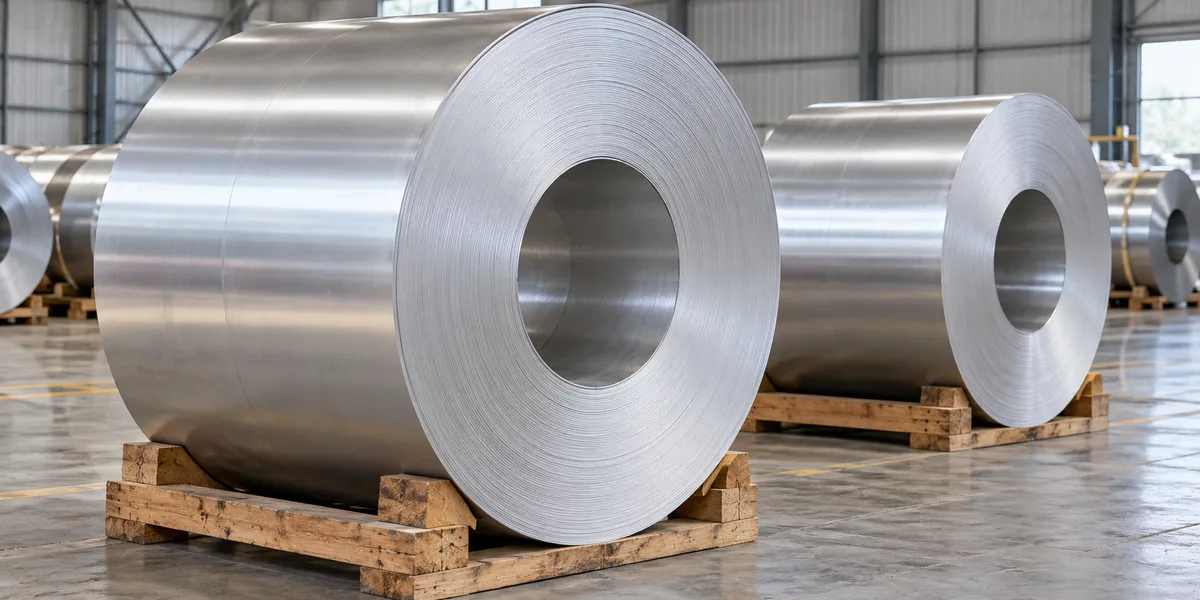
- Alloy
- 6951 (EN AW-6951, A96951)
- Tempers
- O, T4, T6
- Solidus
- About 616 °C
- Main use
- Brazing sheet core and fin stock
Why 6951 exists
Most 6xxx alloys are built for extrusion and structural strength. 6951 is built for one process: furnace brazing, where an assembly is heated to around 590 – 605 °C so that a thin Al-Si cladding melts and flows into every joint.
To come through that cycle the core alloy must not melt or be heavily eroded by the liquid filler. 6951 keeps silicon at 0.20 – 0.50 %, well below 6061 or 6063, which raises its solidus to about 616 °C and leaves a working margin above the filler's melting range. Its copper addition makes the core electrochemically slightly more noble than the clad layer, which helps the filler-side surface corrode sacrificially rather than the core.
The other advantage is heat treatment. The brazing cycle itself acts as a solution treatment, and when the assembly is cooled reasonably quickly and then aged (naturally or in an oven), Mg2Si precipitates and the core gains strength. Non-heat-treatable cores such as 3003 cannot do this, so 6951 is chosen where a thinner, lighter or more pressure-resistant brazed part is wanted.
6951 chemical composition (wt %)
| Element | Minimum | Maximum | Role |
|---|---|---|---|
| Silicon (Si) | 0.20 | 0.50 | Kept low to keep the solidus above brazing temperature |
| Iron (Fe) | — | 0.80 | Impurity |
| Copper (Cu) | 0.15 | 0.40 | Adds strength; raises core corrosion potential relative to the clad |
| Manganese (Mn) | — | 0.10 | Impurity |
| Magnesium (Mg) | 0.40 | 0.80 | Forms Mg2Si for age hardening |
| Zinc (Zn) | — | 0.20 | Impurity |
| Others, each / total | — | 0.05 / 0.15 | |
| Aluminium (Al) | Remainder |
Aluminum Association limits, also registered in EN 573-3 as EN AW-6951 (EN AW-AlMgSi0.3Cu). Magnesium matters for the brazing method: in vacuum brazing Mg helps break up oxide films, but in flux (controlled-atmosphere) brazing, magnesium diffusing to the surface reacts with fluoride flux and can spoil joints, so flux-brazed designs need care with Mg-bearing cores.
Mechanical and physical properties
Typical values for the annealed and fully heat-treated conditions, as published in standard property databases. Brazed and aged parts usually fall between these limits, depending on cooling rate after brazing and the ageing used.
| Property (typical) | 6951-O | 6951-T6 |
|---|---|---|
| Tensile strength | 110 MPa (16 ksi) | 270 MPa (39 ksi) |
| Yield strength (0.2 %) | 40 MPa (6 ksi) | 230 MPa (33 ksi) |
| Elongation | 30 % | 13 % |
| Shear strength | 75 MPa | 180 MPa |
| Brinell hardness | 28 HB | 82 HB |
| Thermal conductivity | ≈ 213 W/m·K | ≈ 197 W/m·K |
Physical constants
- Density
- 2.70 g/cm³
- Melting range
- About 616 – 654 °C (solidus – liquidus)
- Modulus of elasticity
- About 69 GPa
- Coefficient of thermal expansion
- About 23.4 µm/m·°C
- Specific heat
- About 0.89 J/g·°C
These are typical, not specified minimum, values. For a brazed part, ask for post-braze simulated properties on the certificate if your design depends on them.
6951 brazing sheet configurations
Brazing sheet is a roll-bonded composite: a core alloy with a thin Al-Si filler layer on one or both sides, sometimes with an additional water-side liner. Clad thickness is usually a small percentage of total thickness per side.
| Layout | Typical layers | Use |
|---|---|---|
| One-side clad | 4343 or 4045 / 6951 | Tubes and plates brazed on one face only |
| Two-side clad | 4343 or 4045 / 6951 / 4343 or 4045 | Plates and fins joined on both faces |
| Vacuum-braze sheet | 4004 or 4104 / 6951 | Vacuum brazing, where Mg in the filler helps break up oxide |
| With water-side liner | 4343 / 6951 / 7072 | Coolant-side sacrificial 7072 layer protects the core from pitting |
| Multi-layer | Filler / interlayer / 6951 / liner | Designs needing extra erosion or corrosion protection |
Filler choice sets the brazing window: 4343 (about 7 – 8 % Si) and 4045 (about 9 – 11 % Si) are used in flux brazing, 4004 and 4104 in vacuum brazing. 4047 (about 12 % Si) has the lowest melting range and is often used for wire or paste rather than cladding. Compare our 5-layer 6951 brazing sheet page for a detailed multi-layer example.
6951 fin stock and strip
Typical fin and strip supply
- Thickness
- About 0.07 – 0.3 mm for fins; thicker strip for plates and headers
- Width
- Slit to customer width, commonly 15 – 250 mm for fin lines
- Temper
- O or H-tempers for fin forming; final strength develops after brazing and ageing
- Coils
- Wound on cores to suit fin-mill pay-offs; coil weight and ID to customer specification
- Surface
- Clean and degreased; bare or clad
Heat-treatable fins resist crushing and fin-collapse better than 3003 fins of the same gauge, so they allow thinner fins and lighter cores. The trade-off is that Mg in the fin can interfere with flux brazing, so 6951 fins are most common in vacuum-brazed exchangers or with flux systems adapted to Mg-bearing alloys.
Bar, plate and machined parts
6951 is also supplied as bare sheet, plate and bar for headers, side plates, manifolds, fittings and machined blocks that are brazed into an exchanger. Using the same alloy family as the core simplifies the brazing cycle and the post-braze heat treatment. For bar and rod, see 6951 bar; for clad core material in sheet, coil and fin, see 6951 brazing core.
Brazing and post-braze ageing tips
- CleanDegrease formed parts thoroughly; residual oil causes porosity and poor fillets.
- Assemble and fixtureKeep clearances small and consistent so the filler can flow by capillary action.
- BrazeHeat to the filler's brazing temperature (typically around 590 – 605 °C) for the shortest time that gives full fillets; long times increase core erosion.
- CoolFaster cooling after brazing retains more Mg and Si in solution and gives a stronger aged part.
- AgeNatural ageing at room temperature gives a modest rise; an oven ageing step gives the highest strength. Validate the cycle on sample parts.
Common mistakes include using a 6951 core with a high-Mg design in a flux brazing line without adapting the flux, brazing too hot or too long (core erosion), and assuming as-brazed strength equals T6 strength without ageing.
6951 compared with 3003 and 6063 cores
| Aspect | 3003 core | 6951 core | 6063 |
|---|---|---|---|
| Heat-treatable | No | Yes | Yes |
| Solidus | About 640 °C | About 616 °C | About 615 °C |
| Post-braze strength | Low (annealed by brazing) | Higher after ageing | Not normally used as clad core |
| Flux brazing | Very easy | Needs Mg control | — |
| Typical use | General radiator and HVAC cores | Thin, strong vacuum-brazed cores and fins | Extruded tubes and profiles |
References and standards
- The Aluminum Association – International Alloy Designations and Chemical Composition Limits
- EN 573-3 – Chemical composition and form of wrought products
- ASM International – Alloy Digest Al-195: Aluminum 6951 brazing sheet and plate
- ASM Handbook Vol. 6 – Brazing of aluminium alloys
6951 aluminium (aluminum): FAQ
What is 6951 aluminium used for?
Mainly as the core of clad brazing sheet and as fin stock in brazed heat exchangers such as radiators, condensers, evaporators and oil coolers, plus bar and plate for brazed fittings.
Why is 6951 used instead of 6061 for brazing?
6061 has more silicon and a lower solidus, close to brazing temperature, so it risks melting. 6951's low silicon keeps its solidus about 616 °C, giving a safe margin.
Can 6951 be heat-treated after brazing?
Yes. The brazing cycle acts as a solution treatment; after reasonably fast cooling, natural or artificial ageing raises strength toward T6 levels.
Which filler alloys are clad on 6951?
4343 or 4045 for flux brazing and 4004 or 4104 for vacuum brazing, sometimes with a 7072 water-side liner.
What is the EN designation of 6951?
EN AW-6951, chemical symbol EN AW-AlMgSi0.3Cu, under EN 573-3.
Building brazed heat exchangers?
Send your core and clad alloys, gauges and widths. Metline will quote 6951 sheet, fin stock or bar with certificates, worldwide.





