Welding wire (ER4047)
MIG spools and TIG rods, typically 0.8 – 2.4 mm wire and 1.6 – 5 mm rods, to AWS A5.10.



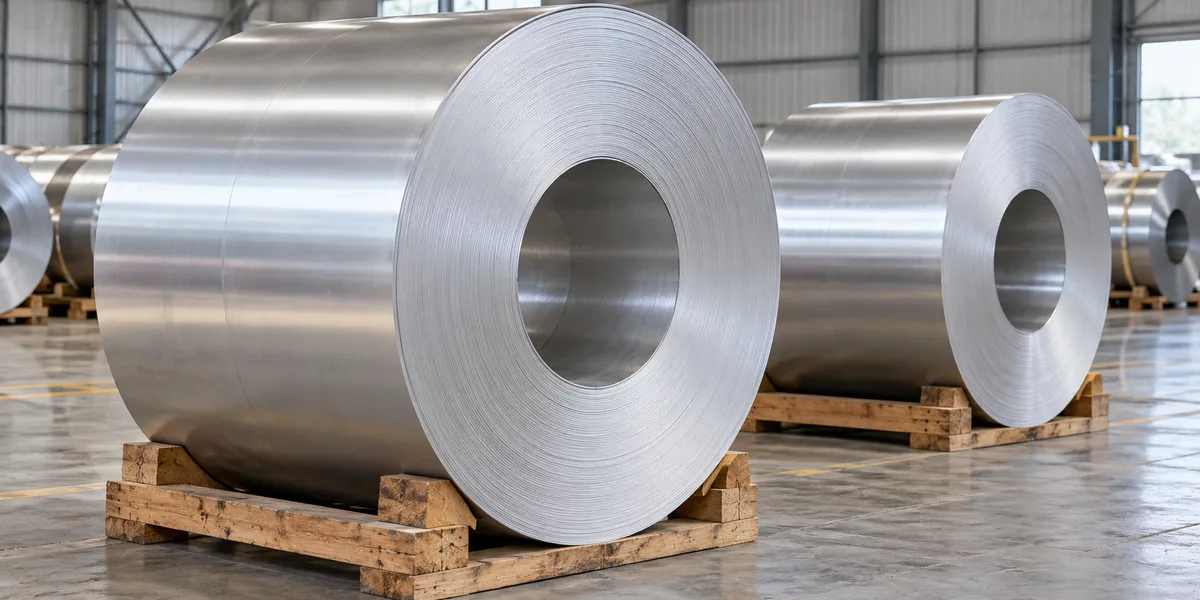
4047 is an aluminium alloy with 11 – 13 % silicon, close to the aluminium-silicon eutectic, so it melts over a narrow range of about 577 – 582 °C and flows very freely. That makes it a standard filler for brazing aluminium (BAlSi-4) and for welding where crack resistance and leak-tight joints matter (ER4047). It is supplied as wire, rod, sheet, coil, clad layers and preforms.
Pure aluminium melts at 660 °C. Adding silicon lowers the melting point until, at about 12.6 % Si, the alloy melts and freezes at a single temperature of about 577 °C: the eutectic. 4047 is formulated just below that point.
Three properties follow. First, it melts well below common base alloys such as 3003 (solidus about 643 °C) and 6063 (about 615 °C), so it can braze them without melting the parts. Second, the narrow freezing range means it solidifies almost at once, with very little shrinkage and almost no tendency to hot cracking. Third, the molten metal is extremely fluid and is drawn into tight gaps by capillary action, which is exactly what a brazed joint needs.
The trade-off is strength and ductility. 4047 is a filler and cladding alloy, not a structural material: as-solidified it is relatively brittle and of modest strength, and it is not heat-treatable. Its value lies in the joints it makes.
| Element | Limit |
|---|---|
| Silicon (Si) | 11.0 – 13.0 |
| Iron (Fe) | ≤ 0.8 |
| Copper (Cu) | ≤ 0.30 |
| Manganese (Mn) | ≤ 0.15 |
| Magnesium (Mg) | ≤ 0.10 |
| Zinc (Zn) | ≤ 0.20 |
| Beryllium (Be), welding filler | ≤ 0.0003 |
| Others each / total | 0.05 / 0.15 |
| Aluminium | Remainder |
Limits follow the Aluminum Association registration and AWS A5.10 (ER4047) / A5.8 (BAlSi-4). ISO 18273 names the welding filler S Al 4047A (AlSi12(A)). Low magnesium is important for flux brazing: magnesium reacts with fluoride fluxes and spoils wetting.
| Al-Si filler | Silicon | Approx. liquidus | Typical brazing range | Typical use |
|---|---|---|---|---|
| 4343 (BAlSi-2) | 6.8 – 8.2 % | about 613 °C | about 599 – 621 °C | Clad layer on brazing sheet |
| 4045 (BAlSi-5) | 9.0 – 11.0 % | about 591 °C | about 588 – 604 °C | Clad layer, furnace (CAB) brazing |
| 4047 (BAlSi-4) | 11.0 – 13.0 % | about 582 °C | about 582 – 604 °C | Wire, rings, paste, clad layer; torch and furnace |
| 4145 (BAlSi-3) | 9.3 – 10.7 % + 3.3 – 4.7 % Cu | about 585 °C | about 571 – 604 °C | Torch brazing, some casting repair |
Temperature ranges are approximate values from AWS A5.8 and producer data. The base metal solidus must stay comfortably above the brazing temperature; 6061 (solidus about 582 °C) is difficult to braze with 4047 for this reason.
MIG spools and TIG rods, typically 0.8 – 2.4 mm wire and 1.6 – 5 mm rods, to AWS A5.10.
Bare or flux-cored rod for torch brazing; brazing wire to AMS 4185 for aerospace work.
Wire formed into rings or stamped shapes placed at each joint for automated furnace or induction brazing.
Thin bare 4047 sheet and coil, often about 0.03 – 2 mm, for shims, foils and stamped preforms.
Roll-bonded onto a 3003 or 6951 core to make brazing sheet; the 4047 layer melts and forms the joint.
Discs for laser-sealed electronics lids and composite structures.
As a MIG or TIG filler, 4047 gives a very fluid pool, a smooth bead and the lowest hot-cracking tendency of the common fillers. It is chosen for leak-tight joints in tanks, heat exchangers and refrigeration parts, for silicon-rich castings, and sometimes as a replacement for 4043 where cracking persists. Fillet shear strength is slightly higher than with 4043.
| Factor | 4047 | 4043 | 4145 |
|---|---|---|---|
| Silicon | 11 – 13 % | 4.5 – 6 % | 9.3 – 10.7 % (+ Cu) |
| Melting range | about 577 – 582 °C | about 573 – 632 °C | about 521 – 585 °C |
| Fluidity | Excellent | Very good | Very good |
| Use as brazing filler | Yes | No | Yes |
| Crack resistance in welding | Highest | Very high | High |
| Colour after anodising | Dark grey | Grey | Dark |
| Standards | AWS A5.10 ER4047, A5.8 BAlSi-4 | AWS A5.10 ER4043 | AWS A5.10 ER4145, A5.8 BAlSi-3 |
Choose 4047 for brazing and for welds that must be leak-tight or crack-free; 4043 for general welding of 6xxx and 3xxx alloys at lower cost; 4145 mainly for torch brazing and repairs where its lower solidus helps.
Mainly as a brazing filler (BAlSi-4) and welding filler (ER4047), and as a clad layer on brazing sheet, for heat exchangers, HVAC, electronics and leak-tight welded assemblies.
It melts between about 577 °C and 582 °C. Brazing is typically done at about 582 – 604 °C.
Yes, AlSi12 is the chemical-symbol name used in EN and ISO standards for this composition.
With difficulty: 6061 starts to melt near 582 °C, so the margin is very small. 3003, 6063 and 6951 cores are easier to braze.
As a filler, 4047 gives slightly higher fillet shear strength and better crack resistance, but neither is a high-strength filler; 5356 is stronger where it can be used.
No. It is supplied in O, H or F tempers and strength comes only from cold work.
Send the form, size, temper and quantity. We will confirm the standard, certificate and delivery.





