5754-O
Fully annealed. The softest condition, used for heads, dished ends and baffles with deep flanges or tight knuckle radii. Specified properties are the same band as H111.



5754 is a medium-strength aluminium-magnesium alloy (about 3 % Mg) that tank builders use for shells, heads and baffles carrying fuel, lubricating oil, water and food liquids at ambient temperature. In the soft O and H111 tempers it rolls, presses and welds easily, resists corrosion without coating and is one of the most widely available plate grades in Europe and Asia. This guide covers its properties, where it fits against 5083, 5182 and 5454, and how to order it.
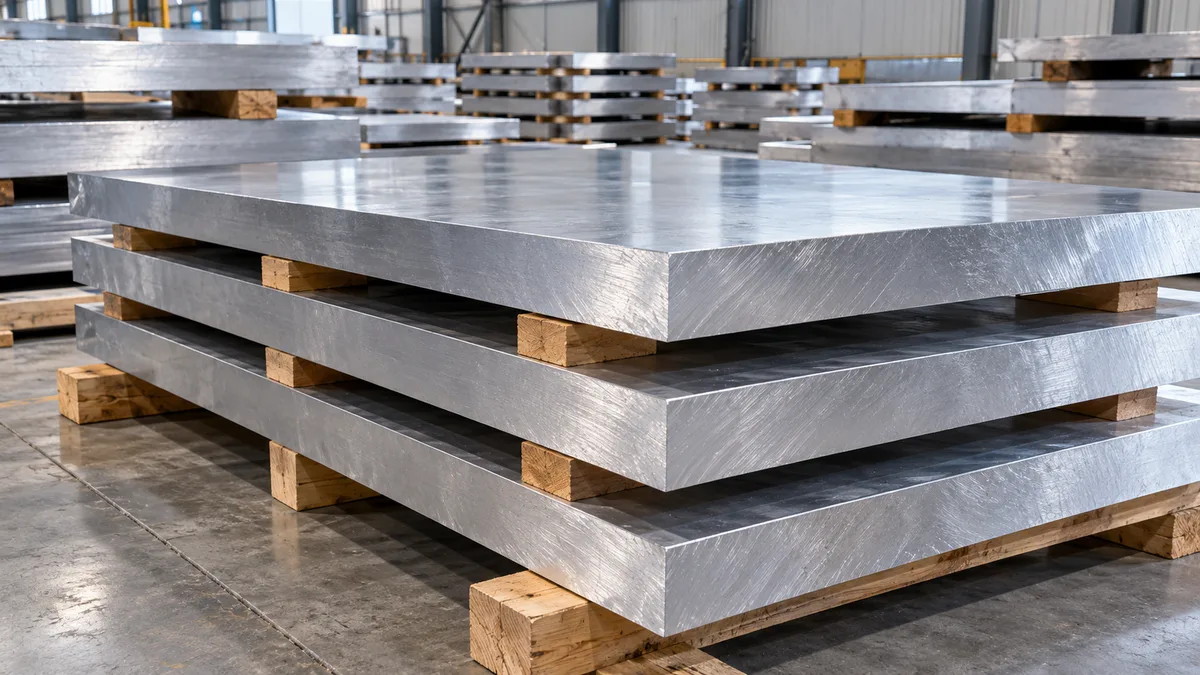
5754 belongs to the non-heat-treatable 5xxx family. Its strength comes from magnesium held in solid solution, topped up by a little manganese and chromium, so welding does not destroy a heat-treated condition the way it does in 6xxx alloys. A welded 5754-H111 tank keeps nearly the full strength of the parent plate.
Compared with the 4.5 % magnesium grades 5083 and 5182, 5754 is about a third weaker, so a 5754 shell may need to be slightly thicker for the same capacity and pressure. In return it is very forgiving to fabricate: it spins and presses into heads and dished ends without cracking, it is less prone to hot cracking during welding, and it is stocked by almost every European plate service centre, which helps builders who need fast replacement plate.
Its magnesium content (2.6 – 3.6 %) sits around the 3 % threshold above which Al-Mg alloys can sensitise during long service above 65 °C. For ambient fuel, oil and food cargo this is irrelevant; for asphalt or heated chemicals the lower-magnesium 5454 plate is the safer choice.
Values follow EN 573-3 (EN AW-5754, AlMg3), which matches the Aluminum Association registration used by ASTM B209.
| Element | Limit |
|---|---|
| Magnesium (Mg) | 2.6 – 3.6 |
| Manganese (Mn) | ≤ 0.50 |
| Chromium (Cr) | ≤ 0.30 |
| Mn + Cr | 0.10 – 0.60 |
| Silicon (Si) | ≤ 0.40 |
| Iron (Fe) | ≤ 0.40 |
| Copper (Cu) | ≤ 0.10 |
| Zinc (Zn) | ≤ 0.20 |
| Titanium (Ti) | ≤ 0.15 |
| Others each / total | ≤ 0.05 / 0.15 |
| Aluminium (Al) | Remainder |
| Condition | Tensile strength Rm | Yield strength Rp0.2 | Elongation |
|---|---|---|---|
| O / H111, specified (EN 485-2, 3 – 12.5 mm) | 190 – 240 MPa | ≥ 80 MPa | about 17 – 18 % min |
| O / H111, typical | 215 MPa | 100 MPa | 22 – 25 % |
| H22 / H32, specified (for comparison) | 220 – 270 MPa | ≥ 130 MPa | lower |
Specified limits depend on the thickness band; the certificate shows the actual results. Typical values from published EN and ASM data.
Fully annealed. The softest condition, used for heads, dished ends and baffles with deep flanges or tight knuckle radii. Specified properties are the same band as H111.
Annealed and then slightly strain-hardened by levelling or stretching. Practically the same strength and formability as O, but flatter, which suits long shell plates. It is the condition most tanker shell plate is ordered in.
If the design wants a thinner, lighter shell, move to 5182-H111 or 5083-H111 rather than a harder 5754 temper: their higher strength survives welding, whereas H32 strength is lost in the heat-affected zone.
| Part | Temper | Typical thickness | Comment |
|---|---|---|---|
| Shell | H111 | 4 – 8 mm | Rolled to an oval or circular barrel; wide plate means fewer seams |
| Heads | O | Shell thickness or more | Spun or pressed; soft temper avoids knuckle cracks |
| Baffles and bulkheads | O / H111 | 4 – 6 mm | Flanged and pierced for manholes |
| Walkways and covers | 5754 tread plate or 5052 tread | 2 – 4 mm | Anti-slip top surfaces |
| Cabinets and lockers | H111 / H22 sheet | 1.5 – 3 mm | Hose boxes and equipment lockers |
Typical cargoes for a 5754 tank include diesel, petrol and jet fuel, lubricating oil, water, milk, edible oils and many non-aggressive liquids. Food-contact tanks are usually internally polished; check the food-contact requirements of your market, as aluminium suitability depends on the product's acidity and salt content.
| Grade | Min. yield (O/H111) | Best for | Limitation |
|---|---|---|---|
| 5754 | 80 MPa | Fuel, oil, food liquids; easy fabrication | Thicker shell than 5083/5182 |
| 5182 | 110 MPa | Lightweight ADR fuel tankers | Not for sustained service above 65 °C |
| 5083 | 125 MPa | Fuel, cryogenic and marine duty | Not for sustained service above 65 °C |
| 5454 | 85 MPa | Asphalt, bitumen, heated chemicals | Lower strength than 5083/5182 |
When you enquire, give temper, thickness, width and length per item, the order standard and quantity. Plate is supplied on EXW, FOB, CIF or DAP terms in seaworthy crates.
Yes. It resists fuels and oils, welds without losing strength and forms easily into heads and baffles. Its main drawback is lower strength than 5083 or 5182, so shells can be slightly heavier.
Both are annealed and have the same specified strength band. H111 has a small amount of strain hardening from levelling, which makes it flatter; it is usually used for shells, while O is used for deep-formed heads.
Not for long periods above about 65 °C. With up to 3.6 % magnesium, 5754 can sensitise in sustained hot service. Use 5454 for asphalt, bitumen and heated chemicals.
ER5356 is the usual filler; ER5183 gives higher weld strength. Both are 5 % magnesium fillers suited to ambient-temperature tanks.
5754 is registered with the Aluminum Association and can be supplied to ASTM B209, but it is far more common in Europe. North American builders often use 5052 or 5454 for similar duties.
Send your plate list, tempers and order standard. Metline will reply with availability, certification and delivered pricing.





