Bright anodising
Chemical or electrochemical brightening followed by thin clear anodising gives a high-gloss metallic surface. 5252's low iron content keeps the film transparent.



5252 is a high-purity version of the 2.5 % magnesium alloy family, with iron and silicon held to a tenth of the usual levels, so it anodises and brightens to a clear, glossy, even finish. That makes 5252 sheet and strip a strong choice for visible housings and trims on computers, communication devices and consumer electronics (3C). Metline supplies 5252 in O, H32, H34 and harder tempers, 0.4 – 8 mm, as sheet, strip or coil, worldwide.
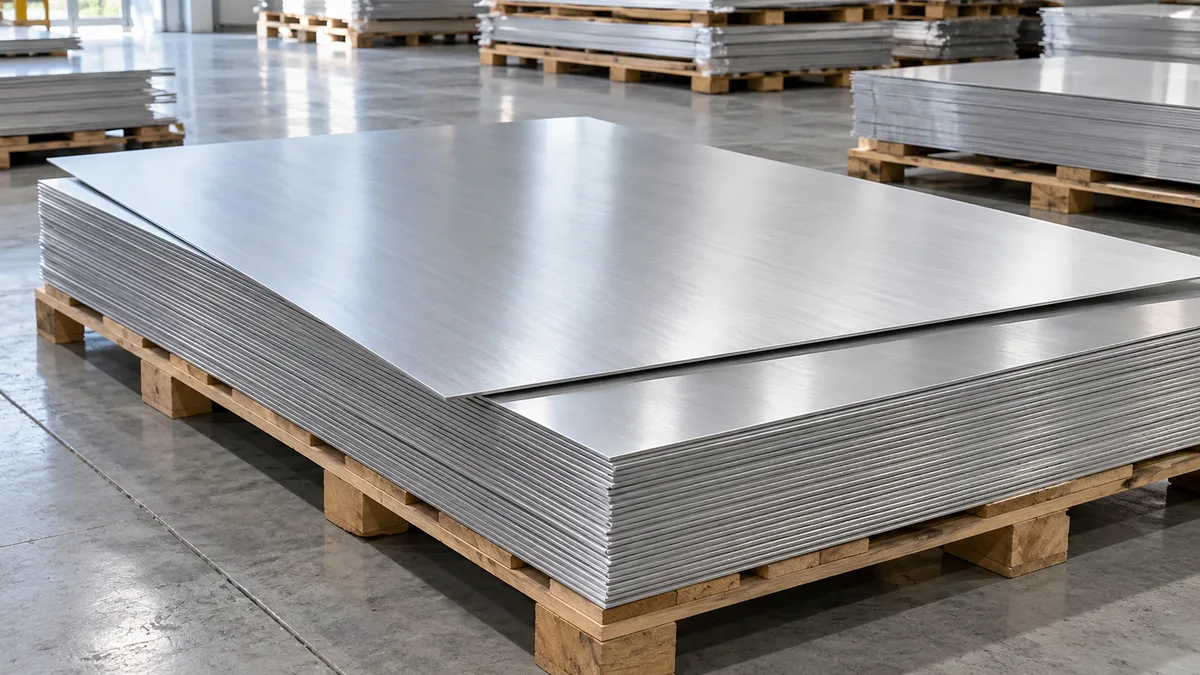
The look of an anodised housing depends on what is inside the metal. Iron and silicon form small intermetallic particles that scatter light and cloud the oxide film, which is why ordinary 5052 anodises to a slightly grey, matt tone. 5252 limits iron to 0.10 % and silicon to 0.08 %, so the oxide stays clear and the surface beneath can be polished or chemically brightened to a near-mirror gloss.
Mechanically, 5252 behaves like 5052: same magnesium range, similar strength in matching tempers, good formability and weldability, and very good corrosion resistance. It was first developed for bright automotive trim, and the same qualities now serve smartphone and tablet accessories, laptop and all-in-one PC panels, camera and gimbal bodies, routers and wearable devices.
The trade-off is price and availability: high-purity primary metal costs more, and fewer mills roll 5252 in thin gauges. Where appearance is less critical, 5052 or 5005 is often enough.
| Element | 5252 | 5052 for comparison |
|---|---|---|
| Magnesium (Mg) | 2.2 – 2.8 | 2.2 – 2.8 |
| Silicon (Si) | 0.08 max | 0.25 max |
| Iron (Fe) | 0.10 max | 0.40 max |
| Copper (Cu) | 0.10 max | 0.10 max |
| Manganese (Mn) | 0.10 max | 0.10 max |
| Chromium (Cr) | — | 0.15 – 0.35 |
| Zinc (Zn) | 0.05 max | 0.10 max |
| Vanadium (V) | 0.05 max | — |
| Others, each / total | 0.03 / 0.10 | 0.05 / 0.15 |
| Aluminium (Al) | Remainder | Remainder |
5252 is mostly ordered in O, H32 and H34 for formed housings and in H2x tempers for flat or lightly formed trim. Values below are typical; specified limits depend on the standard and thickness and are reported on the mill certificate.
| Temper | Tensile strength | Yield strength | Elongation | Best for |
|---|---|---|---|---|
| H24 (ASTM B209 range) | 205 – 260 MPa | — | — | Trim, light forming |
| H25 | about 235 MPa | about 170 MPa | about 11 % | Bright trim |
| H28 | about 285 MPa | about 240 MPa | about 5 % | Flat stiff parts |
H2x values are published typical data for 5252. In O, H32 and H34 the alloy behaves much like 5052 in the same tempers, because the two share the same magnesium range; for those tempers, take the actual tensile, yield and elongation from the mill test certificate or the limits in the order standard.
Chemical or electrochemical brightening followed by thin clear anodising gives a high-gloss metallic surface. 5252's low iron content keeps the film transparent.
Dyes take evenly, so colour matching between parts and batches is easier than with 5052.
Fine bead blasting followed by anodising gives the satin finish common on laptops and tablets.
Chamfers machined after anodising reveal bright metal; low-inclusion 5252 gives a cleaner cut.
Linear brushed textures before anodising for panels and trims.
Conversion coating and paint or pad printing for logos and markings.
Order sheet with protective film and specify the surface grade (for example, free of roll marks and streaks) when the face will be anodised without heavy polishing.
Precision strip for stamping can be supplied with thickness tolerances tighter than the general standards. Typical tight-tolerance values are:
| Thickness (mm) | Typical tolerance (mm) |
|---|---|
| 0.25 – 0.50 | ±0.01 |
| > 0.50 – 1.00 | ±0.02 |
| > 1.00 – 2.00 | ±0.04 |
| > 2.00 – 4.00 | ±0.06 |
| > 4.00 – 6.00 | ±0.10 |
For thermal parts such as heat sinks, 1xxx or 6063 alloys conduct heat better; 5252 is chosen where appearance leads.
| Alloy | Anodised appearance | Strength | Formability | Typical role |
|---|---|---|---|---|
| 5252 | Clear, bright, uniform | Medium | Very good | Premium bright housings and trim |
| 5052 | Slightly grey | Medium | Very good | General housings |
| 5005 | Good, uniform | Low–medium | Excellent | Architectural-look panels |
| 6063 | Very good | Medium (T6) | Fair in T6 | Extruded frames |
| 6013 / 7xxx | Good | High | Limited | Thin, strong unibody parts |
They share the same magnesium range and similar strength, but 5252 keeps iron at 0.10 % and silicon at 0.08 % maximum, against 0.40 % and 0.25 % in 5052. That gives 5252 a clearer, brighter anodised finish.
H32 suits most bent and stamped housings. Choose O for deep drawing and H34 for stiffer, flatter panels.
Yes, by TIG, MIG or laser welding. For anodised parts, welds will look different from the sheet, so housings are usually joined mechanically or by adhesive.
It conducts heat reasonably well (about 138 W/m·K), but 1xxx and 6063 alloys are better conductors. Use 5252 where appearance matters most.
Most housings and panels use 0.5 – 2 mm, with thicker sheet for stands, frames and machined parts.
Send the temper, thickness, width, surface requirement and quantity. We will confirm availability, samples and a delivered price.





