Brightening
Chemical brightening (phosphoric-nitric acid baths) or electrobrightening dissolves surface peaks to produce a mirror-like finish. Low iron and silicon keep the surface free of intermetallic pits.



5252 is a high-purity aluminium-magnesium alloy with 2.2 – 2.8 % magnesium and very low iron and silicon, developed for parts that are chemically brightened and clear-anodised to a mirror-like finish. As H112 extrusions it serves bright vehicle trim, grille surrounds, window mouldings and badges that need more strength than the 1 % Mg trim alloys. Metline supplies 5252 profiles to drawing, worldwide.
5252 has roughly the magnesium content of 5052 but is made from a much purer aluminium base: iron is limited to 0.10 % and silicon to 0.08 %, and there is no chromium addition. Those impurity limits matter because iron- and silicon-rich particles scatter light and leave tiny pits after brightening. Removing them lets the surface reach a deep, specular reflectivity after chemical or electrolytic brightening and clear anodising.
The alloy belongs to a small group of "bright trim" grades (5252, 5457, 5657 and the 6xxx alloy 6463) that were developed for automotive brightwork. Among them, 5252 is the strong one: its 2.5 % magnesium gives noticeably more strength and dent resistance than 5457 or 5657, at the cost of slightly lower brilliance. It is non-heat-treatable, so strength comes from magnesium in solid solution and, in rolled tempers, from cold work.
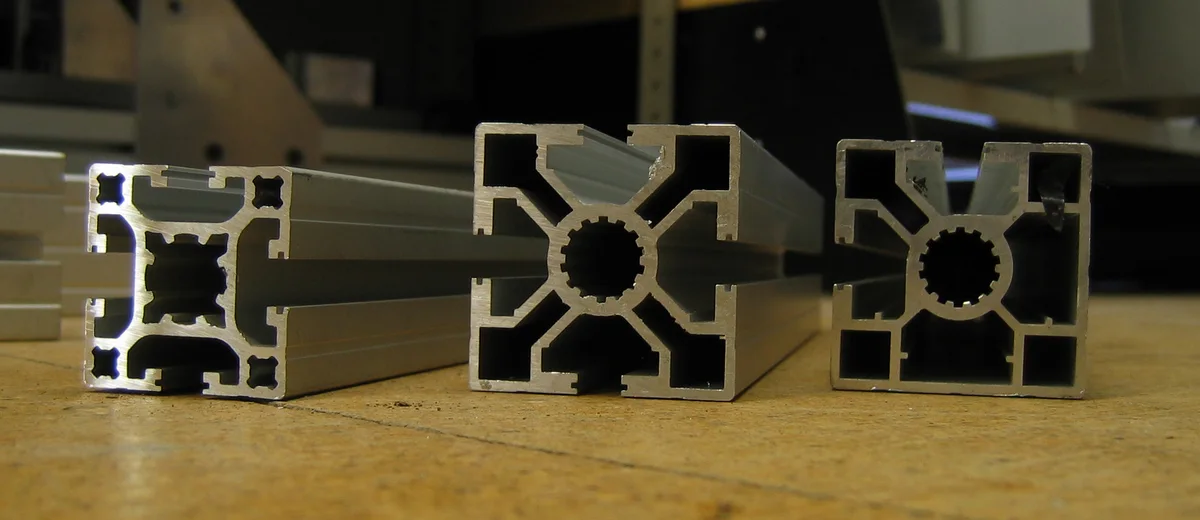
Most 5252 is rolled into sheet for stamped trim, but extrusions are used where the trim has a profiled cross-section: mouldings with a clip channel, grille bars, window surrounds and roof-rail covers. In H112 the profile is used as extruded, then cut, bent and finished.
Limits follow the Aluminum Association registration for 5252. The certificate for each lot reports the measured analysis, which is especially important for brightening quality.
| Element | Minimum | Maximum | Why it matters |
|---|---|---|---|
| Silicon (Si) | — | 0.08 | Very low to avoid dull, pitted bright surfaces |
| Iron (Fe) | — | 0.10 | Very low; iron particles cause haze after brightening |
| Copper (Cu) | — | 0.10 | |
| Manganese (Mn) | — | 0.10 | Kept low; manganese darkens anodic films |
| Magnesium (Mg) | 2.2 | 2.8 | Main strengthening element |
| Zinc (Zn) | — | 0.05 | |
| Vanadium (V) | — | 0.05 | |
| Others, each / total | — | 0.03 / 0.10 | Tighter than standard 5xxx alloys |
| Aluminium (Al) | Remainder | About 96.6 – 97.8 % |
Compared with 5052, 5252 has no chromium and far lower iron and silicon. A 5052 profile will be stronger but will not brighten to the same finish.
H112 properties of 5252 extrusions are close to the annealed condition and are confirmed by tensile testing of each lot; minimums are agreed on the drawing because general extrusion standards do not list 5252 H112 values. Typical figures:
| Condition | Tensile strength (typical) | Yield strength 0.2 % (typical) | Elongation (typical) |
|---|---|---|---|
| H112 extrusion | about 170 – 190 MPa | about 70 – 90 MPa | about 20 % or more |
| H25 sheet (for comparison) | about 240 MPa | about 170 MPa | about 11 % |
| H28 sheet (for comparison) | about 285 MPa | about 240 MPa | about 5 % |
Typical values are indicative only; design to the tested minimums stated on the certificate.
Bright-trim profiles are always drawing-specific. Mark the visible faces on the drawing so that die design and handling protect them.
Typical shapes are clip-channel mouldings, grille bars, U and J trims, small round and rectangular tube for rails, and decorative angles. Sections are kept fairly thin and uniform so that the extrusion surface is consistent before brightening.
Chemical brightening (phosphoric-nitric acid baths) or electrobrightening dissolves surface peaks to produce a mirror-like finish. Low iron and silicon keep the surface free of intermetallic pits.
A thin, clear anodic film, typically about 3 – 10 µm for bright trim, protects the brightened surface while preserving reflectivity. Thicker films improve durability but reduce brilliance.
Hot-water or nickel-acetate sealing closes the pores of the film for weather and car-wash resistance.
Bright trim stock is packed with interleaving and protected from scratches, fingerprints and moisture; one handling mark can scrap a visible part.
Surface quality starts at extrusion. Die lines, pick-up and grain-size variation all become more visible after brightening, so bright-trim orders should include an agreed limit sample and inspection under defined lighting.
Unless the drawing states tighter values, profile dimensions follow the general tolerance tables of the order standard. Automotive programmes often add their own limits on critical features such as mounting faces, wall thickness at crush zones and twist over the part length.
5252 is a trim alloy. Body panels, chassis and suspension parts use structural 5xxx or 6xxx alloys; claims in some product lists that 5252 can be heat-treated or used for chassis members are not correct.
| Property | 5657 | 5457 | 5252 | 6463 |
|---|---|---|---|---|
| Magnesium (%) | 0.6 – 1.0 | 0.8 – 1.2 | 2.2 – 2.8 | 0.45 – 0.9 (with Si) |
| Relative strength | Lowest | Low | Highest of the 5xxx trim alloys | High after T5/T6 |
| Brightness after finishing | Highest | Very high | High | Very high |
| Heat-treatable | No | No | No | Yes |
| Typical form | Sheet | Sheet, extrusion | Sheet, extrusion | Extrusion |
Choose 5252 when trim must resist denting or carry clips under load; 5457 or 5657 when maximum brilliance matters most; and 6463 when a heat-treatable bright extrusion is preferred.
Bright vehicle trim: mouldings, grille bars, badges and roof-rail covers that are chemically brightened and clear-anodised.
Similar magnesium, but 5252 has no chromium and much lower iron and silicon, so it brightens to a mirror finish. 5052 is stronger and cheaper but cannot match the finish.
No. It is non-heat-treatable; strength comes from magnesium and cold work.
Yes. With about 2.5 % magnesium against about 1 %, 5252 is noticeably stronger and more dent-resistant, with slightly lower brilliance.
Usually a thin clear film of about 3 – 10 µm, sealed, to keep reflectivity high; exterior parts may use thicker films as agreed with the OEM.
Yes. Metline ships 5252 profiles worldwide from Mumbai with 3.1 certificates and protective export packing.
Send the drawing, finish and volume. We will reply with feasibility, certification and a delivered price.





