Choose 5052-H32 when
the plate will be bent, exposed to sea air or welded into a tank. It forms with tight radii that would crack 6061-T6, and it is usually the lowest-cost strong grade at this thickness.



A 1/4 inch aluminium plate is 0.250 in or 6.35 mm thick and weighs about 3.5 lb per square foot (17.1 kg/m²) in 6061, so a 4 × 8 ft sheet comes to roughly 112 lb or 51 kg. It is the thinnest gauge that ASTM classes as plate rather than sheet, and it is ordered most often in 5052-H32, 6061-T651 and 7075-T651. This guide gives the weights, grade choices, standards and buying checks in one place.
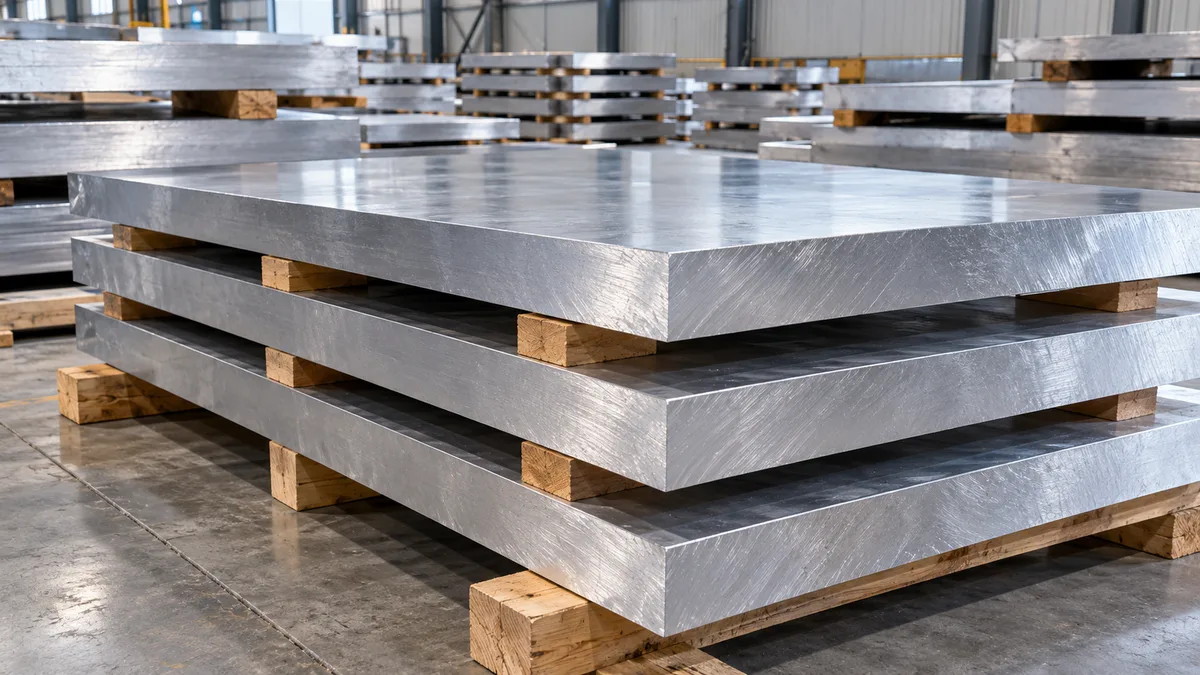
The name describes a thickness, not an alloy. One quarter of an inch is exactly 6.35 mm, because the international inch is defined as exactly 25.4 mm. Any aluminium grade can be rolled to this gauge; what the buyer still has to choose is the alloy, the temper and the sheet or cut size.
The quarter-inch gauge sits on an important boundary. Under ASTM B209 and the ANSI H35.2 dimensional tables used in North America, flat-rolled aluminium from 0.006 in up to 0.249 in is called sheet, and material 0.250 in and thicker is called plate. A 1/4 inch product is therefore the thinnest plate in the American system, and in practice it is sold by both sheet distributors and plate service centres. European standards draw the line at 6 mm (EN 485 and EN 12258 call products over 6 mm plate), so a 6.35 mm product is also plate in Europe, while the closest metric gauge, 6 mm, is technically still sheet.
This matters when you order. Plate tolerances, flatness rules and tempers such as T651 (stress-relieved by stretching) apply to 1/4 inch material, and mills often roll it on plate lines rather than sheet lines. If your drawing says 6 mm but your supplier offers 1/4 inch, or the other way round, the difference is 0.35 mm, about 6 % of the thickness and of the weight, which can affect fits, fastener lengths and freight cost.
Different industries use slightly different words for thickness bands. The table below shows the common trade terms alongside the standards definitions, so you can see why the same piece of metal may be called "heavy sheet" by one buyer and "light plate" by another.
| Band | Approximate range | Typical description |
|---|---|---|
| Foil | Below 0.2 mm (0.006 in) | Packaging, fin stock, insulation |
| Sheet | 0.2 – 6.3 mm (0.006 – 0.249 in) | Panels, enclosures, formed parts |
| Light plate | 6.35 – 12.7 mm (1/4 – 1/2 in) | Brackets, base plates, deck plate, tanks |
| Medium plate | 12.7 – 50 mm (1/2 – 2 in) | Machined parts, fixtures, structural plate |
| Thick plate | 50 – 200 mm (2 – 8 in) | Moulds, aerospace blocks, tooling |
Band names other than sheet and plate are trade usage, not standard definitions. The sheet/plate boundary follows ASTM B209 (0.250 in) and EN 485 (over 6 mm).
Weight is thickness × width × length × density. At 6.35 mm, one square metre of plate holds 0.00635 m³ of metal; multiplied by the density of 6061 (2,700 kg/m³) that is 17.15 kg/m². In imperial units, one square foot of 1/4 inch plate is 36 in³, which at 0.0975 lb/in³ gives 3.51 lb/ft².
Alloy changes the answer by a few per cent, because magnesium makes aluminium lighter and zinc and copper make it heavier. The table uses Aluminum Association nominal densities.
| Alloy | Density (g/cm³) | kg per m² at 6.35 mm | lb per ft² at 0.250 in |
|---|---|---|---|
| 1100 | 2.71 | 17.21 | 3.53 |
| 3003 | 2.73 | 17.34 | 3.55 |
| 5052 | 2.68 | 17.02 | 3.48 |
| 5083 | 2.66 | 16.89 | 3.46 |
| 6061 | 2.70 | 17.14 | 3.51 |
| 7075 | 2.81 | 17.84 | 3.65 |
| 2024 | 2.78 | 17.65 | 3.60 |
Weights for the most common 6061 cut and stock sizes:
| Size | Weight (lb) | Weight (kg) |
|---|---|---|
| 12 × 12 in | 3.5 | 1.6 |
| 24 × 24 in | 14.0 | 6.4 |
| 48 × 96 in (4 × 8 ft) | 112.3 | 50.9 |
| 48 × 120 in (4 × 10 ft) | 140.4 | 63.7 |
| 48 × 144 in (4 × 12 ft) | 168.5 | 76.4 |
| 60 × 120 in (5 × 10 ft) | 175.5 | 79.6 |
| 60 × 144 in (5 × 12 ft) | 210.6 | 95.5 |
For any other size or alloy, use the aluminium plate weight calculator. Remember that freight is charged on gross weight, so add pallet or case weight when you estimate shipping.
Most quarter-inch orders fall into four or five alloys. Pick by the job the plate has to do: forming and corrosion resistance point to the 5xxx series, machining and general structures to 6061, and high stress to 7075.
| Alloy and temper | Typical tensile / yield | Strengths | Typical 1/4 in uses |
|---|---|---|---|
| 3003-H14 | 150 / 145 MPa | Cheap, very formable, good corrosion resistance | Covers, ducting, tread plate (H22), general fabrication |
| 5052-H32 | 230 / 195 MPa | Bends well, excellent in salt air, weldable | Boat parts, fuel tanks, truck bodies, enclosures |
| 5083-H116 / H321 | 315 / 230 MPa (min. ≈ 305 / 215) | Highest non-heat-treatable strength, seawater rated | Hull plating, marine decks, pressure vessels |
| 6061-T651 | 310 / 276 MPa | Machines and welds well, anodises cleanly, stays flat | Machine plates, brackets, frames, fixtures |
| 7075-T651 | 572 / 503 MPa | Very high strength and fatigue resistance | Aerospace fittings, tooling, high-load parts |
| 2024-T351 | 470 / 325 MPa (typical, sheet/plate) | High strength with good fatigue and toughness | Aircraft skins and structure, defence |
Values are typical properties from Aluminum Association and ASM data. Design to the specified minimums in ASTM B209 or EN 485-2, which fall slightly below these figures.
the plate will be bent, exposed to sea air or welded into a tank. It forms with tight radii that would crack 6061-T6, and it is usually the lowest-cost strong grade at this thickness.
the plate will be machined, drilled and tapped, or anodised. Stretching relieves quench stress, so pockets and slots do not make the plate bow.
strength-to-weight is the priority and the part will not be welded. Expect a higher price and plan to protect it from corrosion with anodising or paint.
the plate is permanently in seawater or must be certified by a classification society for a hull or deck.
you need a slip-resistant surface. 1/4 in diamond plate is usually 6061-T6 for strength or 3003-H22 for economy; the quoted thickness excludes the raised pattern on some mills, so check.
flatness and machining stability matter more than strength, for example in jig plates and vacuum tables.
Quarter-inch plate is covered by the same standards as any other rolled aluminium plate. Quote the governing specification on your purchase order so that chemistry, tensile minimums and dimensional tolerances are all defined.
Thickness, width, length and flatness tolerances depend on the alloy group, the width of the plate and whether it is supplied as mill-sheared, saw-cut or precision-milled. Standard mill tolerances are fine for most fabricated parts. If your design relies on a precise 6.35 mm, specify a tighter tolerance or machine the critical faces; if it relies on 6.0 mm, buy metric plate rather than assuming 1/4 inch will do.
Aluminium plate is priced as metal plus conversion. The metal element follows the London Metal Exchange (LME) aluminium price plus a regional premium; the conversion element covers rolling, heat treatment, stretching, testing and packing, and it varies much more between alloys than the metal price does.
To compare offers fairly, convert every quote to a price per kilogram on the same delivery term, and check that the alloy, temper, standard and certificate are identical.
Carbide-tipped circular or panel saws cut 1/4 in plate cleanly and fast. Use blades with a negative or low positive hook and a lubricant to stop aluminium loading the teeth.
Heavy guillotine shears handle 1/4 in in softer alloys such as 3003 and 5052. Shear capacity is usually rated for mild steel, so check the shear's aluminium rating for 6061-T6 and 7075.
No heat-affected zone and tolerances of a few tenths of a millimetre; ideal for 7075 and for complex outlines.
Fibre lasers cut 6.35 mm aluminium well with nitrogen assist; plasma is faster but leaves a wider kerf and a heat-affected edge that may need dressing.
Bend 5052-H32 with an inside radius around 1 × thickness; 6061-T6 needs roughly 1.5 – 3 × thickness and is best bent across the rolling direction. Do not cold-bend 7075-T6.
6061 and 7075 machine to a bright finish with sharp carbide tools. 5052, 5083 and 6061 weld by MIG or TIG; 7075 and 2024 are not normally fusion welded.
For more on cutting methods and their trade-offs, see our guide to CNC aluminium machining.
In 6061 it weighs about 112 lb (50.9 kg). The same sheet in 5052 is about 111 lb, and in 7075 about 117 lb, because of the small density differences between alloys.
Under ASTM B209 it is plate: plate starts at 0.250 in. Anything thinner is sheet. Under European standards plate begins above 6 mm, so 6.35 mm is plate there too.
Exactly 6.35 mm. The nearest common metric plate thickness is 6 mm, which is 0.35 mm thinner.
Choose 5052-H32 for bending, welding and marine exposure, and 6061-T651 for machined parts and higher strength. 6061-T6 is about one third stronger in yield but cracks if bent to tight radii.
Yes. Metline supplies full sheets or saw-cut, waterjet-cut and CNC-profiled blanks to your drawing, with protective film where needed.
Yes. Metline ships plate worldwide from Mumbai on EXW, FOB, CIF or DAP terms, with an EN 10204 3.1 mill certificate and export packing.
Tell us the alloy, temper, size, quantity and destination. We will confirm availability, certification and a delivered price.





