Springback
Higher strength means more springback than 5052. Allow extra over-bend or a restrike operation in the tool design.



GM55 is a proprietary high-magnesium aluminium sheet developed in Japan for electronics housings, offering roughly one and a half times the strength of 5052. Metline supplies high-magnesium 5xxx sheet (about 5.6 – 6.0 % Mg) in thin gauges and O to H18 tempers as an alternative for stamped midframes, support plates and device chassis, matched to your property targets and shipped worldwide.
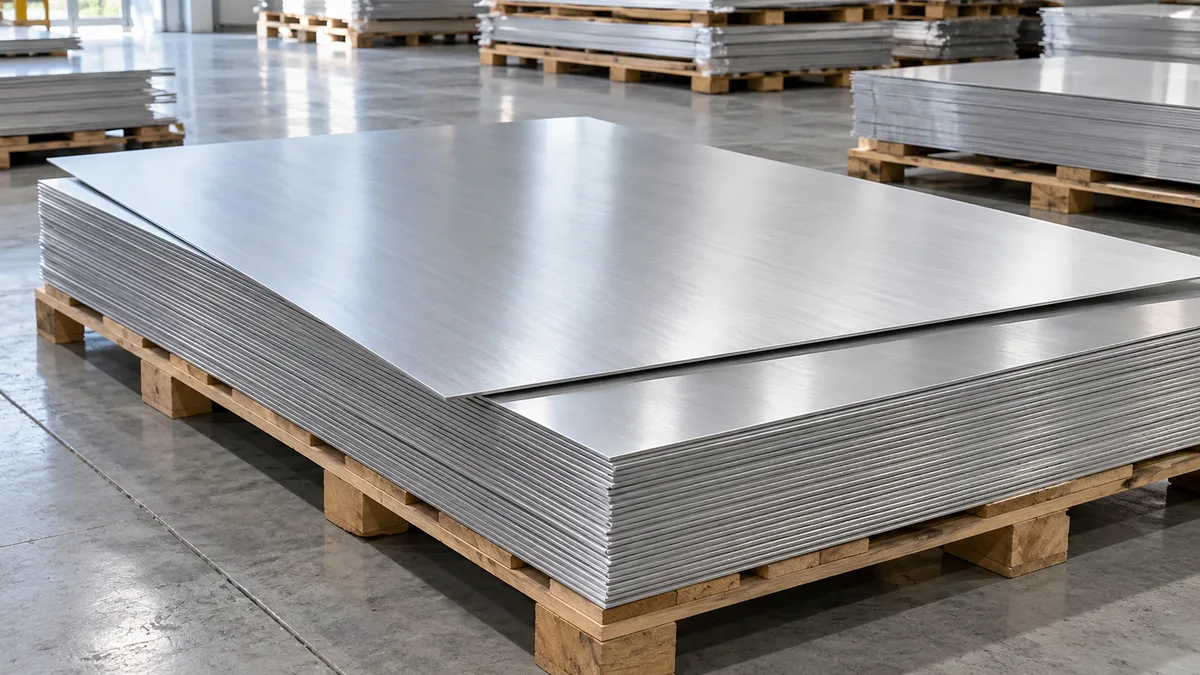
GM55 is a trade name for a high-strength, non-heat-treatable Al-Mg sheet originally developed by Sumitomo Light Metal for casings of cameras, optical drives, flat-panel back covers and similar devices. Its selling point was strength close to cold-rolled steel sheet in an aluminium product that could still be stamped and anodised.
The strength comes from a high magnesium content, well above the 2.2 – 2.8 % of 5052. Magnesium in solid solution strengthens aluminium directly and also raises its work-hardening rate, so each step of cold rolling adds more strength than it would in a leaner alloy. No heat treatment is involved, which means parts keep their properties after forming and there is no risk of distortion from quenching.
Because GM55 is a proprietary product, buyers who need a second source, a different gauge or a shorter supply chain look for a sheet with equivalent chemistry and properties. Metline supplies high-magnesium 5xxx sheet for that purpose. We do not sell the trademarked GM55 product itself; we match your drawing's mechanical and forming requirements with a comparable alloy and temper, confirmed by test results.
The composition below is typical of the high-magnesium sheet we offer as an alternative. Low iron and silicon keep the surface clean for anodising, manganese adds strength and grain control, and a small titanium addition refines the cast structure.
| Element | Typical range | Purpose |
|---|---|---|
| Magnesium (Mg) | 5.6 – 6.0 | Main strengthening element; raises work-hardening rate |
| Manganese (Mn) | 0.25 – 0.30 | Strength and grain-size control |
| Silicon (Si) | ≤ 0.12 | Kept low for anodising quality |
| Iron (Fe) | ≤ 0.20 | Kept low for formability and surface quality |
| Copper (Cu) | ≤ 0.05 | Kept low for corrosion resistance |
| Chromium (Cr) | ≤ 0.10 | — |
| Zinc (Zn) | ≤ 0.20 | — |
| Titanium (Ti) | 0.015 – 0.030 | Grain refiner |
| Aluminium (Al) | Balance |
For reference, registered 5056 contains 4.5 – 5.6 % Mg and 5A06 contains 5.8 – 6.8 % Mg; this sheet sits between them. Exact limits are confirmed on the quotation and mill certificate.
Values are typical for thin sheet and are given for comparison. Properties depend on temper and thickness, so compare candidate materials at the same temper and gauge, and set minimum values in your purchase specification.
| Temper | Tensile strength | Yield strength | Elongation |
|---|---|---|---|
| O | ≈ 290 MPa | ≈ 130 MPa | ≈ 30 % |
| H32 | ≈ 295 – 310 MPa | ≈ 160 – 200 MPa | ≈ 25 % |
| H34 | ≈ 340 – 350 MPa | ≈ 225 – 250 MPa | ≈ 14 – 17 % |
| H36 | ≈ 370 MPa | ≈ 270 – 295 MPa | ≈ 13 % |
| H38 | ≈ 370 – 390 MPa | ≈ 270 – 300 MPa | ≈ 11 – 13 % |
| H18 | ≈ 430 MPa | ≈ 370 MPa | ≈ 8 % |
Measured results on thin gauges show how little the properties change with thickness in this range: at 0.10, 0.30 and 0.50 mm, H34 sheet tested at about 337 – 348 MPa tensile and H38 at about 370 – 386 MPa. Elongation is slightly lower in the thinnest gauge, which matters for flanges on 0.1 mm parts.
Electronic parts are blanked, bent, flanged and coined at high speed. The table gives starting guidance; confirm with a trial on production tooling, because die clearance, lubrication and grain direction all change the result.
| Temper | Forming room | Typical use |
|---|---|---|
| O | Very good: deep draws and tight bends | Drawn housings, complex formed covers |
| H32 | Good: moderate draws, bends around 1 × t | Formed brackets and chassis with flanges |
| H34 | Moderate: bends around 1.5 – 2 × t | Support plates with simple bends |
| H36 / H38 | Limited: gentle bends, mostly flat parts | Midframe plates, stiffeners |
| H18 | Low: flat or lightly formed only | Flat high-strength shims and plates |
Higher strength means more springback than 5052. Allow extra over-bend or a restrike operation in the tool design.
Fully soft high-Mg sheet can show Lüders lines after forming. For cosmetic parts, use a slightly cold-worked temper or a light temper-pass to suppress them.
The harder tempers are more abrasive than 1xxx or 3xxx sheet. Coated or carbide punches extend life on long runs.
Bend across the rolling direction where possible; bends parallel to it crack sooner in hard tempers.
| Alloy and temper | Typical tensile strength | Heat treatment | Selection notes |
|---|---|---|---|
| High-Mg 5xxx, H38 | ≈ 380 MPa | None | Thin stamped structural parts needing strength without post-forming treatment |
| 5052-H34 | ≈ 260 MPa | None | General housings and covers; easier to form, lower strength |
| 5182-H34 / H38 | ≈ 330 – 400 MPa | None | Can-end and formed sheet; 4.0 – 5.0 % Mg |
| 6061-T6 | ≈ 310 MPa | Solution + ageing | Machined parts; forming in T6 is limited |
| 6013-T6 | ≈ 390 MPa | Solution + ageing | Machined housings with good anodising |
| 7075-T6 (phone midframes) | ≈ 570 MPa | Solution + ageing | CNC-machined frames needing the highest strength |
For thin parts that are stamped rather than machined, high-magnesium sheet sits in a useful gap: stronger than 5052, with no heat treatment step, and cheaper to process than a machined 6xxx or 7xxx frame. When the part is CNC-machined from thicker stock, 6013, 6061 or 7075 usually gives a better result.
High-magnesium sheet anodises well in natural silver and dyed colours, including black. Magnesium-rich alloys can produce a slightly warmer tone than very pure alloys such as 5252, so for visible cosmetic parts we recommend anodising a trial batch from production material and agreeing colour limits before series production.
Brushed, blasted and matte textures can be applied before anodising. Specify cosmetic grades, permissible defects and inspection distance on the drawing, because surface acceptance for consumer electronics is stricter than general engineering practice.
Al-Mg alloys with more than about 3 % Mg can become sensitised if held for long periods at 65 – 200 °C, which reduces resistance to intergranular corrosion. This is rarely a concern in consumer electronics but should be considered for parts near heat sources.
No. GM55 is a proprietary product of its owner. We supply a high-magnesium 5xxx sheet with comparable chemistry and properties and confirm the match against your property targets with test data.
Roughly 40 – 60 % in comparable tempers. For example, H34 sheet tests at about 340 – 350 MPa tensile against about 260 MPa for 5052-H34.
H34 to H38 for flat or simply bent plates, H32 when flanges and tighter bends are needed, and O for drawn shapes. Run a die trial before fixing the temper.
Yes, in silver, black and dyed colours. Approve the colour on a trial batch, because high-Mg alloys can give a slightly warmer tone than very pure alloys.
Typically 0.10 – 1.00 mm, in sheet, with slit coil subject to confirmation.
Target properties or the material being replaced, temper, thickness, width, length or coil size, forming steps, finish, quantity, inspection criteria and delivery destination.
Send your datasheet and drawings. We will propose a matching high-strength sheet and arrange test data.





