When to choose T651
The part is a machined fitting or panel loaded mainly in the rolling plane, environment is controlled, and maximum strength-to-weight is the priority.



7475 is a high-purity version of 7075 in which iron and silicon are held to very low levels, giving markedly better fracture toughness and slower fatigue crack growth at almost the same strength. Metline supplies 7475 bare and Alclad sheet and 7475 plate in T61, T651, T7351, T761 and T7651 tempers, certified to the AMS specification on your drawing and shipped worldwide from Mumbai.
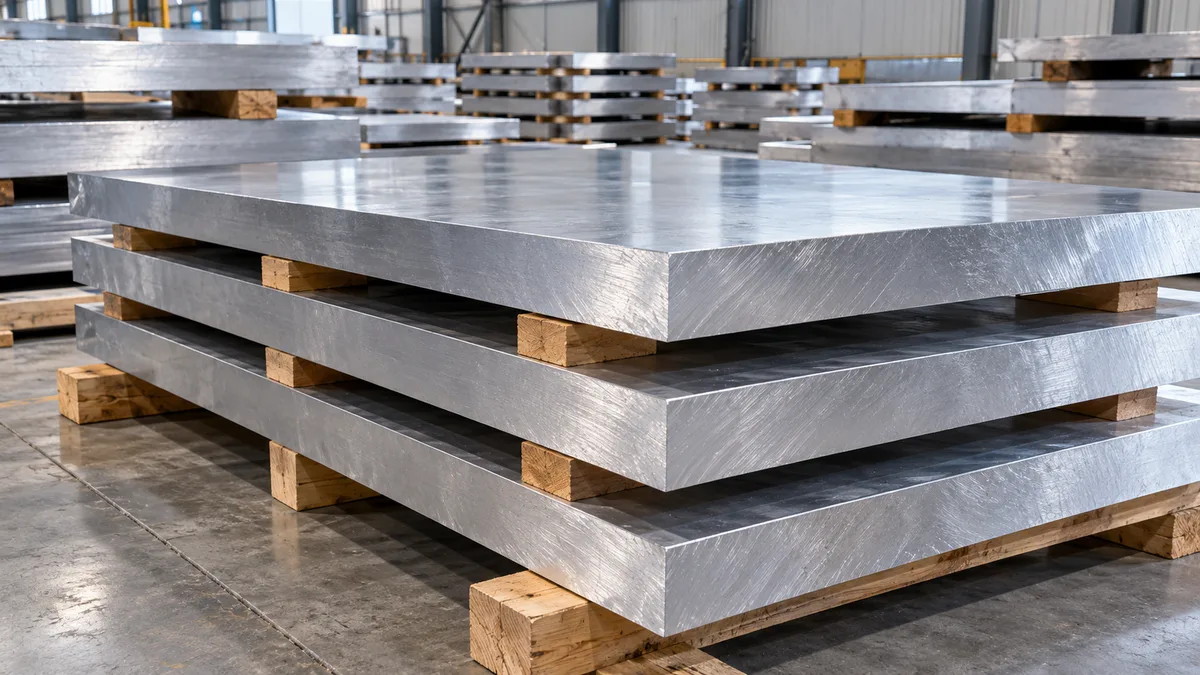
7475 is an Al-Zn-Mg-Cu alloy with the same strengthening elements as 7075, but with iron capped at 0.12 % and silicon at 0.10 %, against 0.50 % and 0.40 % in 7075. Removing those impurities removes most of the coarse iron- and silicon-rich particles that act as starting points for cracks, which is where the gain in toughness comes from.
The alloy was developed for airframe structures designed on damage-tolerance principles, where the question is not only "how strong is the part?" but "how long will a crack take to grow, and how big can it get before the part fails?" In those designs, plane-strain fracture toughness (KIc) and fatigue crack growth rate govern skin thickness as much as tensile strength does. Published comparisons put 7475 well ahead of 7075 in the same temper, which is why it is used for wing skins, fuselage panels, bulkheads and spars on military and commercial aircraft.
Processing matters as much as chemistry. 7475 is rolled and solution heat-treated under tighter control than general-purpose 7xxx plate, and it is usually sold to aerospace material specifications rather than to general commercial standards. That makes it a specialist product: more expensive than 7075, available in a narrower range of sizes, and normally ordered with full traceability.
Limits are the registered Aluminum Association values for 7475, which AMS and EN 573-3 (EN AW-7475) follow. Compare the iron and silicon maxima with 7075 to see where the toughness advantage comes from.
| Element | 7475 min | 7475 max | 7075 max (for comparison) |
|---|---|---|---|
| Silicon (Si) | — | 0.10 | 0.40 |
| Iron (Fe) | — | 0.12 | 0.50 |
| Copper (Cu) | 1.2 | 1.9 | 1.2 – 2.0 |
| Manganese (Mn) | — | 0.06 | 0.30 |
| Magnesium (Mg) | 1.9 | 2.6 | 2.1 – 2.9 |
| Chromium (Cr) | 0.18 | 0.25 | 0.18 – 0.28 |
| Zinc (Zn) | 5.2 | 6.2 | 5.1 – 6.1 |
| Titanium (Ti) | — | 0.06 | 0.20 |
| Others, each / total | — | 0.05 / 0.15 | 0.05 / 0.15 |
| Aluminium (Al) | Remainder | Remainder |
Alclad 7475 sheet carries a cladding layer, typically 7072 or a similar zinc-bearing pure aluminium, metallurgically bonded to each face. The cladding is anodic to the core and corrodes sacrificially to protect it.
The values below are typical figures for room temperature, rounded from published data. They show how the tempers rank against each other. For design, use the minimum values in the governing AMS specification or MMPDS for your thickness band, and check the mill certificate for each lot.
| Temper and form | Tensile strength | Yield strength (0.2 %) | Elongation |
|---|---|---|---|
| T61 sheet, bare | ≈ 550 MPa / 80 ksi | ≈ 495 MPa / 72 ksi | ≈ 12 % |
| T61 sheet, Alclad | ≈ 515 MPa / 75 ksi | ≈ 455 MPa / 66 ksi | ≈ 11 % |
| T651 plate | ≈ 585 MPa / 85 ksi | ≈ 510 MPa / 74 ksi | ≈ 12 % |
| T7651 plate | ≈ 530 MPa / 77 ksi | ≈ 460 MPa / 67 ksi | ≈ 12 % |
| T761 sheet, bare | ≈ 515 MPa / 75 ksi | ≈ 450 MPa / 65 ksi | ≈ 12 % |
| T761 sheet, Alclad | ≈ 490 MPa / 71 ksi | ≈ 420 MPa / 61 ksi | ≈ 12 % |
| T7351 plate | ≈ 495 MPa / 72 ksi | ≈ 420 MPa / 61 ksi | ≈ 13 % |
Two patterns are worth noting. First, each step of over-ageing from T6 to T76 to T73 gives up roughly 30 – 50 MPa of strength in exchange for better corrosion behaviour. Second, Alclad sheet always reads lower than bare sheet of the same temper, because the soft cladding layer carries part of the cross-section; the reduction is larger in thinner gauges, where the cladding is a greater share of the thickness.
Electrical conductivity is used as a non-destructive check on temper: over-aged T73 and T76 material reads measurably higher than T6 material.
7475 is sold in more tempers than most alloys because the airframer chooses a different balance of strength and corrosion resistance for each part. The table below summarises the options and the specifications they are usually bought to.
| Temper | Form | Typical specification | What it gives you |
|---|---|---|---|
| T61 | Bare sheet | AMS 4084 | Peak strength with good toughness; used where stress-corrosion risk is low |
| T651 | Plate | AMS 4090 | Highest strength in plate; stretched for flatness and machining stability |
| T761 | Bare sheet | AMS 4085 | Over-aged for exfoliation resistance with only a small strength loss |
| T7651 | Plate | AMS 4089 | Plate equivalent of T761: good strength, good exfoliation and crack-growth resistance |
| T7351 | Plate | AMS 4202 | Most over-aged: best stress-corrosion resistance, preferred for thick sections and short-transverse loads |
| O / T61 / T761 | Alclad sheet | AMS 4207, AMS 4100 and customer specifications | Clad skins for exterior surfaces; O temper for forming before heat treatment |
The part is a machined fitting or panel loaded mainly in the rolling plane, environment is controlled, and maximum strength-to-weight is the priority.
Wing and fuselage skins exposed to moisture and de-icing fluids, where exfoliation corrosion would be the life-limiting factor.
Thick plate machined into frames or bulkheads with significant short-transverse stress, where stress-corrosion cracking must be designed out.
Most 7475 is bought to SAE AMS specifications or to an airframer's own material specification (for example Boeing BMS or Airbus AIMS documents). Commercial orders can also reference ASTM B209 or EN 485. Tell us which document governs your drawing and we will quote material certified to it.
| System | Designation | Notes |
|---|---|---|
| Aluminum Association | 7475 | Registered wrought alloy |
| UNS | A97475 | — |
| European (EN) | EN AW-7475 / EN AW-AlZn5.5MgCu | EN 573-3 chemistry; EN 485 for commercial sheet and plate |
| SAE AMS | AMS 4084, 4085, 4089, 4090, 4100, 4202, 4207 | Temper- and form-specific aerospace specifications |
| ASTM | 7475 | ASTM B209 lists 7475 sheet and plate |
| Design data | MMPDS | Statistically based allowables used for certified aircraft design |
If your purchase order quotes an airframer specification, the material must come from a mill qualified to that specification. Tell us at the enquiry stage so we can confirm the approved source before quoting.
7475 is produced in specific campaigns by a small number of aerospace mills, so availability depends on temper and gauge. Ask early if you need an unusual size.
At a density of 2.81 g/cm³, 7475 weighs 2.81 kg per square metre for each millimetre of thickness, about 4 % heavier than 6061. The table gives reference weights for common gauges; use the plate weight calculator for other sizes.
| Thickness (mm) | kg per m² | 1220 × 2440 mm (kg) | 1250 × 2500 mm (kg) |
|---|---|---|---|
| 0.81 | 2.28 | 6.8 | 7.1 |
| 1.02 | 2.87 | 8.5 | 9.0 |
| 1.6 | 4.50 | 13.4 | 14.1 |
| 2.03 | 5.70 | 17.0 | 17.8 |
| 3.18 | 8.94 | 26.6 | 27.9 |
| 4.83 | 13.57 | 40.4 | 42.4 |
| 6.35 | 17.84 | 53.1 | 55.8 |
| 12.7 | 35.69 | 106.2 | 111.5 |
| 25.4 | 71.37 | 212.5 | 223.0 |
| 50.8 | 142.75 | 424.9 | 446.1 |
| 76.2 | 214.12 | 637.4 | 669.1 |
| 101.6 | 285.50 | 849.9 | 892.2 |
Aerospace sheet and plate is rejected for defects that would pass in general engineering. The checks below are the ones buyers most often specify; list any additional requirement in your enquiry so it is part of the quotation.
Machines much like 7075: short chips, good surface finish and fast metal removal with sharp carbide tooling and flood coolant. Stretched tempers keep pockets and thin webs flat after heavy machining.
Form in the O or freshly quenched (W) condition, then age to the final temper. Formability in T6x and T7x tempers is limited; use generous bend radii and check the specification for minimum radii.
Not considered fusion-weldable: like other copper-bearing 7xxx alloys it is prone to hot cracking. Assemblies are riveted, bolted or bonded. Friction-stir welding is used in some structures under qualified procedures.
Bare 7475 is normally protected by chromic, boric-sulphuric or sulphuric anodising plus primer. Alclad sheet relies on its cladding for protection on exterior skins.
Solution treatment is followed by a rapid quench and controlled ageing. Over-ageing to T7x must follow the exact two-step cycle of the specification, so re-treatment is best left to qualified heat treaters.
Like most 7xxx alloys, strength falls with prolonged exposure above about 120 °C. It is not chosen for hot sections; 2618 or 2219 are used there.
| Property | 7475 | 7075 | 7050 | 2024 |
|---|---|---|---|---|
| Fe / Si limits | 0.12 / 0.10 | 0.50 / 0.40 | 0.15 / 0.12 | 0.50 / 0.50 |
| Peak typical tensile (plate) | ≈ 585 MPa (T651) | ≈ 570 MPa (T651) | ≈ 525 MPa (T7451) | ≈ 470 MPa (T351) |
| Fracture toughness | High | Moderate | High | High |
| Fatigue crack growth | Slow | Faster | Slow | Slow |
| Stress-corrosion resistance | Very good in T73x | Poor in T6, good in T73 | Very good in T74 | Moderate |
| Best thickness range | Sheet and plate to about 100 mm | Sheet and plate | Thick plate (low quench sensitivity) | Sheet and plate |
| Relative cost | High | Medium | High | Medium |
Choose 7475 when a thin-to-medium section must combine 7xxx strength with damage tolerance. For very thick plate machined into large frames, 7050 is usually preferred because it is less quench-sensitive. Where cost matters more than fracture behaviour, 7075 remains the workhorse, and where fatigue in tension-dominated skins is the issue, 2024 is still common.
Both are Al-Zn-Mg-Cu alloys of similar strength, but 7475 has much lower iron and silicon limits (0.12 % and 0.10 % against 0.50 % and 0.40 %) and tighter processing. The result is higher fracture toughness and slower fatigue crack growth, at a higher price.
T7351. It is the most over-aged temper and is used for thick plate and parts with short-transverse loading. T7651 and T761 sit between T7351 and the peak-strength T61/T651 tempers.
About 2.81 g/cm³ (0.101 lb/in³). A 1 m² sheet weighs 2.81 kg for each millimetre of thickness, so a 1250 × 2500 × 10 mm plate weighs about 87.8 kg.
It is not recommended for arc welding because of hot-cracking sensitivity and strength loss. Aircraft structures in 7475 are riveted, bolted or adhesively bonded; friction-stir welding is possible under qualified procedures.
7475 sheet with a thin layer of high-purity, zinc-bearing aluminium bonded to each surface. The layer corrodes sacrificially and protects the core, which is why Alclad is used for exterior skins. Its strength is slightly lower than bare sheet.
Yes. We supply 7475 with EN 10204 3.1 mill certificates to the AMS or ASTM specification ordered. If your order requires a specific airframer approval, tell us at the enquiry stage so we can confirm a qualified source.
Send the temper, specification, sizes and inspection requirements. We will confirm a certified source and a delivered quotation.





