Welding
MIG and hybrid laser-MIG welding are used, with Al-Mg fillers such as 5183 or 5356 or specially matched Al-Zn-Mg fillers. Control heat input to limit HAZ softening and allow natural ageing time before load testing.



7A52-T6 is a weldable aluminium-zinc-magnesium armour plate used for the hulls, turrets and floors of light and medium armoured vehicles. It combines a minimum tensile strength of 410 MPa with good weldability and toughness, giving better armour-piercing resistance than 5083 at similar weight. Metline supplies 7A52 plate from 5 to 90 mm thick, cut to size and certified, to customers worldwide.
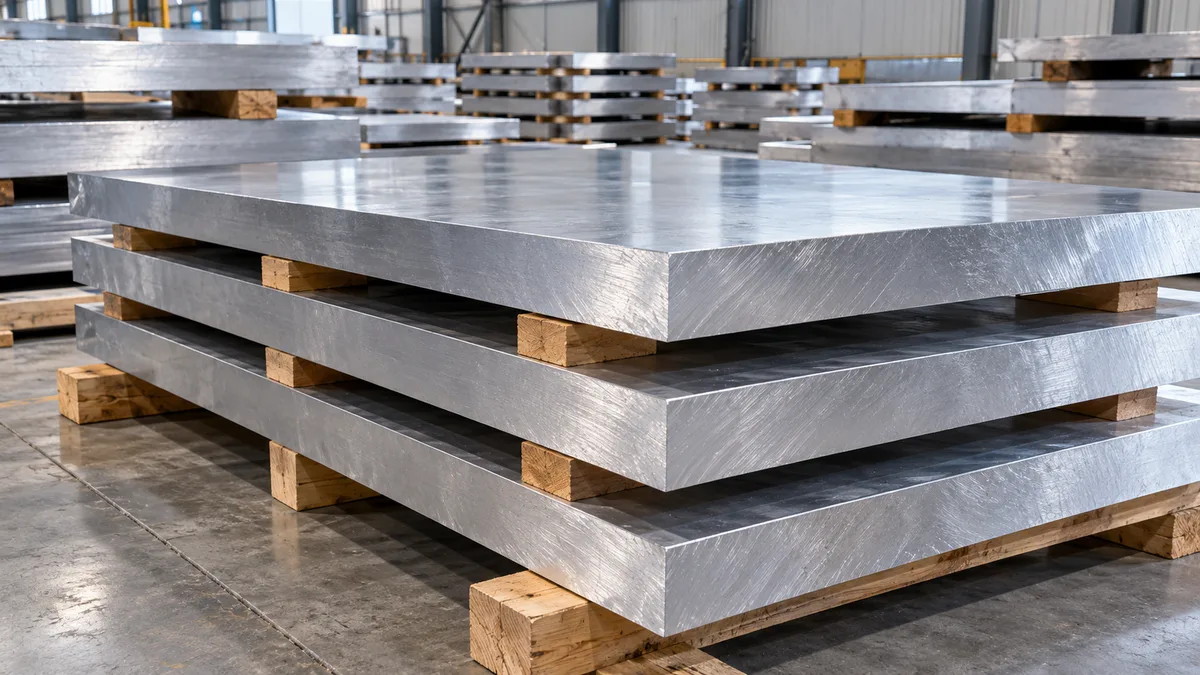
7A52 is a medium-to-high-strength aluminium-zinc-magnesium alloy registered in the Chinese GB/T 3190 system and used mainly for welded armour. Its chemistry, about 4.4 % zinc and 2.4 % magnesium with chromium and zirconium for grain control, places it in the same family as 7039, 7017 and 7020: heat-treatable alloys that remain weldable because they contain very little copper.
After solution treatment, quenching and artificial ageing to T6, 7A52 reaches a minimum tensile strength of 410 MPa and yield strength of 345 MPa, well above 5083-H131. Like other Al-Zn-Mg alloys, its heat-affected zone recovers much of its strength by natural ageing after welding, so welded hulls can be built without post-weld heat treatment.
The alloy is designed as a balance: strong enough to defeat rifle and machine-gun AP rounds at practical thicknesses, tough enough to resist cracking under impact, and weldable enough to build a complete vehicle hull. Its main limitation is the one shared by all zinc-magnesium alloys, a sensitivity to stress-corrosion cracking, which is controlled by temper, chromium and zirconium additions, careful welding and protective coatings.
| Element | Limit |
|---|---|
| Silicon (Si) | 0.25 max |
| Iron (Fe) | 0.30 max |
| Copper (Cu) | 0.05 – 0.20 |
| Manganese (Mn) | 0.20 – 0.50 |
| Magnesium (Mg) | 2.0 – 2.8 |
| Chromium (Cr) | 0.15 – 0.25 |
| Zinc (Zn) | 4.0 – 4.8 |
| Titanium (Ti) | 0.05 – 0.18 |
| Zirconium (Zr) | 0.05 – 0.15 |
| Aluminium | Remainder |
Chromium and zirconium form fine dispersoids that keep the grain structure unrecrystallised and elongated, which improves resistance to stress corrosion and exfoliation. The small copper addition adds strength without seriously harming weldability.
| Thickness | Tensile strength Rm, min | Yield strength Rp0.2, min | Elongation, min |
|---|---|---|---|
| 5.0 – 12.5 mm | 410 MPa | 345 MPa | 7 % (A50) |
| > 12.5 – 90.0 mm | 410 MPa | 345 MPa | 7 % (A) |
Plate is also tested for stress-corrosion resistance, typically with C-ring specimens loaded in the short-transverse direction and exposed in a corrosive environment. This is the direction most prone to SCC in thick plate, so it is the critical test for armour that will be welded and stressed.
Ballistic acceptance for 7A52 plate is normally based on a "safe angle" test: plates of a given thickness are fired at from a set range with a specified rifle or machine-gun round, and the plate must not be perforated at or beyond a stated angle of obliquity. Thinner plates are tested against 7.62 mm steel-core rounds, mid-range thicknesses against 7.62 mm armour-piercing incendiary rounds, and the thickest plates against 12.7 mm armour-piercing incendiary rounds.
| Plate thickness (indicative) | Threat class used for testing |
|---|---|
| About 12 – 18 mm | 7.62 mm steel-core rifle ammunition |
| About 20 – 30 mm | 7.62 mm armour-piercing incendiary ammunition |
| About 35 – 45 mm | 12.7 mm armour-piercing incendiary ammunition |
Test rounds, velocities and acceptance angles are set by the standard on the order. If your programme uses V50 testing to MIL-STD-662 or STANAG 4569 levels instead, state this in the enquiry.
Armour plate tolerances are one-sided: thickness, width and length deviations are plus only, so a plate is never thinner or smaller than ordered. Typical thickness tolerances range from +0.30/0 mm on 5 mm plate under 1 m wide to +3.00/0 mm on 40 – 90 mm plate over 2 m wide.
| Thickness (mm) | Width 800 – 1000 | 1000 – 1500 | 1500 – 2000 | 2000 – 3000 |
|---|---|---|---|---|
| 5.0 | +0.30/0 | +0.36/0 | +0.46/0 | +0.60/0 |
| > 6.3 – 8.0 | +0.64/0 | +0.80/0 | +1.00/0 | +1.00/0 |
| > 10.0 – 16.0 | +1.10/0 | +1.10/0 | +1.30/0 | +1.44/0 |
| > 16.0 – 25.0 | +1.40/0 | +1.40/0 | +1.70/0 | +1.88/0 |
| > 25.0 – 40.0 | +1.50/0 | +1.50/0 | +2.00/0 | +2.40/0 |
| > 40.0 – 90.0 | +2.00/0 | +2.00/0 | +2.50/0 | +3.00/0 |
Width tolerance is typically +6/0 mm up to 2000 mm wide and +7/0 mm above; length tolerances rise from +7/0 mm for short plates to +14/0 mm for 7.5 – 10 m plates. Diagonal difference and flatness are also limited, with flatness tighter for thicker plate.
MIG and hybrid laser-MIG welding are used, with Al-Mg fillers such as 5183 or 5356 or specially matched Al-Zn-Mg fillers. Control heat input to limit HAZ softening and allow natural ageing time before load testing.
Avoid tensile residual stress through the thickness, keep welds away from short-transverse loading, and protect surfaces with conversion coating and paint.
Waterjet and saw cutting avoid heat-affected edges. Plasma-cut edges should be machined back before welding.
T6 plate has moderate ductility; use generous bend radii and form at room temperature. Heating to aid forming will change the temper.
| Property | 7A52-T6 | 7039-T64 | 5083-H131 |
|---|---|---|---|
| Alloy family | Al-Zn-Mg | Al-Zn-Mg | Al-Mg |
| Minimum / typical tensile | 410 MPa min | About 450 MPa typical | 310 MPa min |
| AP resistance | Good | Good | Moderate |
| Weldability | Good | Fair to good | Excellent |
| Stress-corrosion resistance | Fair, controlled by temper and Zr | Fair | Excellent |
| Governing specification | GB-system armour standards | MIL-DTL-46063H | MIL-DTL-46027 |
There is no exact AA or EN equivalent. The closest alloys in character are 7039, 7017 and 7020, all weldable Al-Zn-Mg alloys; 7039 is the nearest armour-specified match.
Yes. It is a low-copper Al-Zn-Mg alloy, so it can be MIG or hybrid laser-MIG welded, and the heat-affected zone partly recovers strength by natural ageing. Welded joint strength is typically 70 – 75 % of the parent plate.
Tensile strength 410 MPa, yield strength 345 MPa and elongation 7 % minimum for plate from 5 to 90 mm.
Ballistic protection depends on thickness. A plus-only tolerance guarantees every plate is at least the ordered thickness, so it meets the ballistic design.
Plate can be tested to the ballistic method your programme specifies, such as V50 to MIL-STD-662. State the requirement and threat in your enquiry so the test scope is quoted correctly.
Send thickness, size, quantity and ballistic test requirements. We will reply with availability and a delivered price.





