7A52-T6
Weldable Al-Zn-Mg alloy that matches 7A52 armour plate, so a forged node can be welded straight into the hull. Medium-high strength with good toughness.



Forgings in 7A52, 7050 and 2A50 supply the thick, shaped parts of armoured vehicles: hatch rings, mounts, brackets and load-bearing nodes. 7A52-T6 is weldable to 7A52 armour plate, 7050-T74 gives the highest strength with good stress-corrosion resistance, and 2A50-T6 is a forgeable medium-strength alloy for complex shapes. Metline supplies all three to drawing, inspected and certified, worldwide.
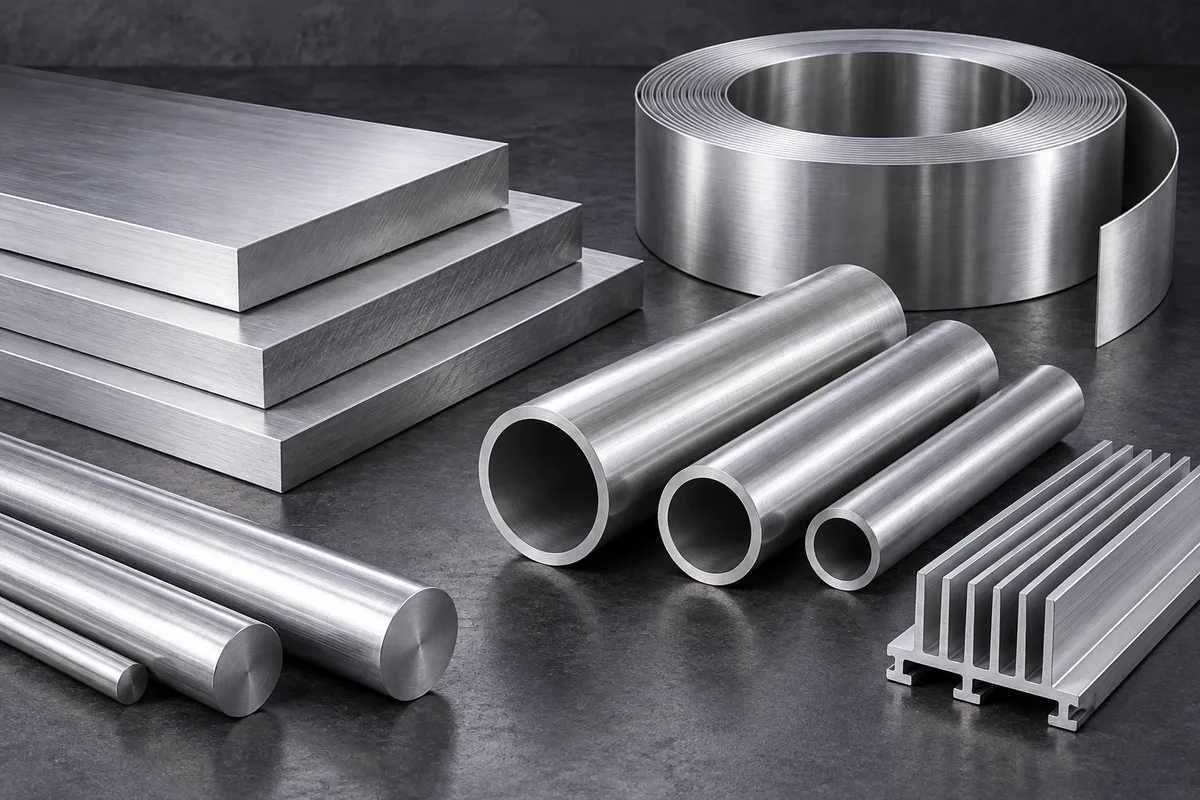
A forging is chosen when a part is thick, shaped and highly loaded, and when the designer wants the grain to follow the shape. In armoured vehicles that means parts such as hatch rings, turret ring sections, suspension mounts and towing eyes.
Weldable Al-Zn-Mg alloy that matches 7A52 armour plate, so a forged node can be welded straight into the hull. Medium-high strength with good toughness.
High-strength Al-Zn-Mg-Cu aerospace alloy. The over-aged T74 temper gives much better stress-corrosion resistance than T6, with strength well above 7A52. Bolted rather than welded.
Al-Mg-Si-Cu forging alloy with good hot workability, used for complex medium-strength parts. Bolted rather than welded.
| Element | 2A50 | 7A52 | 7050 |
|---|---|---|---|
| Silicon (Si) | 0.7 – 1.2 | 0.25 | 0.12 |
| Iron (Fe) | 0.70 | 0.30 | 0.15 |
| Copper (Cu) | 1.8 – 2.6 | 0.05 – 0.20 | 2.0 – 2.6 |
| Manganese (Mn) | 0.40 – 0.80 | 0.20 – 0.50 | 0.10 |
| Magnesium (Mg) | 0.40 – 0.80 | 2.0 – 2.8 | 1.9 – 2.6 |
| Chromium (Cr) | — | 0.15 – 0.25 | 0.04 |
| Zinc (Zn) | 0.30 | 4.0 – 4.8 | 5.7 – 6.7 |
| Titanium (Ti) | 0.15 | 0.05 – 0.18 | 0.06 |
| Zirconium (Zr) | — | 0.05 – 0.15 | 0.08 – 0.15 |
| Nickel (Ni) | 0.10 | — | — |
| Aluminium | Remainder | Remainder | Remainder |
Single values are maximums. 7050 limits follow the Aluminum Association registration; 2A50 and 7A52 follow GB/T 3190.
Forging properties are specified in three directions: longitudinal (along the main grain flow, or tangential in a rolled ring), transverse (or axial) and short transverse (or radial). Strength and especially elongation are lowest in the short-transverse direction.
| Alloy / temper | Forging type | Direction | Tensile, min (MPa) | Yield, min (MPa) | Elongation, min | Hardness, min |
|---|---|---|---|---|---|---|
| 2A50-T6 | Die forging | Longitudinal | 385 | 275 | 10 % | 100 HBW |
| 2A50-T6 | Die forging | Transverse | 365 | 245 | 7 % | 100 HBW |
| 2A50-T6 | Die forging | Short transverse | 345 | — | 5 % | 100 HBW |
| 7A52-T6 | Die, hand or rolled ring | Longitudinal | 410 | 345 | 6 % | 120 HBW |
| 7A52-T6 | Die, hand or rolled ring | Transverse | 380 | — | 4 % | 120 HBW |
| 7A52-T6 | Die, hand or rolled ring | Short transverse | 360 | — | 2 %* | 120 HBW |
| 7050-T74 | Hand forging or rolled ring | Longitudinal | 475 | 406 | 9 % | 140 HBW |
| 7050-T74 | Hand forging or rolled ring | Transverse / short transverse | 468 | 399 | 3 – 4 % | 140 HBW |
*3 % minimum for forgings under 30 kg. Minimums fall with section thickness; the values that apply to your part are set by the forging specification and drawing. Hand-forged 2A50 has slightly lower minimums than die-forged.
Inclusions and oxide films left from the melt are planes of weakness in a forging. Armour forgings are therefore broken open on sample pieces and the fracture surface examined. It must be free of non-metallic inclusions, and the oxide film found within a set inspection area is limited by forging category.
| Forging category | Inspection area | Total oxide-film area, max | Single-spot area, max |
|---|---|---|---|
| I (most critical) | 0.01 m² | 4 mm² | 2 mm² |
| II | 0.01 m² | 6 mm² | 3 mm² |
| III | 0.01 m² | 8 mm² | 3 mm² |
7A52-T6 forgings are weldable to 7A52 armour plate. 7050 and 2A50 are not normally fusion welded in armour structures and are bolted.
T74 is an over-aged temper that gives up some peak strength for much better resistance to stress-corrosion cracking and exfoliation, which matters in thick forgings.
2A50 has no exact AA equivalent. It is an Al-Mg-Si-Cu forging alloy; 2014 (stronger) and 6061 (weaker, more corrosion resistant) are the nearest common alternatives.
Oxide films act as internal cracks under impact. Breaking sample forgings and limiting the oxide area found ensures the metal is clean enough for armour service.
Yes. Forgings can be supplied as forged, rough machined or finish machined to drawing.
Send the drawing, alloy and quantity. We will reply with feasibility, inspection scope and a delivered price.





