Cutting
Waterjet is preferred: it leaves no heat-affected zone and does not open the bond line. Saw cutting is also suitable; avoid plasma near finished edges.



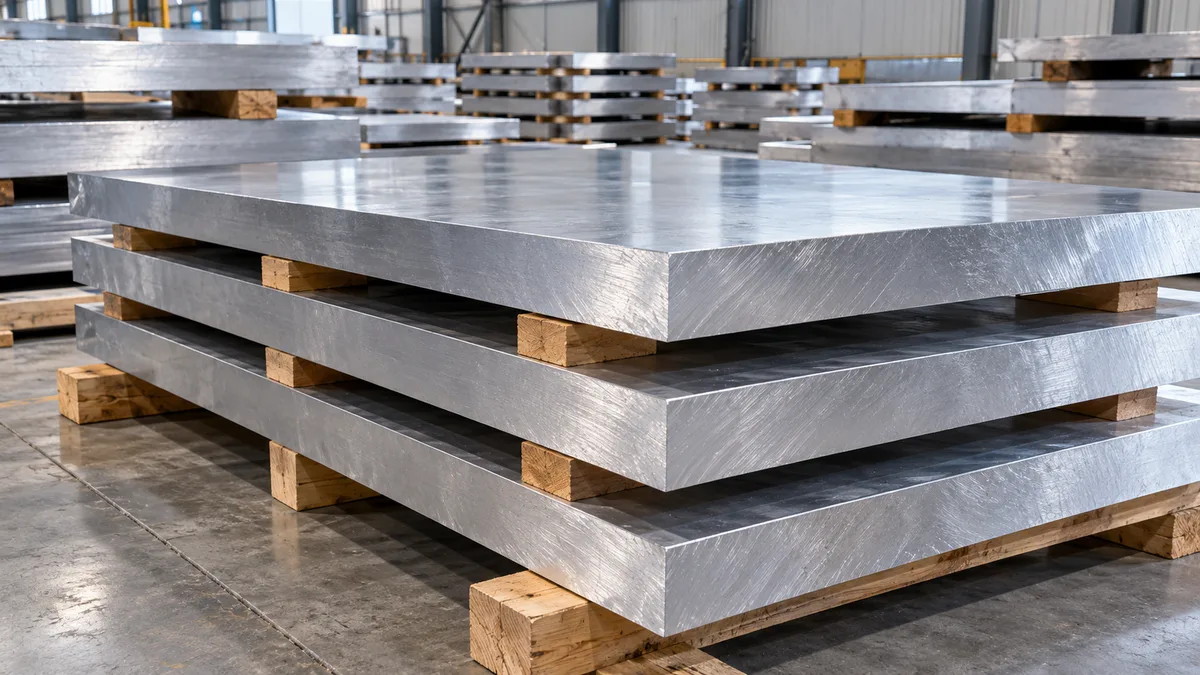
7B52 is a multi-layer aluminium armour plate that bonds a very hard, high-zinc 7xxx face to a ductile interlayer and a tough weldable 7xxx backing. The hard face breaks up and blunts the projectile, the interlayer stops cracks from running through, and the backing absorbs the remaining energy, giving better protection per kilogram than a single alloy. Metline supplies 7B52 plate from 18 to 40 mm thick, worldwide.
A single alloy forces a compromise: hard alloys resist penetration but crack and spall, tough alloys absorb energy but let hard-cored bullets through. Laminated plate gives each job to a different layer.
In 7B52 plate the strike face is a high-zinc, high-magnesium Al-Zn-Mg alloy aged to very high strength and hardness. Behind it sits a thin layer of soft, low-alloy aluminium, and behind that a tough, weldable Al-Zn-Mg alloy of the 7A52 type. The layers are metallurgically bonded by hot roll bonding (or, in some builds, explosion welding), so the plate behaves as one piece during fabrication.
Research on this kind of laminate shows why it works. Under 7.62 mm impacts, the hard front layer tends to fail by spalling, but the ductile interlayer blunts and deflects the spall cracks and delaminates locally, so the failure of the rear layer changes from shear plugging to bending. That consumes more energy and keeps the rear layer intact. Studies of four-layer soft-hard laminates have reported notably lower residual projectile velocities than monolithic high-strength plate of the same weight.
The table gives the composition of the high-strength strike-face alloy, which governs the hardness and AP performance of the laminate. The interlayer and backing alloys are reported separately on the certificate.
| Element (strike face) | Limit (wt %) |
|---|---|
| Silicon (Si) | 0.12 max |
| Iron (Fe) | 0.15 max |
| Copper (Cu) | 0.05 – 0.50 |
| Manganese (Mn) | 0.20 – 0.60 |
| Magnesium (Mg) | 2.5 – 3.2 |
| Chromium (Cr) | 0.10 – 0.20 |
| Zinc (Zn) | 6.7 – 7.4 |
| Titanium (Ti) | 0.03 – 0.10 |
| Zirconium (Zr) | 0.05 – 0.15 |
| Aluminium | Remainder |
Values as specified for the laminate; confirm the test location and layer against the standard on your order.
7B52 plate is typically accepted on safe-angle firing tests at 100 m. Thinner plates (about 18 mm) are tested with 7.62 mm steel-core rounds, mid-range plates (about 20 – 30 mm) with 7.62 mm armour-piercing incendiary rounds and the thickest plates (about 40 mm) with 12.7 mm armour-piercing incendiary rounds. Compared with monolithic 7A52 plate, the laminate reaches the same protection at noticeably lower thickness, which is the main reason to choose it.
If your programme uses V50 testing to MIL-STD-662 or STANAG 4569 protection levels, state the threat and level so the test scope is quoted correctly.
| Dimension | Range | Tolerance (plus only) |
|---|---|---|
| Thickness | 18 – 25 mm | +1.6 mm (width ≤ 1500), +1.88 mm (wider) |
| Thickness | 25 – 40 mm | +2.0 mm (width ≤ 1500), +2.40 mm (wider) |
| Width | 1000 – 2500 mm | +6.0 mm |
| Length | 2000 – 10000 mm | +7.0 to +14.0 mm, rising with length |
| Lateral flatness | by width | ≤ 4 mm (1000 wide) to ≤ 7 mm (1500 – 2500 wide) |
| Longitudinal flatness | all sizes | ≤ 6 mm |
Waterjet is preferred: it leaves no heat-affected zone and does not open the bond line. Saw cutting is also suitable; avoid plasma near finished edges.
The hard face is not intended for fusion welding. Panels are usually bolted as appliqué or welded through the 7A52-type backing only, under a qualified procedure.
Limited. Bending risks delamination and face cracking; design flat panels where possible.
Fit with the hard face towards the threat. Mark panels clearly so they cannot be installed reversed.
A hard, high-zinc Al-Zn-Mg strike face, a thin ductile aluminium interlayer and a tough weldable Al-Zn-Mg backing of the 7A52 type, metallurgically bonded into one plate.
The hard face erodes the projectile while the ductile interlayer stops cracks running through the plate and the tough backing absorbs energy. The result is better protection at the same weight.
The hard strike face is not intended for fusion welding. Panels are normally bolted, or welded only through the backing layer with a qualified procedure.
18 to 40 mm, in widths of 1000 to 2500 mm and lengths of 2 to 10 m.
Hard face towards the threat. Panels should be marked so they cannot be installed the wrong way round.
Send thickness, panel sizes, quantity and threat level. We will reply with availability and a delivered price.





