Flatness
The gap between a flat face of the profile and a reference surface, limited according to section width.



7A52-T6 profiles are weldable Al-Zn-Mg extrusions used for the frames, stiffeners and protective sections of armoured vehicles. They carry the same minimum strength as 7A52 armour plate, 410 MPa tensile and 345 MPa yield, so frames and plates can be welded into one structure of matching performance. Metline supplies 7A52 open and hollow sections to drawing worldwide.
7A52 is a medium-to-high-strength aluminium-zinc-magnesium alloy registered in the Chinese GB/T 3190 system and used mainly for welded armour. Its chemistry, about 4.4 % zinc and 2.4 % magnesium with chromium and zirconium for grain control, places it in the same family as 7039, 7017 and 7020: heat-treatable alloys that remain weldable because they contain very little copper.
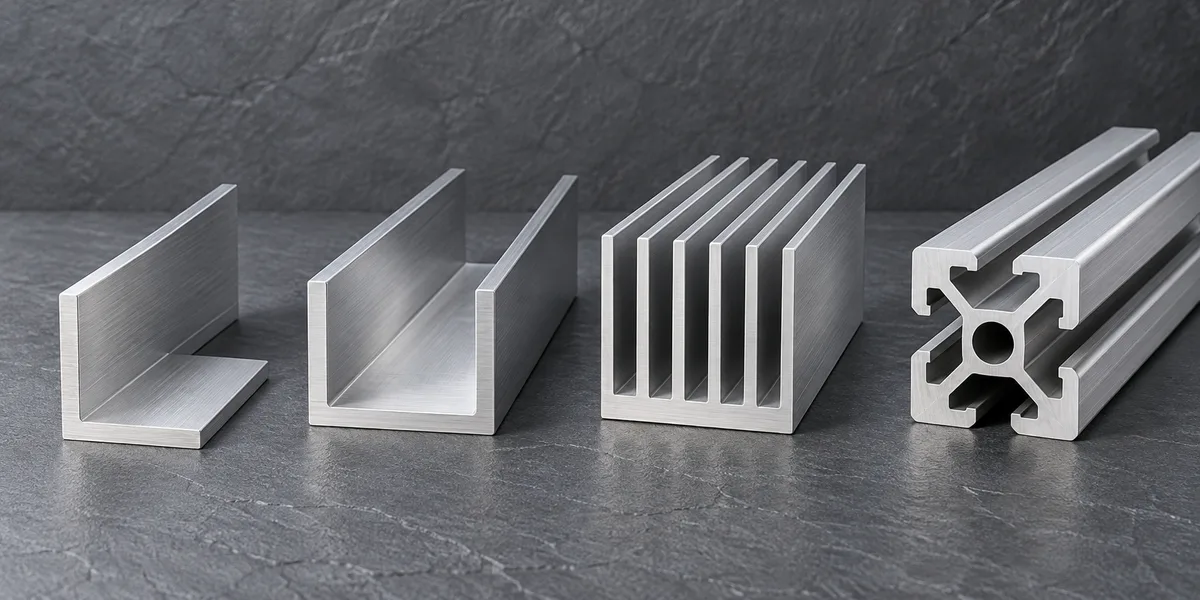
Extrusion lets designers put metal exactly where it is needed: integral stiffeners on a floor panel, thickened flanges at weld seams, or closed hollow sections for frames that must be stiff but light. Using the same alloy for profiles and armour plate keeps welding procedures, corrosion behaviour and strength consistent across the hull.
7A52 extrudes more readily than high-copper 7xxx alloys such as 7075, so reasonably complex sections can be produced, and the T6 temper is reached by press quenching or separate solution treatment followed by artificial ageing.
| Element | Limit |
|---|---|
| Silicon (Si) | 0.25 max |
| Iron (Fe) | 0.30 max |
| Copper (Cu) | 0.05 – 0.20 |
| Manganese (Mn) | 0.20 – 0.50 |
| Magnesium (Mg) | 2.0 – 2.8 |
| Chromium (Cr) | 0.15 – 0.25 |
| Zinc (Zn) | 4.0 – 4.8 |
| Titanium (Ti) | 0.05 – 0.18 |
| Zirconium (Zr) | 0.05 – 0.15 |
| Aluminium | Remainder |
| Wall thickness | Tensile strength, min | Yield strength 0.2 %, min | Elongation A50 / A, min |
|---|---|---|---|
| ≤ 65 mm | 410 MPa | 345 MPa | 8 % |
| > 65 mm | 400 MPa | 335 MPa | 8 % / 7 % |
Thicker walls cool more slowly during quenching, which is why the minimum strength falls slightly above 65 mm. For ballistic parts, ask for tests from the thickest wall of the section, since it is the weakest location.
Achievable sizes depend on section shape and wall ratio; send the drawing for a feasibility check.
The gap between a flat face of the profile and a reference surface, limited according to section width.
The angular rotation of the section along its length, measured on a flat table; limits are given per metre and over full length.
The bow along the length, measured as the maximum gap under a straight edge, per metre and over full length.
The deviation of a face from its nominal angle, limited by section width.
The surface must be free of cracks, corrosion and blisters. Minor surface defects may be dressed out by smooth blending along the length, as long as the section stays within its dimensional tolerances. Extra surface or inspection requirements, such as ultrasonic testing or dye-penetrant checks of weld preparations, should be stated on the drawing.
7A52 profiles are welded with the same procedures as 7A52 plate: MIG or hybrid laser-MIG with Al-Mg or matched Al-Zn-Mg filler, controlled heat input and time for natural ageing. Protect welded assemblies with conversion coating and paint, and avoid designs that leave sustained tensile stress in the short-transverse direction of thick flanges. Profiles can be anodised, but for armour a paint system is normal.
Yes for most sections: the T6 minimums are 410 MPa tensile and 345 MPa yield up to 65 mm wall, falling slightly to 400 / 335 MPa above that.
Yes. Using the same alloy for profiles and plate is the main reason to choose 7A52 profiles, as one welding procedure covers the whole structure.
6000 mm is standard; longer lengths can be supplied depending on section and transport.
Usually yes for a custom armour section. Send the drawing and we will confirm feasibility, tolerances and tooling.
There is no exact equivalent alloy. MIL-DTL-46083 covers weldable extruded aluminium armour in US practice, and 7039 is the closest comparable Al-Zn-Mg armour alloy.
Send your section drawing, length and quantity. We will reply with feasibility and a delivered price.





