5083
Al-Mg alloy with about 4.5 % magnesium. Non-heat-treatable, highly weldable and very corrosion resistant. Gives good fragment protection and is the natural choice when the forging is welded into a 5083 hull.



Forged aluminium armour is used where an armour part has a shape that plate cannot give, such as a hatch, a turret ring section or a thickened hull corner, but must still meet ballistic requirements. MIL-DTL-45225F covers aluminium alloy armour die forgings from 3/4 in thick; 5083 and 5456 give weldable, corrosion-resistant forgings, while 7039 gives higher strength and armour-piercing resistance. Metline supplies forged armour to drawing and specification worldwide.
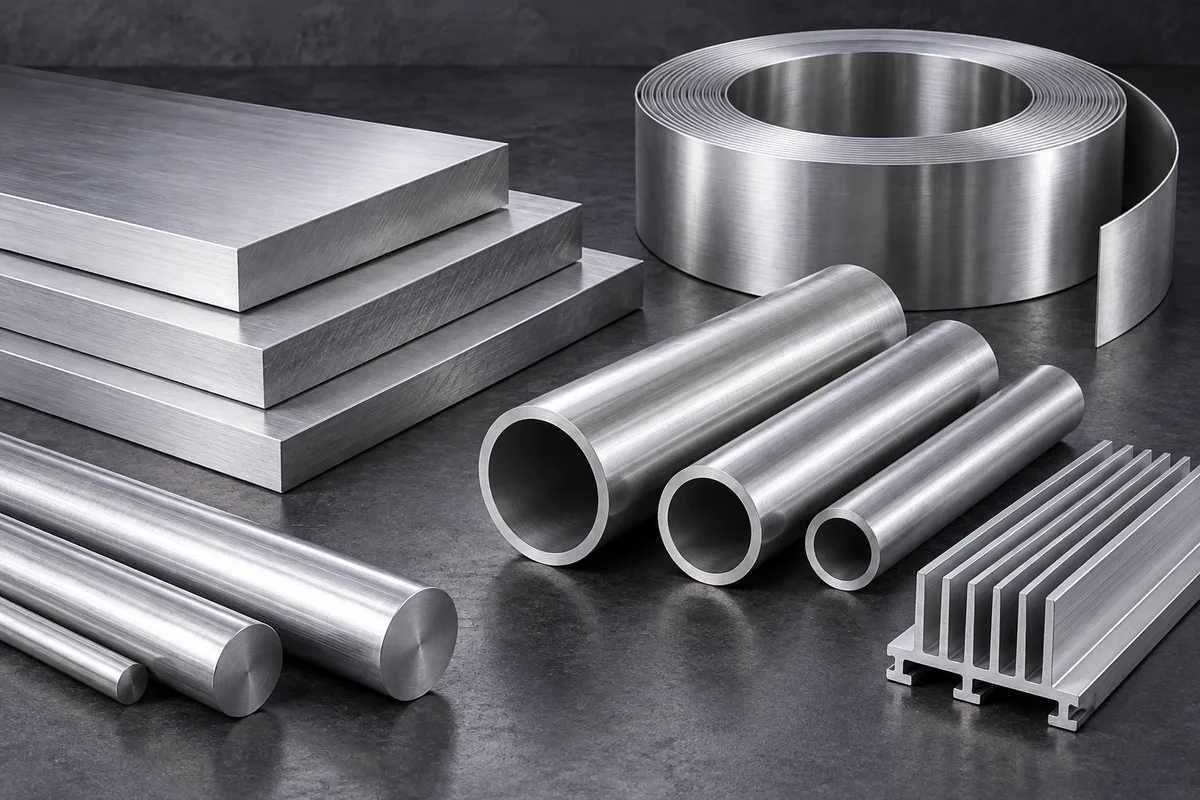
A forging is worked into shape under a press or hammer, so the metal grain follows the outline of the part. Compared with a shape machined from thick plate, a forging has more uniform properties in all directions, fewer weak planes and less waste.
Armoured vehicles contain many parts that are thick and shaped at the same time: hatch covers and rings, sponson and corner sections, mounts for weapons and suspension, and thick transitions between hull plates. Machining these from plate wastes most of the material and can expose the weak short-transverse direction of the plate on critical faces. A die forging is close to the final shape, needs less machining, and has properties defined by the forging specification rather than by plate tests.
MIL-DTL-45225F is the US detail specification for forged aluminium alloy armour. It covers die forgings from 3/4 in up to 3 in thick for Type I Class A forgings and up to 4 in for Type I Class B forgings, and it sets chemistry, mechanical property and ballistic acceptance requirements.
Al-Mg alloy with about 4.5 % magnesium. Non-heat-treatable, highly weldable and very corrosion resistant. Gives good fragment protection and is the natural choice when the forging is welded into a 5083 hull.
Higher-magnesium relative of 5083 with slightly higher strength. Used in the same way, with 5556 or 5183 filler for welding.
Al-Zn-Mg alloy that is solution treated and aged. Higher strength and better armour-piercing resistance than the 5xxx alloys, but more sensitive to stress corrosion, especially near welds.
As a working rule, 5xxx forgings are chosen when the part is welded into the hull and the main threat is fragments, while 7039 forgings are chosen for bolted or lightly welded parts where armour-piercing resistance matters more than weldability.
| Element | 5083 | 5456 | 7039 |
|---|---|---|---|
| Silicon (Si) | 0.40 | 0.25 | 0.30 |
| Iron (Fe) | 0.40 | 0.40 | 0.40 |
| Copper (Cu) | 0.10 | 0.10 | 0.10 |
| Manganese (Mn) | 0.40 – 1.0 | 0.50 – 1.0 | 0.10 – 0.40 |
| Magnesium (Mg) | 4.0 – 4.9 | 4.7 – 5.5 | 2.3 – 3.3 |
| Chromium (Cr) | 0.05 – 0.25 | 0.05 – 0.20 | 0.15 – 0.25 |
| Zinc (Zn) | 0.25 | 0.25 | 3.5 – 4.5 |
| Titanium (Ti) | 0.15 | 0.20 | 0.10 |
| Others, each / total | 0.05 / 0.15 | 0.05 / 0.15 | 0.05 / 0.15 |
| Aluminium | Remainder | Remainder | Remainder |
Registered Aluminum Association limits; single values are maximums.
Forging specifications set minimums that depend on the alloy class and on the direction in which the test piece is taken relative to the grain flow. The higher values apply in the main grain direction, the lower ones across it.
| Alloy group | Thickness | Tensile strength, min | Yield strength (0.2 %), min | Elongation, min |
|---|---|---|---|---|
| 5083 / 5456 | 0.75 – 3.0 in | 40 – 42 ksi (276 – 290 MPa) | 32 – 33 ksi (221 – 228 MPa) | 4 – 7 % |
| 7039 | 0.75 – 4.0 in | 54 – 57 ksi (372 – 393 MPa) | 45 – 48 ksi (310 – 331 MPa) | 4 – 8 % |
Ranges summarise the with-grain and across-grain minimums commonly quoted for these forgings. Confirm the exact figures for each direction against the specification revision on your order.
Forged armour is accepted on ballistic tests of representative test plates as well as on mechanical tests. The test projectile changes with thickness, so that each thickness band is tested against a realistic threat. The V50 ballistic limit, the velocity at which half the shots are expected to perforate, must meet the minimum the specification sets for the nominal thickness, and the required V50 rises steeply with thickness.
| Nominal thickness band | Typical test projectile | Threat represented |
|---|---|---|
| About 0.7 – 1.1 in | .50 calibre fragment-simulating projectile (FSP) | Shell and mine fragments |
| About 1.1 – 1.7 in | .30 calibre AP M2 and 20 mm FSP | Rifle AP rounds and large fragments |
| About 1.7 – 3.0 in | .50 calibre AP M2 | Heavy machine-gun AP rounds |
| Over 3.0 in (7039 only) | Larger-calibre AP projectile | Cannon-calibre threats |
Bands are indicative; 7039 changes projectile at slightly lower thicknesses than the 5xxx alloys because it is stronger. The governing values are the tables in the specification.
Ballistic tests follow MIL-STD-662 procedures for V50 determination. For production parts, the purchaser and supplier agree how test plates represent the forgings, for example by forging test blocks from the same lot with the same reduction.
A typical example is a crew hatch: the frame is forged in 5083 so that it can be welded into a 5083 hull, and the hatch lid may be forged in 7039 and bolted on, giving the lid better AP resistance without welding it.
MIL-DTL-45225F, Aluminum Alloy Armor, Forged. It covers die forgings from 3/4 in to 3 in thick for Type I Class A and up to 4 in for Type I Class B, with mechanical and ballistic requirements.
For shaped, thick parts, yes. The grain follows the shape, properties are more even and less material is machined away. For flat panels, rolled armour plate is simpler and cheaper.
Yes. 5083 and 5456 forgings weld readily with 5183 or 5556 filler and do not need heat treatment after welding, which is why they are used for parts welded into 5xxx hulls.
7039 is more susceptible to stress-corrosion cracking than 5083, particularly in the heat-affected zone of welds, and it is harder to weld. It is chosen where AP resistance matters more and the part can be bolted or carefully welded and protected.
Chemistry and tensile tests on every lot, ultrasonic and penetrant inspection as specified, and ballistic V50 tests on representative test plates when the order calls for MIL-DTL-45225F acceptance.
Send the drawing, alloy, quantity and specification. We will reply with feasibility, test scope and a delivered price.





