7B05-T4
Solution treated and naturally aged. Softer and more ductile, so it suits parts that are bent or formed after extrusion and later artificially aged, or welded structures where maximum toughness matters.



7B05 is a weldable, medium-strength aluminium-zinc-magnesium alloy from the Chinese GB/T 3190 system, closely related to JIS 7N01 and to European 7005 and 7020. In T5 and T6 it gives minimum yield strengths of about 245 – 275 MPa with good weld-zone recovery, which is why it is used for vehicle frames, chassis members and rail car underframes. Metline supplies 7B05 profiles to drawing, worldwide.
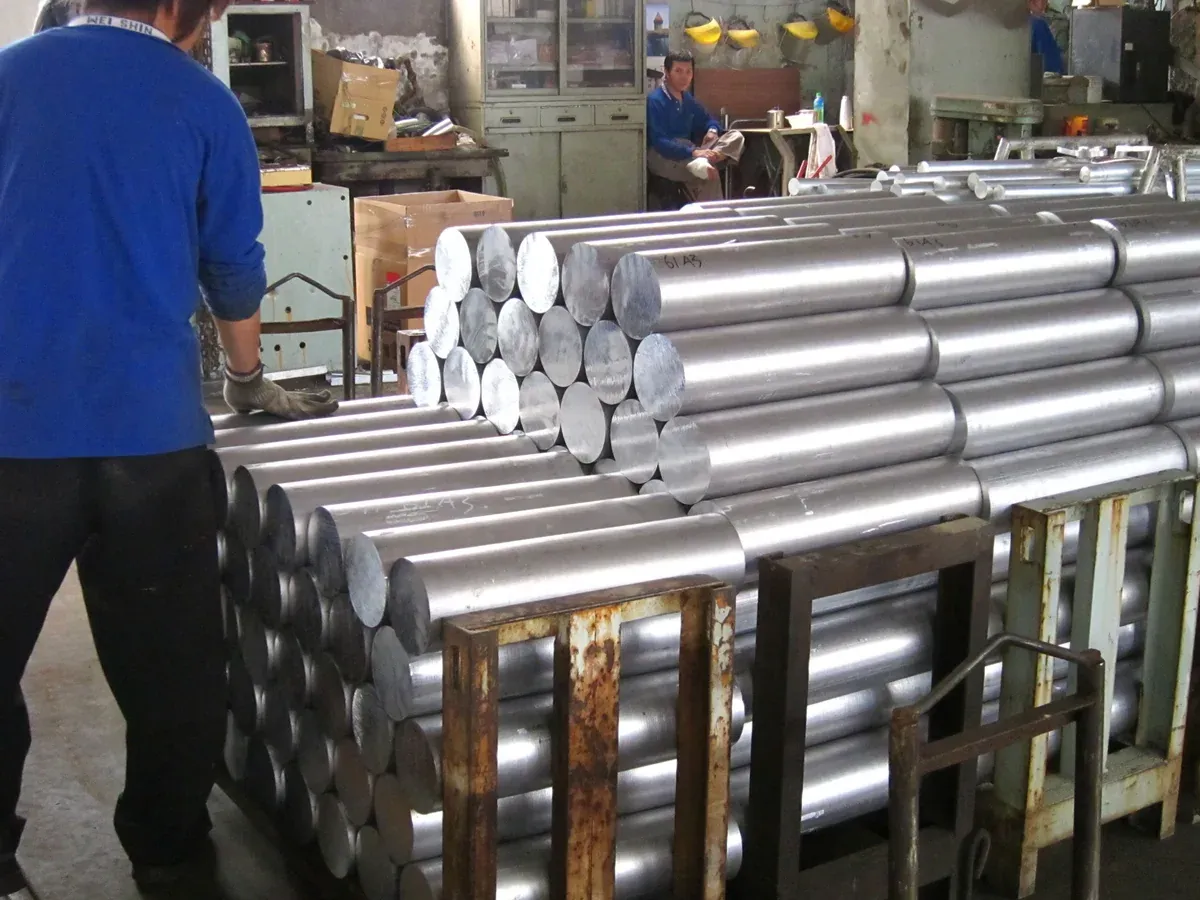
7B05 is designed for welded structures. Its zinc-magnesium balance gives it strength above 6061 and 6082, while its low copper content and natural-ageing behaviour mean that welded joints regain much of their strength at room temperature. It is widely used for the underframes and traction beams of rail vehicles and for welded road-vehicle structures.
The alloy contains about 4 – 5 % zinc and 1 – 2 % magnesium, with manganese, chromium, zirconium and vanadium additions for grain-structure control. This places it in the same family as JIS 7N01 (used for Japanese rail car bodies) and European 7005 and 7020. Buyers familiar with any of those grades will find 7B05 behaves very similarly in extrusion, welding and service.
Because Al-Zn-Mg alloys of this type are only mildly quench-sensitive, 7B05 is often supplied in T5, cooled at the press and artificially aged. T6, with separate solution treatment, gives slightly higher minimum strength and more uniform properties in thicker walls.
Main limits for 7B05 as published in GB/T 3190, in line with the closely related JIS 7N01. Confirm the current edition of the standard for the full list of trace elements; every lot ships with its actual analysis.
| Element | Range or maximum | Role |
|---|---|---|
| Zinc (Zn) | 4.0 – 5.0 | Strengthening with Mg |
| Magnesium (Mg) | 1.0 – 2.0 | Strengthening with Zn |
| Manganese (Mn) | 0.20 – 0.70 | Grain control, toughness |
| Chromium (Cr) | ≤ 0.30 | Grain control, SCC resistance |
| Zirconium (Zr) | ≤ 0.25 | Inhibits recrystallisation |
| Vanadium (V) | ≤ 0.10 | Grain control |
| Copper (Cu) | ≤ 0.20 | Kept low for weldability |
| Silicon (Si) | ≤ 0.30 | Impurity |
| Iron (Fe) | ≤ 0.35 | Impurity |
| Titanium (Ti) | ≤ 0.20 | Grain refiner |
| Aluminium (Al) | Remainder |
Some listings give 7B05 with 5.5 – 6.5 % zinc and up to 0.6 % copper. Those values do not match the standard alloy; check your certificate against GB/T 3190.
Minimums below are the values commonly specified for 7B05 extrusions up to about 25 mm wall thickness, consistent with the JIS 7N01 requirements. Natural ageing continues for some weeks after quenching, so T4 values are measured after a stabilisation period agreed in the specification.
| Temper | Tensile strength (min.) | Yield strength 0.2 % (min.) | Elongation (min.) |
|---|---|---|---|
| T5 | 325 MPa | 245 MPa | 10 % |
| T6 | 335 MPa | 275 MPa | 10 % |
| T4 | Lower than T5; per agreed specification | — | Higher than T5 |
Solution treated and naturally aged. Softer and more ductile, so it suits parts that are bent or formed after extrusion and later artificially aged, or welded structures where maximum toughness matters.
Cooled at the press and artificially aged. The most common temper for large hollow rail and vehicle profiles: good strength, low distortion and no separate solution treatment.
Separately solution heat-treated, quenched and aged. Highest minimum strength and most uniform through thick walls.
| System | Nearest grade | Note |
|---|---|---|
| China (GB) | 7B05 | GB/T 3190 composition; GB/T 6892 and GB/T 33910 profiles |
| Japan (JIS) | 7N01 | Very close in composition and use (rail car bodies) |
| Aluminum Association / EN | 7005, EN AW-7020 | Similar family; not identical limits |
Extrusion dies are made to your drawing. Send the section with critical dimensions and tolerances.
MIG and TIG weld well with ER5356 or ER5183 filler, the standard choice for rail car bodies in this alloy family. The heat-affected zone softens but recovers much of its strength by natural ageing over several weeks; allow for this before proof loading.
Like all Al-Zn-Mg alloys, 7B05 can crack under sustained tensile stress in damp or salty service if the temper, residual stress and grain structure are wrong. Specify a controlled ageing practice, avoid cold forming after ageing, keep assembly stresses low, and ask for SCC test data (for example ASTM G47 alternate immersion) on critical parts.
Stretch bending and rotary-draw bending are best done in the freshly quenched (W) or T4 condition, then aged to T5 or T6. Bending in the fully aged condition needs generous radii and raises residual stress.
Machines more cleanly than 6xxx alloys in the aged condition, with short chips and a good finish using sharp carbide tools and flood coolant.
Accepts anodising, e-coating and powder coating. Zinc-rich alloys anodise with a slight yellow-grey tint, so check colour needs for visible parts. Coatings also add a barrier against galvanic and stress corrosion.
Isolate 7B05 from steel, carbon fibre and copper with sealants, coatings or insulating washers, and use coated fasteners, to avoid galvanic corrosion in wet road environments.
Welded 7B05 frames are designed to fatigue detail categories for aluminium. Grind or dress weld toes on highly loaded joints and avoid sharp section changes.
Doors, bonnets and boot lids are pressed from 5xxx and 6xxx sheet rather than extruded 7B05; the profile alloy is used in the reinforcements and frames behind them.
| Property | 7B05-T6 | 7005-T6 | 6082-T6 | 7003-T5 |
|---|---|---|---|---|
| Minimum or typical yield | ≥ 275 MPa (min.) | about 290 MPa (typ.) | ≥ 250 – 260 MPa (min.) | ≥ 260 MPa (min.) |
| HAZ recovery by natural ageing | Yes | Yes | No | Yes |
| Extrudability of large hollows | Good | Good | Very good | Good |
| Main standard | GB/T 3190 | ASTM B221 | EN 755-2 | EN 755-2 |
The closest is JIS 7N01. 7005 and EN AW-7020 belong to the same Al-Zn-Mg family and are often used as alternatives, though their limits are not identical.
Yes. It is designed for welded structures and is welded with ER5356 or ER5183. The weld zone recovers much of its strength by natural ageing.
Commonly specified minimums are 325 MPa tensile, 245 MPa yield and 10 % elongation for sections up to about 25 mm.
It extrudes into large hollow profiles, welds well and is stronger than 6xxx alloys, which suits long welded underframes and traction beams.
Yes. We supply 7B05 worldwide, certified to GB/T or to an agreed specification with an EN 10204 3.1 certificate.
Send drawings, temper and volumes. We will reply with feasibility, certification and a delivered price.






