6063-O
Fully annealed, maximum formability. Use for deep-drawn covers and complex trim shapes. Strength can be restored by solution treatment and ageing after forming.



6063 is best known as an extrusion alloy, but it is also rolled into sheet and plate for parts that must match 6063 extrusions in appearance, anodise brightly, conduct heat well or be formed and then aged. Typical automotive uses are decorative trim panels, heat spreaders and battery cooling plates, covers and lightly loaded brackets. Metline supplies 6063 sheet and plate in O, T4 and T6, cut to size with the surface finish you need, to manufacturers worldwide.
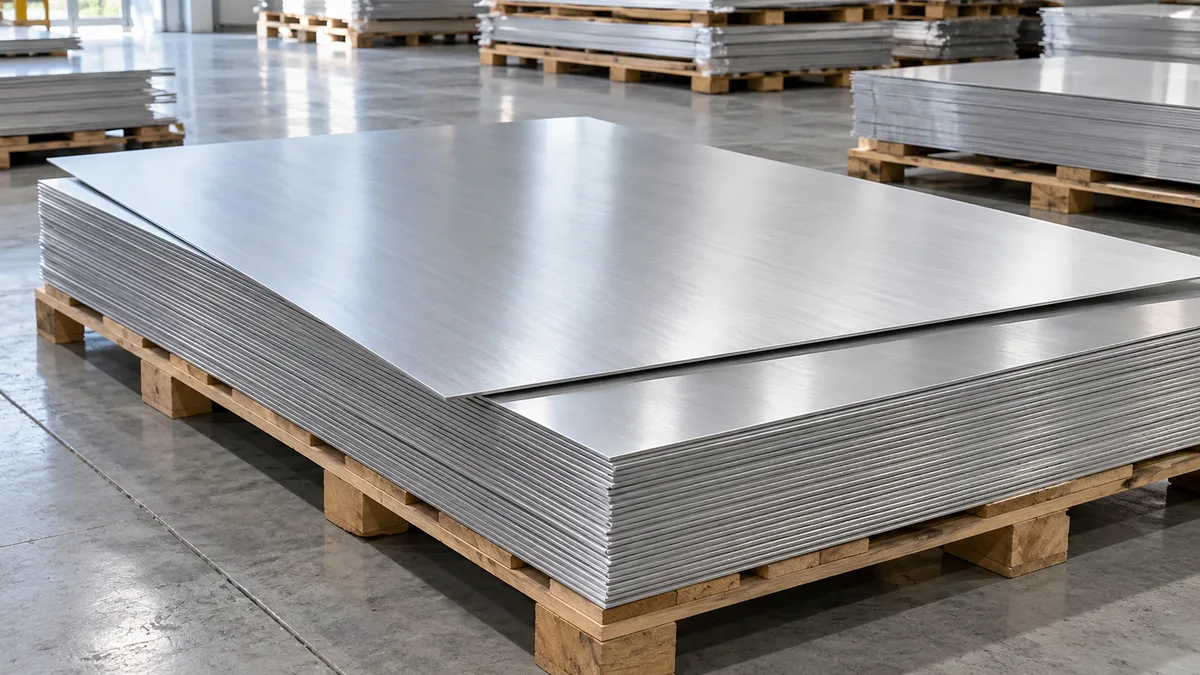
Most automotive sheet is chosen for strength or formability: 5754 and 5182 for inner panels, 6016 and 6022 for outer panels, 6061 and 6082 for structural brackets. 6063 sheet is chosen for different reasons: its lean, low-iron chemistry gives an even, bright anodised finish that matches 6063 extrusions, its thermal conductivity is among the highest of the heat-treatable alloys, and it forms readily in the O and T4 tempers.
That makes it useful where sheet and extrusions sit side by side and must look identical after anodising, for example trim panels fitted between 6063 roof rails or window frames. It is also used for flat heat spreaders, cooling plates and electronics covers in electric vehicles, where conductivity matters more than strength.
Buyers should be realistic about its limits. 6063 sheet is less widely rolled than 6061 or 5754, so not every width and gauge is available from stock, and its T6 strength is roughly 20 % below 6061-T6. For brackets and reinforcements that carry significant load, 6061 or 6082 sheet is usually the better choice; for complex drawn structural parts, 5754-O.
Sheet uses the same registered composition as 6063 extrusions. Strontium, vanadium or gallium are not specified elements in 6063; where they appear on a certificate they fall under "others", limited to 0.05 % each.
| Element | Minimum | Maximum | Role |
|---|---|---|---|
| Silicon (Si) | 0.20 | 0.6 | Forms Mg2Si with magnesium |
| Iron (Fe) | — | 0.35 | Kept low for bright anodising |
| Copper (Cu) | — | 0.10 | |
| Manganese (Mn) | — | 0.10 | |
| Magnesium (Mg) | 0.45 | 0.9 | Main strengthening element |
| Chromium (Cr) | — | 0.10 | |
| Zinc (Zn) | — | 0.10 | |
| Titanium (Ti) | — | 0.10 | Grain refiner |
| Others, each / total | — | 0.05 / 0.15 | |
| Aluminium (Al) | Remainder | About 97.5 – 99.4 % |
Values below are typical properties published for wrought 6063 by the Aluminum Association and ASM. Specified minimums for sheet depend on the standard used and should be confirmed on the order; the mill certificate reports actual results.
| Temper | Tensile strength (typical) | Yield strength (typical) | Elongation (typical) | Hardness (typical) |
|---|---|---|---|---|
| O (annealed) | about 90 MPa | about 48 MPa | about 25 – 30 % | about 25 HB |
| T4 | about 172 MPa | about 90 MPa | about 22 % | about 46 HB |
| T6 | about 241 MPa | about 214 MPa | about 12 % | about 73 HB |
Some trade tables give 6063-T4 sheet as "≥ 190 MPa tensile". That is above typical 6063-T4 values and close to T6 levels, so it should not be used as a design minimum.
Fully annealed, maximum formability. Use for deep-drawn covers and complex trim shapes. Strength can be restored by solution treatment and ageing after forming.
Solution treated and naturally aged. Good formability with more strength than O; age to T6 at about 175 – 185 °C after forming.
Fully aged for maximum strength. Best for flat or lightly bent parts such as heat spreaders and panels.
H116 is a marine temper for 5xxx alloys and is not applicable to 6063. H112 6063 plate is simply as-rolled and has no guaranteed heat-treated strength.
6063 sheet is rolled in smaller volumes than 6061 or 5754; confirm gauge and width early in a project.
| Option | Code often used | Purpose |
|---|---|---|
| Mill finish | MF | Standard rolled surface; base for further treatment |
| Electro-discharge textured | EDT | Fine isotropic texture that holds lubricant and improves paint appearance |
| Ti/Zr conversion coating | P | Pretreatment for adhesive bonding and paint adhesion |
| No protection | NP | Clean, untreated surface for immediate processing |
| Dry-film lubricant | DO | Uniform, clean lubrication for deep drawing |
| Electrostatic oiling | EO | Thin, even oil film for forming and temporary corrosion protection |
6063 sheet is less standardised than 6061. It is commonly supplied to China's GB/T 3880 sheet standard, or to ASTM B209 or EN 485 tolerance rules with properties agreed in the contract. Representative thickness tolerances for cold-rolled automotive sheet are:
| Thickness (mm) | Width ≤ 1500 mm | > 1500 – 1700 mm | > 1700 – 2000 mm | > 2000 – 2400 mm |
|---|---|---|---|---|
| 0.30 – 0.50 | ± 0.03 | ± 0.04 | — | — |
| > 0.50 – 0.80 | ± 0.03 | ± 0.04 | ± 0.04 | — |
| > 0.80 – 1.20 | ± 0.04 | ± 0.04 | ± 0.05 | ± 0.06 |
| > 1.20 – 2.00 | ± 0.05 | ± 0.05 | ± 0.06 | ± 0.07 |
| > 2.00 – 2.50 | ± 0.06 | ± 0.07 | ± 0.07 | ± 0.08 |
| > 2.50 – 3.00 | ± 0.07 | ± 0.08 | ± 0.08 | ± 0.09 |
| > 3.00 – 3.50 | ± 0.08 | ± 0.09 | ± 0.10 | ± 0.11 |
| Part | Typical temper | Why 6063 |
|---|---|---|
| Decorative trim panels beside 6063 rails and frames | T5 or T6 | Anodised colour match with extrusions |
| Interior decorative panels and inlays | O or T4, aged | Brushed or bright finish, easy forming |
| Heat spreaders and battery cooling plates | T6 or O | High thermal conductivity |
| Electronics and charger covers | T4, aged | Formable, light and conductive |
| Light brackets and clips | T6 | Adequate strength for non-structural mounts |
Door frames, window frames and roof rails are normally extruded rather than formed from sheet. Radiators use brazing sheet, and suspension and brake parts are forged or cast; 6063 sheet is not a substitute in those roles.
| Property | 6063-T6 | 6061-T6 | 5754-O | 5005-H34 |
|---|---|---|---|---|
| Tensile strength (typical) | about 241 MPa | about 310 MPa | about 220 MPa | about 160 MPa |
| Anodised appearance | Excellent | Good | Fair | Excellent |
| Thermal conductivity | about 200 W/m·K | 167 W/m·K | about 130 W/m·K | about 200 W/m·K |
| Heat-treatable | Yes | Yes | No | No |
| Typical use | Trim, cooling plates | Brackets, plates | Inner structures | Anodised panels |
If you only need an anodised, non-heat-treatable panel, 5005 is widely available and matches anodised 6063 closely. Choose 6063 sheet when you need heat-treatable strength as well as the appearance match.
Both. Extrusions are far more common, but 6063 is also rolled into sheet and plate, typically in O, T4 and T6, for parts that need its anodising quality or conductivity.
Typical values are about 241 MPa tensile and 214 MPa yield with around 12 % elongation, roughly 20 % lower than 6061-T6.
Mainly for appearance and conductivity. 6063 anodises more evenly and brightly and conducts heat better. Choose 6061 when strength is the priority.
Yes. Form in O or T4, then age (from T4) or solution treat and age (from O) to reach T6 strength.
It is the closest match available, but rolled and extruded surfaces can still differ slightly. Anodise trial pieces of both together before production.
Yes. We ship 6063 sheet and plate worldwide with mill certificates and protective export packing on EXW, FOB, CIF or DAP terms.
Send temper, size, surface and quantity. Our team will confirm availability and reply with delivered pricing.





