Drawing and stretching
O temper draws deeply; Lüders (stretcher-strain) bands are less pronounced than in 5182, but exposed surfaces should still be checked. Use lubricated or EDT-textured surfaces for deep draws.



5049 (EN AW-5049, AlMg2Mn0.8) is a medium-strength aluminium-magnesium-manganese alloy that forms well in the annealed O and H111 tempers and does not become sensitive to intergranular corrosion in warm service. It is used for inner panels, reinforcements, floor and cab panels, heat shields and tanks. Metline supplies 5049 automotive sheet and coil to EN 485, GB/T 33227 and customer specifications worldwide.
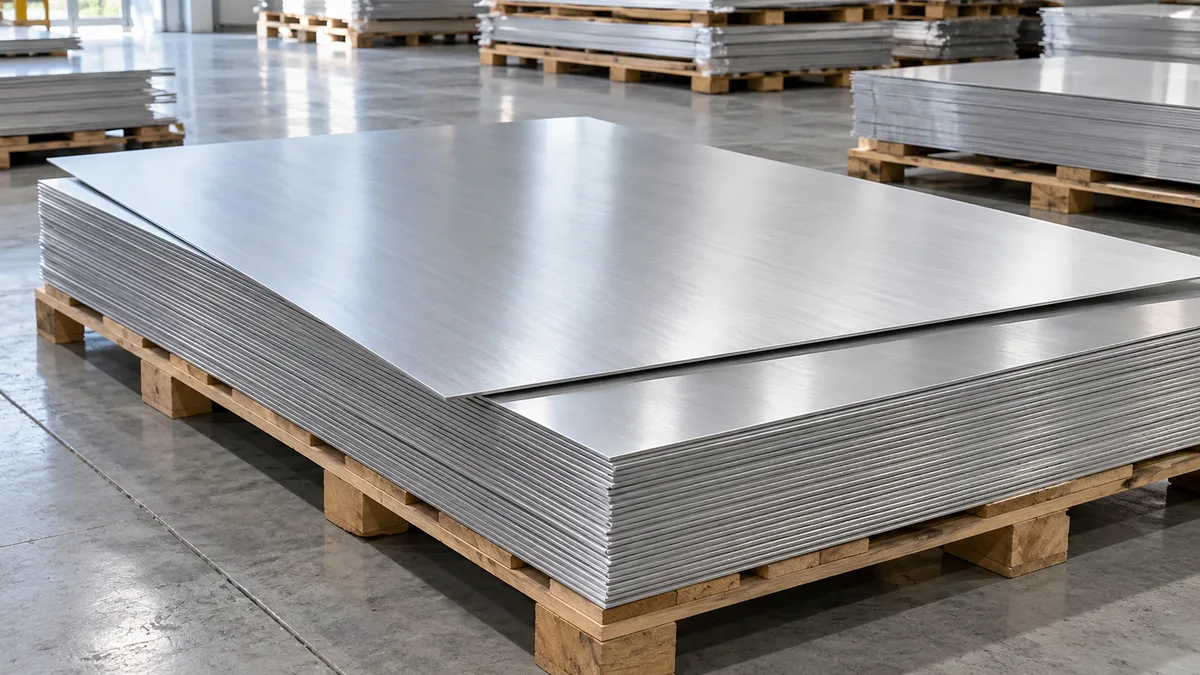
5049 combines 1.6 – 2.5 % magnesium with 0.5 – 1.1 % manganese. The magnesium provides solid-solution strength, and the manganese adds further strength and a fine, stable grain structure. The result is an annealed sheet that is noticeably stronger than 5052-O while keeping excellent drawability.
For body engineers, 5049 sits between the formability-led alloys (3xxx, 5005) and the high-magnesium inner-panel alloys (5182, 5754). Its main advantage over 5182 is that, with magnesium below about 3 %, it does not form continuous grain-boundary β-phase during long service above roughly 65 °C, so it remains resistant to intergranular and stress corrosion near engines, exhausts and battery heat sources.
The O temper is fully recrystallised and gives the best drawing and stretch-forming performance. H111 is annealed sheet that has received a slight amount of strain from levelling or stretching, which improves flatness for blanking and laser cutting with practically no change in properties.
Limits follow the Aluminum Association registration and EN 573-3 (EN AW-5049). The measured analysis of each lot is reported on the mill certificate.
| Element | Minimum | Maximum | Role in the alloy |
|---|---|---|---|
| Silicon (Si) | — | 0.40 | Impurity |
| Iron (Fe) | — | 0.50 | Impurity |
| Copper (Cu) | — | 0.10 | Kept low for corrosion resistance |
| Manganese (Mn) | 0.50 | 1.1 | Strength and grain control |
| Magnesium (Mg) | 1.6 | 2.5 | Main strengthening element |
| Chromium (Cr) | — | 0.30 | Grain control |
| Zinc (Zn) | — | 0.20 | |
| Titanium (Ti) | — | 0.10 | Grain refiner |
| Others, each / total | — | 0.05 / 0.15 | |
| Aluminium (Al) | Remainder | About 95.3 – 97.9 % |
The specified ranges below apply to automotive and general-engineering sheet from 0.3 to 3.5 mm. They agree with EN 485-2 values for EN AW-5049 in O and H111.
| Supply temper | Test temper | Thickness (mm) | Tensile strength Rm | Yield strength Rp0.2 (min) | Elongation A50 (min) |
|---|---|---|---|---|---|
| O | O | 0.30 – 3.50 | 190 – 240 MPa | 80 MPa | 16 % (thinner gauges slightly lower) |
| H111 | H111 | 0.30 – 3.50 | 190 – 240 MPa | 80 MPa | 14 % |
Typical results for O-temper 5049 are about 210 MPa tensile and 90 MPa yield strength with around 18 – 20 % elongation. Strain-hardened tempers (H22 – H28, H32 – H38) are available for flat parts that need more yield strength.
Widths, coil weights and surface combinations are confirmed against your press-line and blanking requirements at quotation.
5049 weighs 2.70 kg per square metre for each millimetre of thickness:
| Thickness (mm) | kg per m² | 1250 × 2500 mm (kg) | 1500 × 3000 mm (kg) |
|---|---|---|---|
| 0.5 | 1.35 | 4.2 | 6.1 |
| 0.7 | 1.89 | 5.9 | 8.5 |
| 0.8 | 2.16 | 6.8 | 9.7 |
| 1 | 2.70 | 8.4 | 12.2 |
| 1.2 | 3.24 | 10.1 | 14.6 |
| 1.5 | 4.05 | 12.7 | 18.2 |
| 2 | 5.40 | 16.9 | 24.3 |
| 2.5 | 6.75 | 21.1 | 30.4 |
| 3 | 8.10 | 25.3 | 36.5 |
A body sheet is judged on more than tensile strength. Automotive sheet standards such as GB/T 33227 and the OEM material specifications that sit above them add forming, surface and processing requirements. The table summarises the points that are usually written into the purchase order.
| Requirement | What it controls | How it is specified |
|---|---|---|
| Hemming / flanging grade | Whether the edge can be folded flat (hemmed) around an inner panel without cracking | Grade agreed on the order; checked with flat-hem or bend tests |
| Paint-brush lines | Fine streaks that become visible after painting on outer panels | Grade agreed on the order for exposed parts |
| Forming limit (FLD) | The strain combinations the sheet can survive before necking | Forming limit curve supplied when the buyer requests it |
| Dent resistance | Resistance of finished panels to local denting | Test data supplied on request |
| High-strain-rate tensile data | Behaviour in crash simulation | Supplied on request for crash-relevant parts |
| Oil amount | Lubricant weight for pressing and corrosion protection in transit | g/m² per side, agreed on the order |
| Passivation / conversion film | Bonding and paint adhesion | Coating type and weight agreed on the order |
| Appearance | Scratches, roll marks, colour variation | Stricter for outer panels; minor marks that do not affect forming are acceptable on inner and structural parts |
For the wider 0.3 – 3.5 mm range, the thickness tolerances below are typical of automotive sheet orders; tighter values can be agreed for specific programmes.
| Thickness (mm) | Width ≤ 1,500 mm | Width > 1,500 – 2,000 mm | Width > 2,000 – 2,400 mm |
|---|---|---|---|
| 0.30 – 0.80 | ±0.02 mm | ±0.03 mm | — |
| > 0.80 – 1.20 | ±0.03 mm | ±0.04 mm | ±0.05 mm |
| > 1.20 – 2.00 | ±0.04 mm | ±0.05 mm | ±0.06 mm |
| > 2.00 – 2.50 | ±0.04 – 0.05 mm | ±0.05 mm | ±0.07 mm |
| > 2.50 – 3.00 | ±0.05 – 0.06 mm | ±0.07 mm | ±0.08 mm |
| > 3.00 – 3.50 | ±0.06 – 0.07 mm | ±0.08 mm | ±0.09 mm |
O temper draws deeply; Lüders (stretcher-strain) bands are less pronounced than in 5182, but exposed surfaces should still be checked. Use lubricated or EDT-textured surfaces for deep draws.
Resistance spot welding needs controlled surface oxide; a conversion-coated or pickled surface gives more consistent electrode life. Laser and MIG welding with 5xxx fillers work well.
Titanium/zirconium pre-treatment improves bond durability for bonded and riveted inner structures.
Very good resistance to road salt and humidity; stable in warm service where 5182 and 5083 would need caution.
Compatible with phosphate or zirconium pre-treatment and e-coat lines used for aluminium bodies.
Body-shop offcuts of 5049 can be returned as clean, segregated 5xxx scrap.
Older descriptions list 5049 sheet for brake discs, cylinder blocks and suspension arms. Those parts are cast, forged or made of iron; sheet is not used for them.
| Property (O temper) | 5052 | 5049 | 5754 | 5182 |
|---|---|---|---|---|
| Magnesium (%) | 2.2 – 2.8 | 1.6 – 2.5 | 2.6 – 3.6 | 4.0 – 5.0 |
| Tensile strength Rm | 170 – 215 MPa | 190 – 240 MPa | 190 – 240 MPa | 255 – 315 MPa |
| Yield strength (min) | 65 MPa | 80 MPa | 80 MPa | 110 MPa |
| Warm-service sensitisation risk | Low | Low | Low–moderate | Higher above about 65 °C |
| Typical body use | Brackets, tanks | Inners, floors, shields | Inners, structures, wheel arches | Deep-drawn inners |
5049 and 5754 have the same specified property range in O temper; 5754 is more widely specified in European body programmes, while 5049 offers a slightly leaner magnesium content. Choose 5182 when the extra strength of a 4.5 % Mg alloy is needed and the part stays cool.
Inner panels, reinforcements, floor and cab panels, heat shields, tanks and battery-pack covers: formed parts that need more strength than 3xxx alloys and must resist corrosion.
Both are annealed with the same property range. H111 has a little strain from levelling or stretching, which improves flatness for blanking.
No, but they are close. 5754 has more magnesium (2.6 – 3.6 %), while both carry the same O-temper property range of 190 – 240 MPa tensile.
Yes. With magnesium below about 3 %, 5049 is not prone to sensitisation in warm service, unlike 5182 or 5083.
Yes. Consistent surface condition matters; conversion-coated or cleaned surfaces give more stable spot-weld quality.
Yes. Metline ships 5049 sheet and coil worldwide from Mumbai with EN 10204 3.1 certificates, on EXW, FOB, CIF or DAP terms.
Send the temper, gauge, width, surface and volume. We will reply with availability, certification and a delivered price.





