Pressing and drawing
O and H24 sheet draws well; H14 is better for flat panels and shallow forms. Embossing for heat shields is routine and adds stiffness.



3A21 is the Chinese GB designation for an aluminium-manganese alloy that is close to 3003, with slightly wider manganese limits and lower magnesium and zinc. In H14 and H24 tempers it gives a moderately strong, very formable and corrosion-resistant sheet for heat shields, tanks, air ducts, trim and other non-structural vehicle parts. Metline supplies 3A21 sheet and coil to GB/T 33227, ASTM B209 and EN 485 to buyers worldwide.
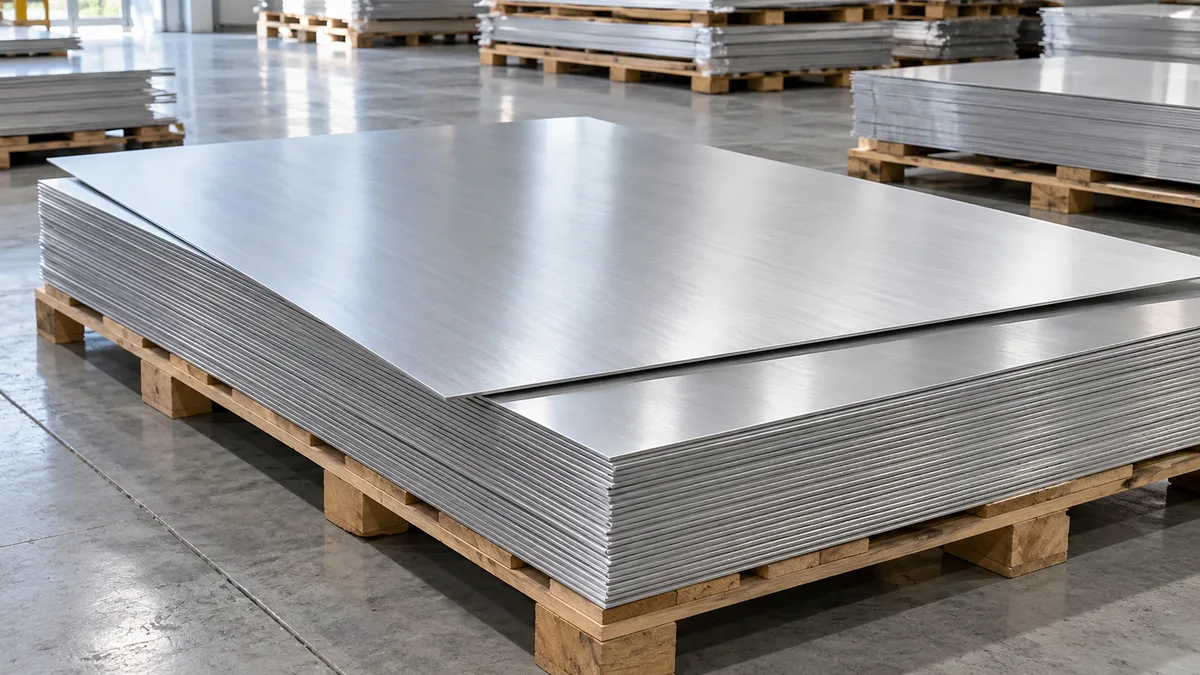
3A21 (formerly LF21 in China, and the counterpart of the Russian AMts) is a non-heat-treatable aluminium-manganese alloy. Manganese in the range 1.0 – 1.6 % gives it about 20 % more strength than commercially pure aluminium while keeping excellent formability, weldability and corrosion resistance.
In vehicles, 3A21 is a workhorse for parts that need to be formed, joined and left in service for years without corrosion, but that do not carry crash or structural loads. Typical examples are heat shields over exhausts and turbochargers, fuel and fluid tanks for commercial vehicles, air and HVAC ducts, battery-pack covers and liners, wheel-arch and underbody shields, and interior trim backings.
It is worth being clear about what 3A21 is not used for. Modern aluminium outer panels (bonnets, doors, roofs) are made from bake-hardenable 6xxx alloys such as 6016 or 6014, and inner panels from high-magnesium 5xxx alloys such as 5182 or 5754, because those grades reach much higher strength and dent resistance. 3A21 cannot be hardened by heat treatment, so where older literature suggests it for bonnets or doors, a 6xxx or 5xxx body sheet is the right choice.
Limits follow GB/T 3190. Each delivery carries a mill certificate with the measured analysis of the lot.
| Element | 3A21 (GB/T 3190) | 3003 (AA / EN AW-3003) | Comment |
|---|---|---|---|
| Silicon (Si) | ≤ 0.60 | ≤ 0.6 | Impurity |
| Iron (Fe) | ≤ 0.70 | ≤ 0.7 | Impurity |
| Copper (Cu) | ≤ 0.20 | 0.05 – 0.20 | 3003 requires a minimum copper content; 3A21 does not |
| Manganese (Mn) | 1.0 – 1.6 | 1.0 – 1.5 | Main alloying element |
| Magnesium (Mg) | ≤ 0.05 | — | |
| Zinc (Zn) | ≤ 0.10 | ≤ 0.10 | |
| Titanium (Ti) | ≤ 0.15 | — | Grain refiner |
| Others, each / total | 0.05 / 0.10 | 0.05 / 0.15 | |
| Aluminium (Al) | Remainder | Remainder |
Because 3A21 may contain no copper at all while 3003 needs at least 0.05 %, a 3A21 lot does not automatically satisfy a 3003 order, and vice versa. Where cross-certification matters, ask for the chemistry to be held inside both ranges.
Values are the ranges commonly applied to 3A21 sheet under GB/T 3880 and GB/T 33227. H14 is strain-hardened to half-hard; H24 reaches a similar strength by harder rolling followed by partial annealing, which leaves more ductility for forming.
| Temper | Thickness (mm) | Tensile strength Rm | Elongation A50 (min) | Typical use |
|---|---|---|---|---|
| O (annealed) | 0.3 – 3.5 | 100 – 150 MPa | about 20 % (thickness-dependent) | Deep drawing, spinning, complex shields |
| H14 | 0.8 – 4.5 | 145 – 215 MPa | 6 % or more (varies with thickness) | Flat and lightly formed panels, ducts |
| H24 | 0.8 – 4.5 | 145 MPa min | 6 % or more, typically higher than H14 | Pressed parts needing strength and formability |
| H18 (on request) | thin gauges | about 185 MPa min | low | Stiff flat covers and trim |
Yield strength is not always specified for 3A21 in GB tables; typical 0.2 % proof values are about 40 MPa in O and about 125 – 145 MPa in H14/H24. The certificate for each lot states the measured values.
| System | Designation | Relationship to 3A21 |
|---|---|---|
| China (GB) | 3A21 (formerly LF21) | Chemistry to GB/T 3190; automotive sheet to GB/T 33227; general sheet to GB/T 3880 |
| Russia / CIS (GOST) | AMts (АМц), 1400 | Essentially the same alloy |
| Aluminum Association / ASTM | Nearest: 3003 | Sheet to ASTM B209; copper minimum differs |
| European (EN) | Nearest: EN AW-3003 (AlMn1Cu) | Sheet to EN 485; EN AW-3103 is the copper-free near match |
| Japan (JIS) | Nearest: A3003P | Sheet to JIS H4000 |
For a copper-free equivalent in the European system, EN AW-3103 (AlMn1) is often a closer chemical match than 3003. We confirm which designation will appear on the certificate before production.
Widths, coil weights and surface combinations are confirmed against your press-line and blanking requirements at quotation.
3A21 weighs about 2.73 kg per square metre for each millimetre of thickness. Reference weights for common blank sizes:
| Thickness (mm) | kg per m² | 1250 × 2500 mm (kg) | 1500 × 3000 mm (kg) |
|---|---|---|---|
| 0.5 | 1.36 | 4.3 | 6.1 |
| 0.7 | 1.91 | 6.0 | 8.6 |
| 0.8 | 2.18 | 6.8 | 9.8 |
| 1 | 2.73 | 8.5 | 12.3 |
| 1.2 | 3.28 | 10.2 | 14.7 |
| 1.5 | 4.09 | 12.8 | 18.4 |
| 2 | 5.46 | 17.1 | 24.6 |
| 2.5 | 6.83 | 21.3 | 30.7 |
| 3 | 8.19 | 25.6 | 36.9 |
A body sheet is judged on more than tensile strength. Automotive sheet standards such as GB/T 33227 and the OEM material specifications that sit above them add forming, surface and processing requirements. The table summarises the points that are usually written into the purchase order.
| Requirement | What it controls | How it is specified |
|---|---|---|
| Hemming / flanging grade | Whether the edge can be folded flat (hemmed) around an inner panel without cracking | Grade agreed on the order; checked with flat-hem or bend tests |
| Paint-brush lines | Fine streaks that become visible after painting on outer panels | Grade agreed on the order for exposed parts |
| Forming limit (FLD) | The strain combinations the sheet can survive before necking | Forming limit curve supplied when the buyer requests it |
| Dent resistance | Resistance of finished panels to local denting | Test data supplied on request |
| High-strain-rate tensile data | Behaviour in crash simulation | Supplied on request for crash-relevant parts |
| Oil amount | Lubricant weight for pressing and corrosion protection in transit | g/m² per side, agreed on the order |
| Passivation / conversion film | Bonding and paint adhesion | Coating type and weight agreed on the order |
| Appearance | Scratches, roll marks, colour variation | Stricter for outer panels; minor marks that do not affect forming are acceptable on inner and structural parts |
The body-panel thickness tolerances commonly applied to 0.7 – 1.5 mm automotive sheet are tighter than general-engineering tables, because thickness variation changes draw-die clearance and springback. Typical values:
| Thickness (mm) | Width 800 – 1,600 mm | Width > 1,600 – 1,800 mm | Width > 1,800 – 2,400 mm |
|---|---|---|---|
| 0.70 – 1.00 | ±0.03 mm | ±0.05 mm | ±0.08 mm |
| > 1.00 – 1.20 | ±0.04 mm | ±0.06 mm | ±0.09 mm |
| > 1.20 – 1.50 | ±0.05 mm | ±0.07 mm | ±0.10 mm |
O and H24 sheet draws well; H14 is better for flat panels and shallow forms. Embossing for heat shields is routine and adds stiffness.
TIG, MIG and resistance welding all work, with ER4043 or ER1100 filler. 3A21 also brazes easily, which suits fluid tanks and duct assemblies.
Very good resistance to road spray and atmosphere. Avoid direct contact with steel or copper without isolation to prevent galvanic attack.
Very close but not identical. 3A21 allows 1.0 – 1.6 % manganese and no minimum copper; 3003 requires 0.05 – 0.20 % copper and 1.0 – 1.5 % manganese. Mechanical properties in the same temper are practically the same.
Both are half-hard. H14 gets its strength from rolling alone; H24 is rolled harder and then partially annealed back to the same strength level, which leaves more elongation and better formability.
No. It is non-heat-treatable. Strength comes only from manganese and cold work. If a part needs bake-hardening or high strength, use a 6xxx or 5xxx automotive sheet.
Not for modern panels. Outer panels use bake-hardenable 6xxx sheet for dent resistance, and inner panels use 5182 or 5754. 3A21 suits heat shields, tanks, ducts and trim.
Yes. It welds by TIG, MIG and resistance methods and brazes easily, which is why it is common for tanks and ducting.
Yes. Metline ships 3A21 sheet and coil worldwide from Mumbai with EN 10204 3.1 certificates and seaworthy packing, on EXW, FOB, CIF or DAP terms.
Send the temper, size, quantity and destination, and we will confirm availability, certification and a delivered price.





