Dimensions
Outside diameter and wall to ASTM B491 / B210 or EN 754-7 tables, or tighter on drawing. Ovality is controlled so that end fittings and O-rings seal.



1200 and 1100 tube coil is small-diameter, seamless round tube in commercially pure aluminium, wound in long continuous lengths. It bends easily, conducts heat well and brazes cleanly, so vehicle and heat-exchanger makers use it for connecting lines, cooler circuits and refrigerant pipework. Metline supplies H112 and annealed O-temper tube coil to manufacturers worldwide.
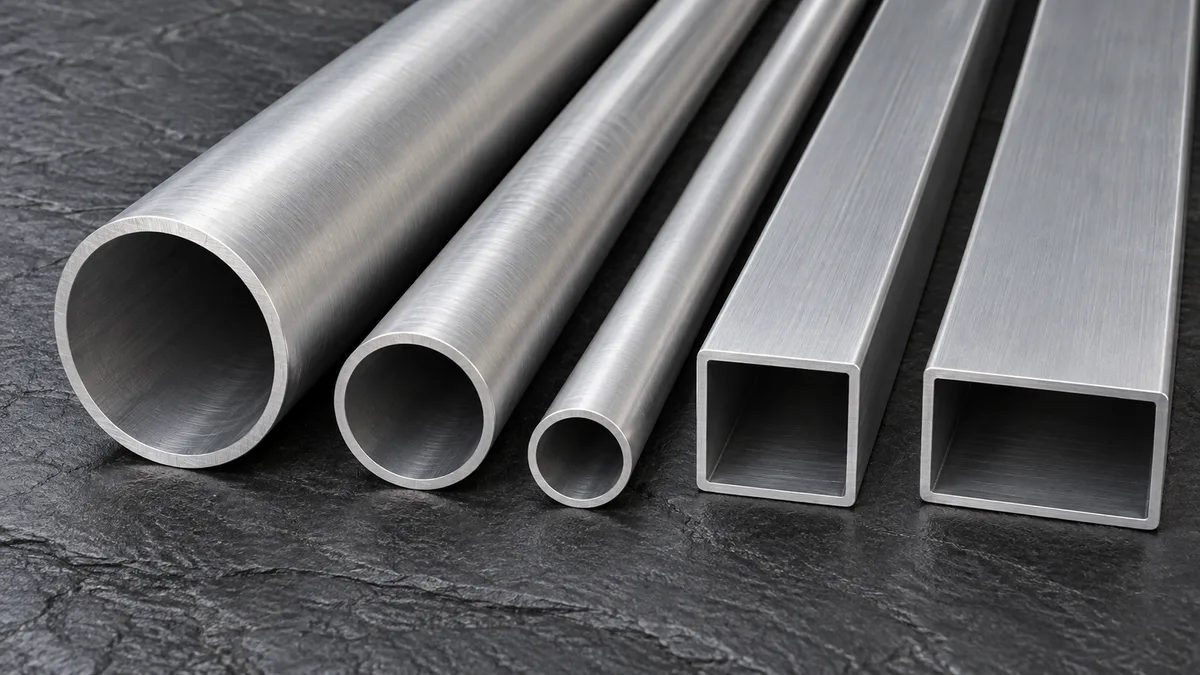
Tube coil is round tube supplied wound on itself rather than in straight lengths. Long coils let a manufacturer straighten, cut and bend tube automatically, with far less scrap and fewer joints than straight 6 m lengths. Fewer joints mean fewer potential leak paths, which matters in any sealed fluid circuit.
Small-diameter coils in 1100 and 1200 are usually produced by continuous extrusion, where aluminium rod is fed into a rotating grooved wheel and forced through a die without the stop-start of a billet press. The process gives seamless tube with a uniform structure in very long lengths. Larger or tighter-tolerance tube may be extruded on a press and then drawn.
The as-extruded H112 temper is soft and ready for bending. Where tube will be bent very tightly, flared or expanded, it is supplied annealed (O temper). Neither alloy can be heat-treated for strength, so post-braze properties equal those of O temper whatever the starting condition.
| Element | 1200 | 1100 |
|---|---|---|
| Si + Fe | 1.00 max | 0.95 max |
| Copper (Cu) | 0.05 max | 0.05 – 0.20 |
| Manganese (Mn) | 0.05 max | 0.05 max |
| Zinc (Zn) | 0.10 max | 0.10 max |
| Titanium (Ti) | 0.05 max | — |
| Others, each / total | 0.05 / 0.15 | 0.05 / 0.15 |
| Aluminium (Al) | 99.00 min | 99.00 min |
Registered Aluminum Association limits, also listed in EN 573-3 as EN AW-1200 and EN AW-1100. The two are interchangeable for most tube uses; 1100 is slightly stronger because of its copper, while 1200 is common in European and Asian specifications.
| Temper | Tensile strength | Yield strength (0.2 %) | Elongation | Note |
|---|---|---|---|---|
| H112 extruded, specified minimum | 75 MPa / 11 ksi | 20 MPa / 3 ksi | — | ASTM B221 / B491 basis |
| O, typical | 90 MPa / 13 ksi | 34 MPa / 5 ksi | 30 – 40 % | For tight bends, flares and expansion |
| H14 drawn, typical | 125 MPa / 18 ksi | 115 MPa / 17 ksi | 10 – 20 % | Straight lengths needing stiffness |
Working pressure depends on diameter, wall thickness and temperature. Calculate it from the post-braze (O temper) strength with a suitable safety factor, and confirm by burst testing.
Weight per metre and approximate metres per tonne for common automotive sizes (density 2.71 g/cm³):
| OD × wall (mm) | kg per metre | metres per tonne (approx.) |
|---|---|---|
| 4 × 0.5 | 0.015 | 67,119 |
| 6 × 0.5 | 0.023 | 42,712 |
| 6.35 × 0.8 | 0.038 | 26,454 |
| 8 × 0.5 | 0.032 | 31,322 |
| 8 × 1 | 0.060 | 16,780 |
| 9.53 × 1 | 0.073 | 13,770 |
| 10 × 1.25 | 0.093 | 10,739 |
| 12 × 1.75 | 0.153 | 6,548 |
| 12.7 × 1.2 | 0.117 | 8,511 |
| 15.88 × 1.65 | 0.200 | 5,003 |
| 16 × 2 | 0.238 | 4,195 |
| 19.05 × 1.65 | 0.244 | 4,091 |
Outside diameter and wall to ASTM B491 / B210 or EN 754-7 tables, or tighter on drawing. Ovality is controlled so that end fittings and O-rings seal.
Refrigerant and oil circuits need low residual oil and particles. Ask for internal cleanliness limits and dry, capped ends.
In-line eddy-current testing finds wall defects along the full coil length; pressure or helium leak testing is done on the finished assembly.
Flattening, flaring and expansion tests confirm that the tube will form without cracking.
EN 10204 3.1 certificate with chemistry and mechanical results for each lot.
Coils wrapped in film with desiccant, palletised or cased for export.
Brake lines are a common error in older descriptions of aluminium tube coil. Hydraulic brake pipes are almost always steel or copper-nickel because of their very high pressures and safety rules; 1xxx aluminium is not used for them. For higher-pressure refrigerant lines, 3003 or 6063 tube is normally specified.
| Property | 1100 / 1200 | 3003 | Copper (C12200) |
|---|---|---|---|
| Typical tensile, O temper | ~90 MPa | ~110 MPa | ~220 MPa |
| Thermal conductivity | ~220 W/m·K | ~160 – 190 W/m·K | ~340 W/m·K |
| Density | 2.71 g/cm³ | 2.73 g/cm³ | 8.94 g/cm³ |
| Bendability | Excellent | Very good | Excellent |
| Brazing | Very good | Very good | Excellent |
| Typical use | Low-pressure lines, connectors | Refrigerant lines, higher pressure | Legacy and service lines |
Step up to 3003 tube coil when you need about 20 % more strength at similar formability.
H112 is the as-extruded condition, soft enough for normal bending. O is fully annealed, with the highest elongation, and is chosen for tight bends, flaring and expansion into fins or fittings.
Both are 99.0 % aluminium. 1100 has a small copper addition that makes it marginally stronger; for most tube uses the two are interchangeable.
Typically 4 – 19 mm outside diameter with 0.4 – 3 mm walls, in metric or inch sizes, as pancake or level-wound coils.
No. Brake pipes run at very high pressures and are made from steel or copper-nickel. 1100 / 1200 tube suits low- and moderate-pressure fluid and heat-exchanger lines.
Tube is cleaned internally, dried, capped at both ends and wrapped with desiccant, then palletised or cased for export.
Yes. Metline ships tube coil worldwide with mill certificates and EXW, FOB, CIF or DAP terms.
Send the size, temper, coil type and volume, and our team will reply with availability and a delivered quotation.





