Eddy-current testing
In-line eddy-current testing along the full coil length detects pinholes and wall defects before shipment.



3003 coil tube is seamless round aluminium-manganese tube wound in long coils, about 20 % stronger than pure aluminium tube while keeping excellent bendability, brazeability and corrosion resistance. It is widely used for automotive air-conditioning, cooling and fluid lines. Metline supplies 3003 and 1xxx coil tube to manufacturers worldwide, cleaned, capped and fully certified.
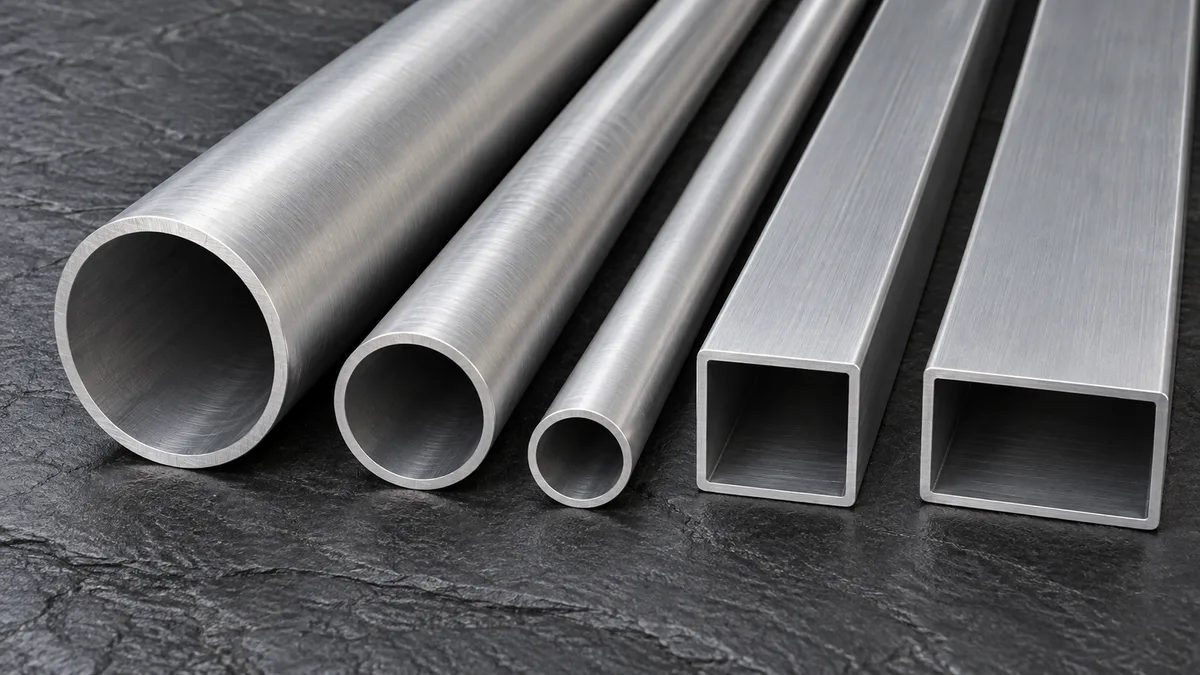
3003 adds about 1.2 % manganese to commercially pure aluminium. The manganese raises strength by roughly 20 % over 1100 without sacrificing formability, and it slightly improves corrosion resistance. That makes 3003 the default alloy for small-diameter tube that must be bent, flared, brazed and pressurised.
Supplying the tube as a coil rather than straight lengths means a manufacturer can straighten, cut and bend on automatic lines with little scrap, and route long continuous runs with fewer joints. Every joint avoided is one less potential refrigerant or coolant leak.
Coils are produced as pancake coils or level-wound coils (LWC), in which the tube is laid in neat layers so that it pays off smoothly at high speed. The inside of the tube is cleaned and dried, and both ends are sealed before packing.
| Element | 3003 | 3103 (EN) | 1100 (reference) |
|---|---|---|---|
| Silicon (Si) | 0.6 max | 0.50 max | Si + Fe 0.95 max |
| Iron (Fe) | 0.7 max | 0.7 max | — |
| Copper (Cu) | 0.05 – 0.20 | 0.10 max | 0.05 – 0.20 |
| Manganese (Mn) | 1.0 – 1.5 | 0.9 – 1.5 | 0.05 max |
| Magnesium (Mg) | — | 0.30 max | — |
| Zinc (Zn) | 0.10 max | 0.20 max | 0.10 max |
| Aluminium (Al) | Remainder | Remainder | 99.00 min |
3103 is the common European equivalent of 3003 and is interchangeable for most tube uses. The certificate reports the actual chemistry.
| Temper | Tensile strength | Yield strength (0.2 %) | Elongation | Use |
|---|---|---|---|---|
| 3003-O, specified (ASTM B210) | 95 – 130 MPa | ≥ 35 MPa | — | Bending, flaring, expansion |
| 3003-O, typical | 110 MPa / 16 ksi | 42 MPa / 6 ksi | 30 – 40 % | |
| 3003-H14, typical | 150 MPa / 22 ksi | 145 MPa / 21 ksi | 8 – 16 % | Straight runs needing stiffness |
| 1100-O, typical | 90 MPa / 13 ksi | 34 MPa / 5 ksi | 35 – 45 % | Low-pressure lines |
Weight per metre for common sizes (density 2.73 g/cm³):
| OD × wall (mm) | kg per metre | metres per tonne (approx.) |
|---|---|---|
| 4.76 × 0.5 | 0.018 | 54,740 |
| 6.35 × 0.71 | 0.034 | 29,117 |
| 7.94 × 0.8 | 0.049 | 20,413 |
| 9.52 × 0.8 | 0.060 | 16,714 |
| 9.52 × 1 | 0.073 | 13,685 |
| 12.7 × 1 | 0.100 | 9,966 |
| 15.88 × 1 | 0.128 | 7,836 |
| 19.05 × 1.2 | 0.184 | 5,443 |
| 22.22 × 1.2 | 0.216 | 4,622 |
| 28 × 1.5 | 0.341 | 2,933 |
In-line eddy-current testing along the full coil length detects pinholes and wall defects before shipment.
Residual oil and particle limits suitable for refrigerant circuits; tube is dried and capped.
OD, wall and ovality to ASTM B210 / B491 or EN 754-7 tables, or tighter on drawing.
Tensile, flattening and flare tests for each lot.
Pressure or helium leak tests on finished assemblies, to the customer specification.
EN 10204 3.1 certificate with chemistry and mechanical results.
Hydraulic brake lines are made from steel or copper-nickel, not aluminium coil tube, because of their pressure and safety requirements.
| Property | 3003 aluminium | Copper (C12200) |
|---|---|---|
| Density | 2.73 g/cm³ | 8.94 g/cm³ |
| Thermal conductivity | ~ 160 – 190 W/m·K | ~ 340 W/m·K |
| Typical tensile, O temper | ~ 110 MPa | ~ 220 MPa |
| Material cost per metre | Lower | Higher |
| Joining | Al-Si brazing, more temperature-sensitive | Easy brazing with Cu-P alloys |
| Galvanic risk | Must be isolated from copper and steel | Corrodes aluminium it touches |
Copper conducts heat better and is stronger, but aluminium wins on weight and cost. In tube-to-fin heat exchangers, aluminium tube with aluminium fins also avoids galvanic corrosion between tube and fin. Wall thickness is increased slightly to compensate for the lower strength.
3003 is about 20 % stronger thanks to its manganese, so it handles higher pressures at the same wall thickness while keeping almost the same bendability.
Mostly O (annealed) for bending, flaring and expansion. H12 or H14 is used where straight runs need extra stiffness.
A coil in which the tube is laid in neat, even layers, so it unwinds smoothly on automatic straightening and cutting lines.
Copper conducts heat better and is stronger, but aluminium is about one-third the weight, costs less and avoids galvanic problems with aluminium fins. Wall thickness is set to suit.
Typically 4 – 28 mm outside diameter with 0.3 – 1.5 mm walls, in metric and inch sizes.
Yes. Metline ships 3003 and 1xxx coil tube worldwide with mill certificates and EXW, FOB, CIF or DAP terms.
Send the size, temper, coil type and volume, and our team will reply with availability and a delivered quotation.





