6066-O
Annealed. Used as forging or heavy-forming stock that will be heat-treated afterwards.



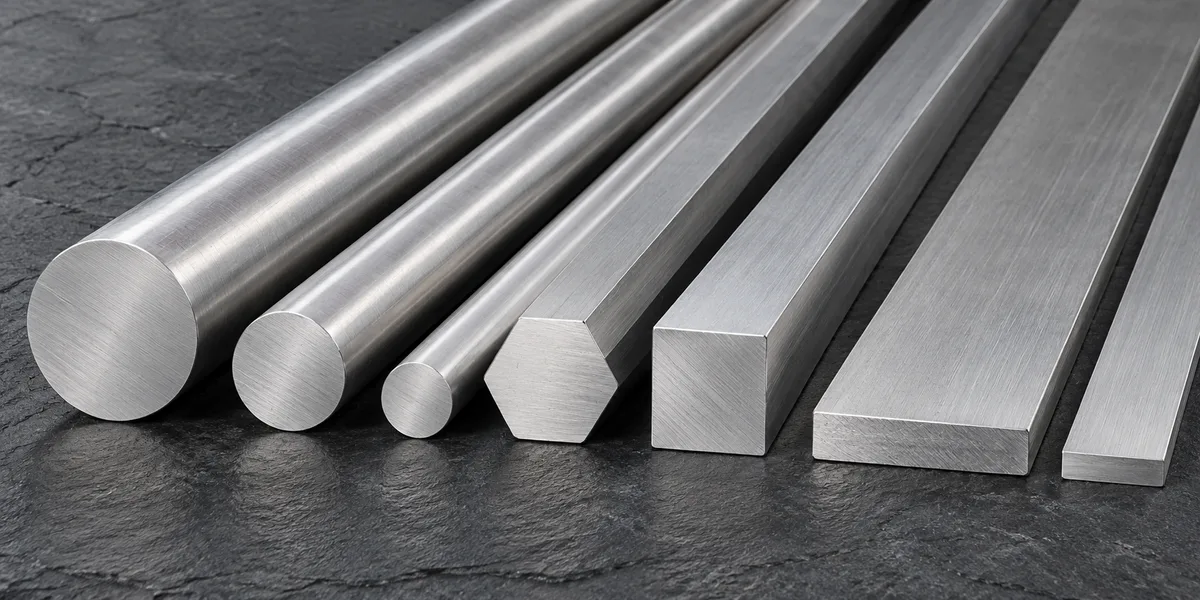
6066 is a high-copper, high-silicon Al-Mg-Si alloy and, in T6, the strongest of the commonly extruded 6xxx grades, with a minimum tensile strength of 345 MPa. It is used for machined and forged aircraft fittings, ground equipment and defence hardware that need more strength than 6061 without moving to 2xxx or 7xxx alloys. Metline supplies 6066 round, square, hex and flat bar in O, T4, T6 and stress-relieved tempers to ASTM B221, worldwide.
6066 carries roughly double the silicon, three times the copper and a deliberate manganese addition compared with 6061. After solution treatment and ageing this gives a T6 bar with a typical tensile strength near 395 MPa and yield near 360 MPa, about a quarter stronger than 6061-T6.
The extra alloy content has costs. Copper lowers corrosion resistance, so 6066 parts are normally anodised, conversion-coated or primed. The alloy is crack-sensitive in fusion welding and is generally treated as non-weldable for structural joints. And it is harder to extrude than 6061, so it is produced mainly as solid bar, rod and simple shapes rather than intricate hollows.
Those trade-offs define where 6066 bar is used in aerospace: machined fittings, brackets, bellcranks, hinge blocks and housings that are bolted rather than welded, forged components made from extruded stock, and high-load ground-support and defence hardware. It appeared widely in US designs through the federal extrusion standard QQ-A-200/10, now replaced by ASTM B221.
Registered Aluminum Association limits, used by ASTM B221. Some trade data sheets quote "others" as 0.20 %; the registered limit is 0.05 % each and 0.15 % total.
| Element | Minimum | Maximum | Role in the alloy |
|---|---|---|---|
| Silicon (Si) | 0.9 | 1.8 | High Si with Mg gives a large volume of Mg2Si plus excess Si |
| Iron (Fe) | — | 0.50 | Impurity |
| Copper (Cu) | 0.7 | 1.2 | Raises aged strength substantially; lowers corrosion resistance |
| Manganese (Mn) | 0.6 | 1.1 | Strength and grain control |
| Magnesium (Mg) | 0.8 | 1.4 | Strengthens with Si |
| Chromium (Cr) | — | 0.40 | Grain control |
| Zinc (Zn) | — | 0.25 | Impurity |
| Titanium (Ti) | — | 0.20 | Grain refiner |
| Others, each / total | — | 0.05 / 0.15 | |
| Aluminium (Al) | Remainder | About 93 – 97 % |
Specified limits for extruded bar and rod to ASTM B221 apply to all sizes in the standard. These are the values to design to.
| Temper | Tensile strength (min) | Yield strength 0.2 % (min) | Elongation in 50 mm (min) |
|---|---|---|---|
| O | ≤ 200 MPa (29 ksi) max | ≤ 124 MPa (18 ksi) max | 16 % |
| T4, T4510, T4511 | 276 MPa (40 ksi) | 172 MPa (25 ksi) | 14 % |
| T42 | 276 MPa (40 ksi) | 165 MPa (24 ksi) | 14 % |
| T6, T6510, T6511 | 345 MPa (50 ksi) | 310 MPa (45 ksi) | 8 % |
| T62 | 345 MPa (50 ksi) | 290 MPa (42 ksi) | 8 % |
| Temper | Typical tensile | Typical yield | Typical elongation | Brinell hardness |
|---|---|---|---|---|
| O | 150 MPa / 22 ksi | 83 MPa / 12 ksi | 18 % | 43 HB |
| T4 | 360 MPa / 52 ksi | 207 MPa / 30 ksi | 18 % | 90 HB |
| T6 | 395 MPa / 57 ksi | 359 MPa / 52 ksi | 12 % | 120 HB |
T42 and T62 are tempers produced when the user (or the producer, from O or F) heat-treats the material, so their minimum yield values are slightly lower.
Annealed. Used as forging or heavy-forming stock that will be heat-treated afterwards.
Solution treated and naturally aged; T4510 and T4511 are also stretched for stress relief. Formable stock for parts aged after shaping.
Solution treated and artificially aged for full strength. The standard condition for machined fittings.
T6 bar stretched 1 – 3 % to remove quench stress; T6511 allows minor straightening. Preferred where parts are machined deeply and must stay true.
Heat-treated by the user after receipt, or by the producer to demonstrate response.
T651 is a plate designation. For bar, ask for T6510 or T6511, which give the same stress relief.
6066 is a North American alloy and has no direct European (EN AW) or JIS equivalent. If a European drawing needs similar strength in a 6xxx alloy, 6082-T6 is the nearest common grade but is weaker; any substitution requires engineering approval.
| System | Designation / standard | Scope |
|---|---|---|
| ASTM / ASME | ASTM B221 / ASME SB-221 | Extruded bar, rod, wire, profiles and tube |
| US Federal (legacy) | QQ-A-200/10 | 6066 extrusions; cancelled, replaced by ASTM B221 |
| UNS | A96066 | — |
| Aluminum Association | 6066 | Registered composition |
| European | No direct equivalent | Nearest in use: EN AW-6082 |
Round bar weight per metre is π/4 × d² × 2.72 ÷ 1000 kg (d in mm).
| Diameter (mm) | kg per metre | kg per 3 m bar | Diameter (in) |
|---|---|---|---|
| 6 | 0.077 | 0.23 | 0.24 |
| 10 | 0.214 | 0.64 | 0.39 |
| 12 | 0.308 | 0.92 | 0.47 |
| 16 | 0.547 | 1.64 | 0.63 |
| 20 | 0.855 | 2.56 | 0.79 |
| 25 | 1.335 | 4.01 | 0.98 |
| 30 | 1.923 | 5.77 | 1.18 |
| 40 | 3.418 | 10.25 | 1.57 |
| 50 | 5.341 | 16.02 | 1.97 |
| 60 | 7.691 | 23.07 | 2.36 |
| 80 | 13.672 | 41.02 | 3.15 |
| 100 | 21.363 | 64.09 | 3.94 |
| 150 | 48.066 | 144.20 | 5.91 |
| 200 | 85.451 | 256.35 | 7.87 |
| 250 | 133.518 | 400.55 | 9.84 |
| 300 | 192.265 | 576.80 | 11.81 |
Very good in T6: short chips, low built-up edge and good surface finish with carbide tooling. O and T4 are gummier.
Forges well from extruded or cast stock at about 430 – 480 °C, then is solution treated and aged to T6.
Prone to hot cracking in fusion welding and heavily weakened in the heat-affected zone. Design for bolted or riveted joints; weld only non-structural attachments after qualification.
Fair because of the copper content. Anodise, apply chemical conversion coating or prime, especially for exposed fittings.
Solution treat at about 515 – 545 °C, quench, and age at about 175 °C for several hours to reach T6 (follow AMS 2772 or the governing specification).
Accepts sulphuric and hard anodising; the film is slightly grey because of silicon and copper.
A typical example is a GSE towbar head: it is machined from 6066-T6511 round bar, which gives higher strength than 6061 for the same section, while the welded towbar tube itself is 6061-T6 because 6066 should not be welded.
| Property | 6066-T6 | 6061-T6 | 6082-T6 | 2024-T3511 |
|---|---|---|---|---|
| Minimum tensile (extruded bar) | 345 MPa | 260 MPa | 295 – 310 MPa | 395 MPa and up (by size) |
| Minimum yield | 310 MPa | 240 MPa | 250 – 260 MPa | 290 MPa and up |
| Weldability | Poor | Good | Good | Poor |
| Corrosion resistance | Fair | Good | Good | Poor |
| Machinability | Very good | Very good | Very good | Very good |
| Fatigue performance | Good | Good | Good | Excellent |
Use 6061 or 6082 when welding or corrosion resistance matter; 6066 when a bolted part needs more strength than 6061; and 2024 or 7075 when strength or fatigue performance dominates.
ASTM B221 requires at least 345 MPa (50 ksi) tensile and 310 MPa (45 ksi) yield with 8 % elongation. Typical values are about 395 MPa tensile and 360 MPa yield.
It is not recommended for structural welds. The high copper and silicon make it crack-sensitive, and the heat-affected zone loses much of its strength. Use bolted or riveted joints.
There is no direct EN AW equivalent. 6082-T6 is the closest widely available 6xxx alloy but has lower strength, so substitution needs engineering approval.
QQ-A-200/10 for 6066 extrusions is cancelled. ASTM B221 is the usual replacement for new orders.
For bar the stress-relieved tempers are T6510 and T6511. T651 is the equivalent designation for plate.
Yes. Metline supplies 6066 bar cut to length or as full bars, with an EN 10204 3.1 certificate, to customers worldwide.
Send the shape, size, temper, specification and quantity. We will reply with availability, certification and a delivered price.





