Machining
Machines well in T6511 and T61 with short, broken chips. The Fe-Ni particles are mildly abrasive, so carbide or PCD tools last longer than HSS on production runs.



2618A rod and bar is the heat-resistant aluminium machinists use for parts that must keep their strength at 150 – 250 °C: pistons, impellers, turbocharger wheels, valve bodies and engine-area fittings. Metline supplies 2618A and 2618 extruded, drawn and forged bar in T6511, T651, T6 and T61, certified to aerospace and engine-maker specifications and shipped worldwide.
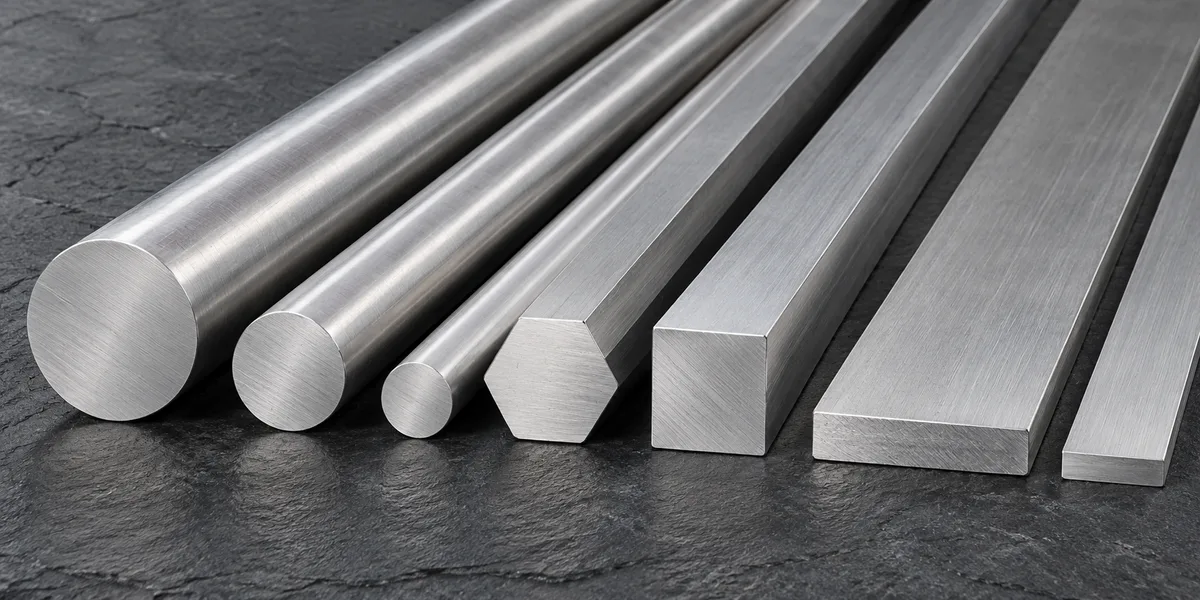
2618A is an aluminium-copper-magnesium alloy with roughly 1 % each of iron and nickel. Those two elements form hard Al9FeNi particles that stay stable when hot, so bar machined from 2618A keeps a large part of its strength and resists creep where 2024, 2014 and 7075 would soften.
Bar is the most practical starting form for many 2618A parts. Turned pistons for prototype and low-volume engines, compressor wheels, pump and valve bodies, bushes, studs and brackets are all machined from extruded or forged round bar. Stretched T6511 extruded bar machines with little movement, while T61 forged bar gives the best through-thickness properties for large diameters.
The same chemistry is sold under several names: 2618 (US), 2618A (Europe), AlCu2Mg1.5Ni, Werkstoff 3.1924, RR58 in older British practice and AU2GN in French practice. The differences between 2618 and 2618A are small composition-range adjustments, and most engine programmes state which one they accept.
| Temper | What it is | Specifications often quoted | Best for |
|---|---|---|---|
| T6511 | Extruded, solution treated, stretched, straightened, aged | DTD 5014 / 5014A, MSRR 8018, AIR 9051 | Precision machined parts that must not move |
| T6 / T61 | Solution treated and aged; T61 uses a hot-water quench | DTD 717A, 731B, 745A, 5084A forging stock | Forged bar and forging stock |
| T651 | Stretched and aged plate-type temper | AIR 9048.640, WS 3.1924 | Large machined blanks with low stress |
| T351 / T851 | Stretched; naturally aged (T351) or artificially aged (T851) | AIR 9048.640, EN aerospace series | Parts aged after machining (T351) or full strength (T851) |
Several of these are legacy UK and French documents. Always state the exact specification and revision; we confirm what can be certified before quoting. US 2024 bar specifications such as AMS 4120 or QQ-A-225/6 do not apply to 2618A, despite appearing on some older listings.
| Element | 2618 (AA / ASTM) | 2618A (EN AW-2618A) | Role |
|---|---|---|---|
| Copper (Cu) | 1.9 – 2.7 | 1.8 – 2.7 | Precipitation strengthening with Mg |
| Magnesium (Mg) | 1.3 – 1.8 | 1.2 – 1.8 | Forms the S-phase (Al2CuMg) with copper |
| Iron (Fe) | 0.9 – 1.3 | 0.9 – 1.4 | With Ni forms heat-stable Al9FeNi particles |
| Nickel (Ni) | 0.9 – 1.2 | 0.8 – 1.4 | Elevated-temperature and creep strength |
| Silicon (Si) | 0.10 – 0.25 | 0.15 – 0.25 | Controlled addition |
| Titanium (Ti) | 0.04 – 0.10 | 0.20 max (Ti + Zr 0.25 max) | Grain refiner |
| Manganese (Mn) | — | 0.25 max | Impurity |
| Zinc (Zn) | 0.10 max | 0.15 max | Impurity |
| Others each / total | 0.05 / 0.15 | 0.05 / 0.15 | |
| Aluminium | Remainder | Remainder |
| Property (T61 / T6511) | Typical value |
|---|---|
| Tensile strength | 440 MPa / 64 ksi |
| Yield strength (0.2 %) | 370 MPa / 54 ksi |
| Elongation | 10 % |
| Shear strength | 260 MPa / 38 ksi |
| Fatigue strength (5×10⁸ cycles) | 125 MPa / 18 ksi |
| Hardness | 115 HB |
| Poisson's ratio | 0.33 |
These are typical values; specification minimums for extruded bar are lower and vary with diameter. The figure that really matters for engine parts is retained strength after long exposure:
| Test temperature | Tensile strength | Yield strength | Elongation |
|---|---|---|---|
| 24 °C | 440 MPa | 370 MPa | 10 % |
| 100 °C | 420 MPa | 350 MPa | 10 % |
| 150 °C | 345 MPa | 305 MPa | 14 % |
| 205 °C | 220 MPa | 180 MPa | 24 % |
| 260 °C | 90 MPa | 62 MPa | 50 % |
Typical values for 2618-T61 after 10,000 hours at the test temperature (ASM data). They show strength retention, not design minimums.
| Product | Typical size range | Lengths |
|---|---|---|
| Extruded round bar | Ø 5 – 250 mm | up to about 6 m |
| Forged round bar | Ø 150 – 420 mm | to order |
| Square bar | 6 – 50 mm | up to about 6 m |
| Flat bar | 3 – 10 × 10 – 130 mm | 1 – 3 m |
| Hexagon bar | 12 – 65 mm A/F | 1 – 2.5 m |
| Cold-finished / precision bar | small diameters with tight tolerances | cut lengths |
Bar weight is easy to estimate: a 2618A round bar weighs about 0.002168 × d² kg per metre (d in millimetres). A 100 mm bar is roughly 21.7 kg per metre; a 50 mm bar about 5.4 kg per metre. The bar weight calculator handles other shapes.
Machines well in T6511 and T61 with short, broken chips. The Fe-Ni particles are mildly abrasive, so carbide or PCD tools last longer than HSS on production runs.
Choose stretched tempers (T6511, T651, T851) for thin-walled or asymmetric parts. Rough-machine, then finish after a rest period on critical parts.
Solution treatment around 525 – 535 °C and ageing around 190 – 200 °C. Re-heat-treating finished parts is rarely done because of distortion risk.
Not suited to fusion welding for load-bearing parts. Design for bolting, press fits or threaded joints.
Hard anodising for wear surfaces such as ring grooves; conversion coating and paint for general protection.
Ultrasonic inspection of larger bar and forged bar to AMS-STD-2154 or the customer specification.
A typical racing piston programme machines prototype pistons from 2618A forged bar, then moves to closed-die forgings in the same alloy once the design is frozen, keeping the material qualification unchanged.
| Factor | 2618A-T6511 | 2024-T3511 | 2014-T6511 | 4032-T6 |
|---|---|---|---|---|
| Room-temperature strength | High | High | High | Medium–high |
| Strength after long exposure at 200 °C | Best | Fair | Fair | Good |
| Creep resistance | Very good | Fair | Fair | Good |
| Thermal expansion | Normal | Normal | Normal | Low |
| Machinability | Good | Good | Good | Fair (abrasive) |
For parts that stay below about 120 °C, 2024 or 2014 bar is cheaper and easier to source. Above that, 2618A is the usual answer; 4032 competes only in pistons where low expansion is the priority.
T6511 is extruded bar that has been stretched and straightened before ageing, so it machines with minimal movement. T61 is the forging temper with a hot-water quench, used for forged bar and forging stock.
They are close variants. 2618 is the US registration and 2618A the European one; 2618A allows slightly wider iron, nickel and titanium ranges. Mechanical properties are similar, and many programmes accept either, but the specification on your drawing decides which is certified.
Machined engine and hot-running parts: pistons, compressor wheels, impellers, valve bodies and engine-area brackets in aerospace, motorsport and high-performance engines.
Billet is cast and homogenised, then extruded or forged, solution heat-treated, quenched, stretched where the temper requires it, artificially aged, and inspected and tested.
Extruded round bar from about 5 mm to 250 mm, and forged bar up to about 420 mm. Square, flat and hexagon bar are also available.
Price depends on size, temper, testing, quantity and the aluminium market. Sending a full size list and accepting random mill lengths usually gives the most economical quotation.
Send the size list, temper and specification. We will confirm stock options, certification and a delivered price.





