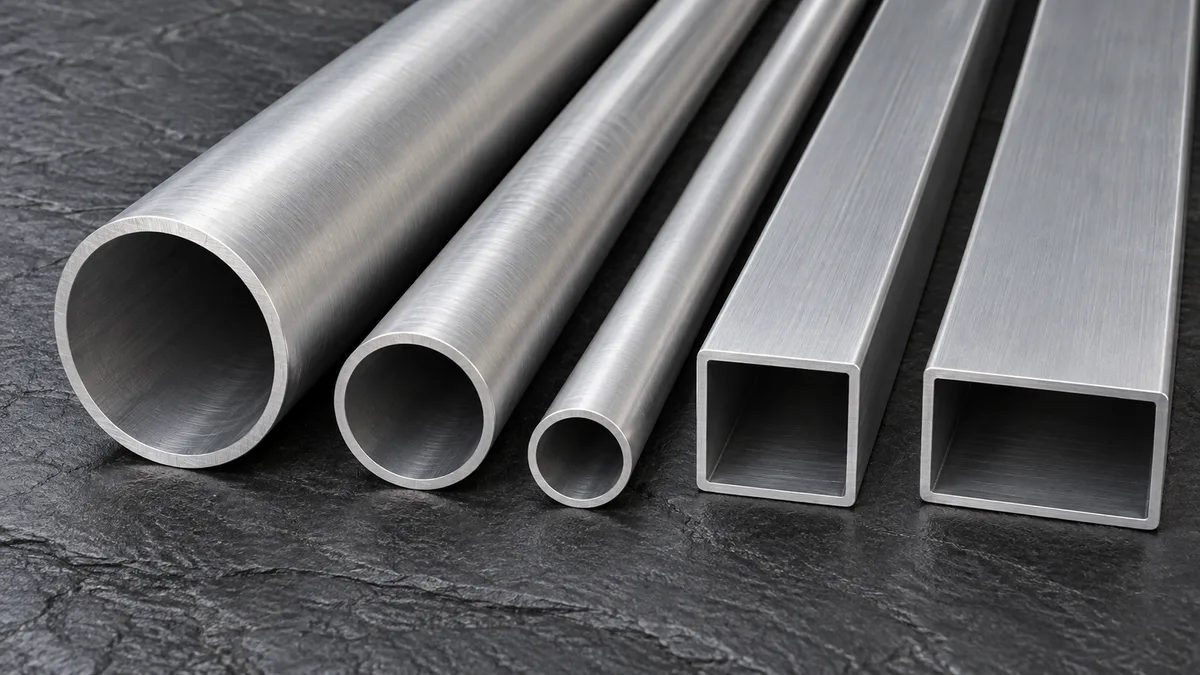
Aluminium Street Light Poles: Alloys, Tube Sizes & Design
Most aluminium street light poles are made from seamless extruded 6063 or 6061 tube that is welded to a base and then heat-treated to the T6 temper. This guide explains which alloy suits which pole, how wind load and weld zones drive the design, and what to specify when you buy the tube, plate and extrusions. Metline supplies these aluminium materials to pole manufacturers and fabricators worldwide; we do not make or install finished poles.
Aluminium has about one third the density of steel, so an aluminium lighting pole is much lighter than a steel pole for the same duty; it also needs no galvanising and does not rust. Those three facts explain why municipalities, highway authorities and private developers specify aluminium for street, car-park, park and coastal lighting.
The weight saving matters twice: once in freight and handling, because a crew can often lift a 6 m aluminium shaft by hand, and again on site, where a lighter pole needs a smaller foundation and a lighter crane. Aluminium forms a thin, self-renewing oxide film, so an uncoated pole keeps its structural section for decades, even near the sea or where de-icing salt is used. Painted or anodised poles hold their finish well because there is no rust creeping under the coating.
Aluminium does have trade-offs. Its modulus of elasticity (about 69 GPa) is one third of steel, so an aluminium shaft must have a larger diameter or thicker wall to limit deflection and vibration. Welding reduces the strength of heat-treated alloys locally, which is why quality pole makers heat-treat the whole shaft after the base is welded on. Good pole design is mostly about managing these two points.
Alloy selection
Which aluminium alloy for which pole?
Pole shafts use heat-treatable 6xxx alloys because they extrude well into seamless tube and reach useful strength in the T6 temper. The choice between them is a balance of strength, surface finish and cost.
Alloy and temper
Where it is used
Why
6063-T6
Most round and tapered street and car-park pole shafts, decorative and fluted poles
Excellent extrusion surface, takes anodising and paint well, adequate strength for most heights; the usual North American shaft alloy
6061-T6
Taller poles, high-wind sites, mast arms, sign and signal supports
About 30 % higher strength than 6063-T6, so walls can be thinner for the same load
6005A-T6
Extruded columns and multi-sided sections, common in European practice
Strength between 6063 and 6061 with good extrudability for complex or larger sections
6082-T6
Heavy-duty columns and brackets to EN specifications
Highest strength of the common 6xxx grades in thick sections
5083 / 5086 plate
Base plates and gussets in marine environments
Non-heat-treatable, keeps strength after welding, very good seawater resistance
6061-T6 plate
Base plates, flanges and anchor plates
Machinable, strong, matches the shaft alloy for welding
Bases and transformer bases are often aluminium castings (for example A356-T6) made by the pole manufacturer. Metline supplies the wrought materials: tube, extrusions, plate, sheet and bar.
Chemical composition
6063 and 6061 composition limits (wt %)
Both alloys are registered with the Aluminum Association and appear in ASTM B221 and EN 573-3. The higher magnesium, silicon and copper in 6061 explain its higher strength; the leaner chemistry of 6063 gives the smoother extruded surface preferred for decorative poles.
Element
6063
6061
Silicon (Si)
0.20 – 0.60
0.40 – 0.80
Iron (Fe)
≤ 0.35
≤ 0.70
Copper (Cu)
≤ 0.10
0.15 – 0.40
Manganese (Mn)
≤ 0.10
≤ 0.15
Magnesium (Mg)
0.45 – 0.90
0.80 – 1.20
Chromium (Cr)
≤ 0.10
0.04 – 0.35
Zinc (Zn)
≤ 0.10
≤ 0.25
Titanium (Ti)
≤ 0.10
≤ 0.15
Others each / total
≤ 0.05 / 0.15
≤ 0.05 / 0.15
Aluminium
Remainder
Remainder
Mechanical properties
Strength of pole alloys, including the weld zone
The figures a structural engineer uses are the specified minimums of the product standard, not typical values. The welded column is the one most often overlooked: if a shaft is welded in T6 and not heat-treated again, the metal next to the weld drops to roughly the strength of the O or T4 condition.
Material
Typical tensile
Typical yield
Minimum tensile / yield (ASTM B221)
Welded, not re-treated (ADM tensile)
6063-T6
241 MPa
214 MPa
205 / 170 MPa
about 117 MPa
6061-T6
310 MPa
276 MPa
260 / 240 MPa
about 165 MPa
6005A-T6 (EN 755-2, wall ≤ 5 mm)
—
—
270 / 225 MPa
see EN 1999-1-1
Typical values from Aluminum Association / ASM data; minimums from ASTM B221 and EN 755-2; welded strengths from the Aluminum Design Manual. Exact limits depend on wall thickness and are shown on the mill certificate.
Physical properties used in pole design
Density
2.70 g/cm³
Modulus of elasticity
about 69 GPa (one third of steel)
Coefficient of thermal expansion
about 23 µm/m·°C
Electrical conductivity
6063-T6 about 53 % IACS; 6061-T6 about 43 % IACS
Engineering
Design points: wind, deflection, fatigue and welds
Wind load
The governing load on most poles is wind on the luminaire, bracket and shaft. Designers sum the effective projected area (EPA) of the fittings and check bending at the base. Europe uses EN 40-3-1 for loads and EN 40-6 for aluminium columns; North America uses the AASHTO LRFD specification for structural supports for signs, luminaires and traffic signals.
Deflection and stiffness
Because aluminium is more flexible than steel, deflection at the top often controls the section rather than strength. A larger diameter is a far more efficient fix than a thicker wall, since stiffness rises with the cube of diameter.
Fatigue and vibration
Wind can excite vortex-shedding vibration in tall, slender poles. Weld details at the base and at handhole openings are the usual fatigue hot spots; smooth transitions, reinforced handholes and vibration dampers are standard remedies.
Welds and heat treatment
The best practice is to weld the shaft to its base in the T4 or as-extruded condition and then solution heat-treat and age the whole assembly to T6. Welding to AWS D1.2 (North America) or EN 1090-3 (Europe) is normally specified.
Passive safety
Roadside poles in Europe may need classification under EN 12767, which rates how a support behaves in a vehicle impact. Aluminium columns are often chosen because they can be designed to absorb energy or shear away predictably.
Galvanic contact
Steel anchor bolts, stainless fixings and copper earthing parts must be isolated from the aluminium with washers, sleeves or coatings, and concrete contact below ground should be protected with a bituminous coating.
Pole shapes
Pole shapes and the aluminium forms behind them
Pole shape
How it is usually made
Material Metline can supply
Straight round
Cut length of seamless extruded tube welded to a base
Seamless 6063 / 6061 round tube
Tapered (conical)
Round tube spun or swaged to a taper by the pole maker, then heat-treated
Heavy-wall round tube in T4 or O for forming
Square and rectangular
Extruded square tube, often with radiused corners
6063 / 6061 square and rectangular tube
Octagonal and fluted
Custom extrusion die
Profiles extruded to the customer drawing
Mast arms and brackets
Bent tube or extruded sections
Smaller-diameter tube, bar and profiles
Base plates, door covers
Plate and sheet cut and machined
6061-T6, 5083 plate; 5052 sheet
Pole types range from short bollards and 3 – 4 m garden and park columns, through 6 – 12 m street and car-park poles, to traffic signal and sign supports. Solar and smart poles add a battery or electronics compartment and extra cable entries, so the shaft must be checked for the larger openings and the added weight and wind area of panels, cameras or antennas.
Supply range
Typical pole tube sizes and weights
The table lists sizes commonly used for pole shafts. Weight is calculated from geometry using 2.70 g/cm³; actual weight varies slightly within the standard tolerances. Use the round tube weight calculator for other sizes.
Outside diameter (mm)
Wall (mm)
Mass (kg/m)
Mass of 6 m length (kg)
76.2
3.00
1.86
11.2
101.6
3.20
2.67
16.0
114.3
3.20
3.02
18.1
127.0
4.00
4.17
25.0
152.4
4.80
6.01
36.1
165.0
4.00
5.46
32.8
165.0
6.00
8.09
48.6
203.2
4.80
8.08
48.5
203.2
6.35
10.60
63.6
254.0
6.35
13.34
80.0
Material supply range
Round tube
Seamless extruded, common pole sizes from about 76 mm to 254 mm OD; other sizes to order
Wall thickness
Typically 3 – 10 mm for pole shafts
Length
Cut lengths from 3 m to 12 m, or mill lengths
Temper
T6 for straight poles; T4 or O on request for tapering and post-weld heat treatment
Finish
Mill finish, brushed, anodised or powder coated to RAL on request
Surface finishing
Finishes for aluminium poles
Mill-finish aluminium weathers to a uniform matt grey and needs no coating for protection. Most specifiers still choose a finish for appearance and to keep the surface clean.
Powder coating: the most common finish, in black, grey, green or any RAL colour; use a pretreatment and powder qualified to a recognised architectural standard for outdoor use
Anodising: clear or bronze anodic films, at least 20 – 25 µm for exterior exposure; 6063 gives the most even appearance
Brushed or satin finish: mechanical finish, usually followed by clear anodising or lacquer
Root protection: bitumen or epoxy on the buried section of direct-embedded poles
SpecifyAlloy and temper, OD, wall, length, quantity, and the standard (ASTM B221 / B429, EN 755). State whether the tube will be tapered or heat-treated after welding.
QuoteWe confirm availability, tolerances, certification and delivery terms (EXW, FOB, CIF or DAP).
ProcessCutting to length, end deburring and surface protection on request.
DocumentEN 10204 3.1 mill certificate with chemistry and mechanical results for each lot.
ShipBundled with protective wrapping and timber spacers, in containers or flat racks for long lengths.
Sources
References and standards
EN 40-6 – Lighting columns: requirements for aluminium lighting columns
AASHTO LRFD Specifications for Structural Supports for Highway Signs, Luminaires, and Traffic Signals
EN 12767 – Passive safety of support structures for road equipment
FAQ
Aluminium (aluminum) street light poles: FAQ
Which is better for a street light pole, 6063 or 6061?
6063-T6 is the usual choice for standard street and car-park poles because it extrudes with a better surface and is easier to finish. 6061-T6 is about 30 % stronger and is chosen for taller poles, high wind zones, mast arms and sign supports where a thinner wall saves weight.
Do aluminium poles lose strength when welded?
Yes, locally. The heat-affected zone of a T6 alloy drops to roughly half its strength. Good practice is to weld the base on first and then heat-treat the whole pole back to T6, or to design the base using the reduced welded strength.
How long does an aluminium street light pole last?
Aluminium does not rust, so the structural section is preserved for decades with little maintenance. Service life depends mostly on design against fatigue, protection of the buried section, isolation from steel and copper, and the condition of the finish.
What standard covers aluminium lighting columns?
In Europe, EN 40-6 covers aluminium lighting columns, with loads and verification in EN 40-3. In North America, the AASHTO LRFD specification for structural supports for signs, luminaires and traffic signals applies, with tube to ASTM B221 or B429 and welding to AWS D1.2.
Can Metline supply finished poles?
No. Metline supplies the aluminium materials, such as seamless tube, extrusions, plate, sheet and bar, cut to length or machined to drawing. Pole manufacturers carry out tapering, welding, heat treatment, finishing and assembly.
How heavy is an aluminium light pole tube?
A 114.3 mm OD × 3.2 mm wall tube weighs about 3.0 kg per metre, so a 6 m shaft is roughly 18 kg before the base and bracket. A 152.4 × 4.8 mm tube is about 6.0 kg/m.
Sourcing tube for lighting poles?
Tell us the alloy, sizes, quantities and destination. We will reply with availability, certification and a delivered price.