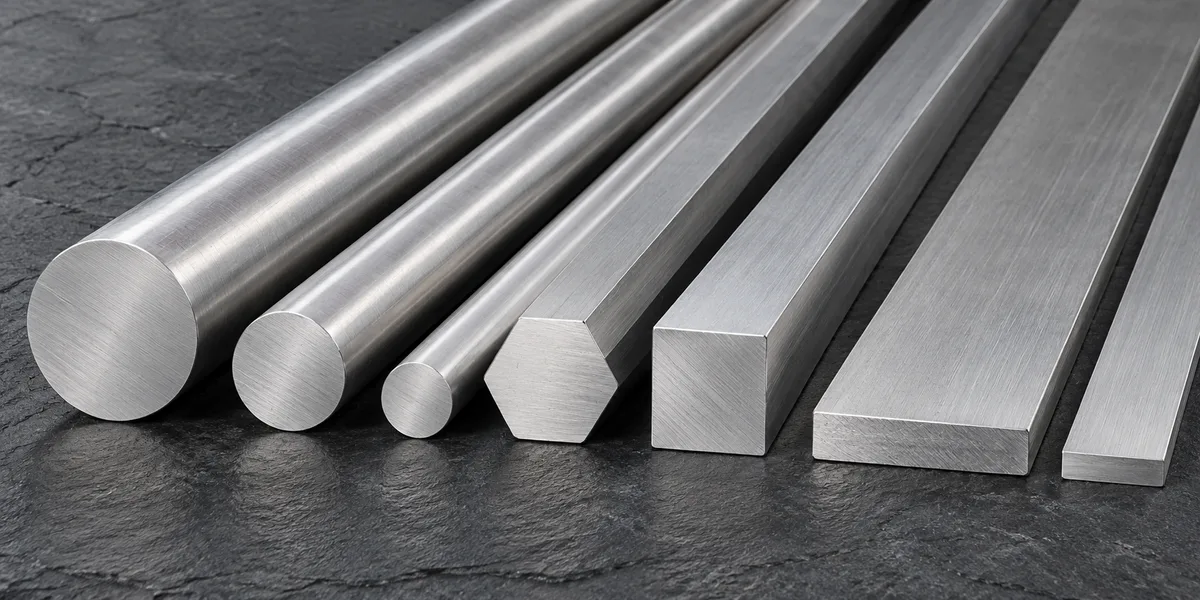
Aluminium square bar is solid bar with four equal flat sides, extruded or cold-drawn in grades such as 6061, 6063, 6082, 7075, 2024 and 5083 and sold from about 3 mm to 250 mm across flats. Square hollow bar is the same outline with a bore, for lighter frames and parts. This guide compares grades and tempers, gives weights and section properties, explains tolerances and standards, and lists what to include in an order.
Square bar is one of the basic mill shapes, alongside round, flat and hexagonal bar. Its flat faces make it easy to clamp, mark out and machine, and its symmetric section has the same stiffness about both axes, so it is a natural choice for frames, guides, spacers, keys, fixtures and any part that will be milled to a rectangular shape.
Two product families share the name. Solid square bar is fully dense, and is chosen when parts are machined from it or when maximum strength and stiffness per outline are needed. Square hollow bar (often called square tube when the wall is thin) has a central bore; it saves weight and material in structures where load is carried mainly by the outer fibres, such as frames, posts and handrails.
Grade selection follows the same logic as for other bar forms. 6061 and 6082 are general structural grades; 6063 is chosen for its surface finish; 7075 and 2024 are high-strength aerospace and tooling grades; 5083 is used where seawater resistance matters; and free-machining 2011 is used for turned and milled parts made in volume.
Manufacturing
How square bar is produced
Extruded square bar
A heated billet is pushed through a square die. This is the main route for sizes from about 10 mm to over 200 mm. Corners can be sharp or radiused, and the bar is stretched after quenching (T6511) to straighten it and relieve stress. Tolerances follow EN 755-4 or ASTM B221 tables.
Cold-drawn (cold-finished) square bar
Extruded bar drawn through a die at room temperature. Gives tighter dimensions, sharper corners and a brighter surface, and is common from about 3 mm to 100 mm. Covered by EN 754-4 and ASTM B211.
Cut from plate
Large squares beyond the extrusion range, or squares in stress-relieved T651 plate tempers, are sawn from thick plate. Useful for one-off blocks and very large sizes.
Extruded square hollow bar
Produced through porthole (bridge) dies in 6063, 6061 and 6082, giving seam-welded-in-the-die tube with consistent wall. Seamless hollow bar is extruded over a mandrel for high-strength or pressure uses.
Drawn square hollow bar
Hollow extrusions drawn to final size for precise outer dimensions and walls, for example 2024-T3 drawn square tube to aerospace specifications.
Forged square bar
For very large sections or where grain flow and through-thickness properties matter, squares can be open-die forged and machined.
Chemical composition
Composition of common square bar grades (wt %)
Registered Aluminum Association limits (also used by EN 573-3). Single values are maxima; aluminium is the remainder.
Grade
Si
Fe
Cu
Mn
Mg
Cr
Zn
Ti
6061
0.40 – 0.8
0.7
0.15 – 0.40
0.15
0.8 – 1.2
0.04 – 0.35
0.25
0.15
6063
0.20 – 0.6
0.35
0.10
0.10
0.45 – 0.9
0.10
0.10
0.10
6082
0.7 – 1.3
0.50
0.10
0.40 – 1.0
0.6 – 1.2
0.25
0.20
0.10
7075
0.40
0.50
1.2 – 2.0
0.30
2.1 – 2.9
0.18 – 0.28
5.1 – 6.1
0.20
2024
0.50
0.50
3.8 – 4.9
0.30 – 0.9
1.2 – 1.8
0.10
0.25
0.15
5083
0.40
0.40
0.10
0.40 – 1.0
4.0 – 4.9
0.05 – 0.25
0.25
0.15
Mechanical properties
Mechanical properties by grade and temper
Typical values (ASM / Aluminum Association data) show how the grades compare. For design, use the specified minimums of the order standard, which fall with increasing section size for the heat-treatable grades and are reported on the mill certificate.
Grade & temper
Tensile (MPa)
Yield 0.2 % (MPa)
Elongation (%)
Hardness (HB)
6061-T6 / T6511
310
276
12
95
6063-T5
186
145
12
60
6063-T6
241
214
12
73
6082-T6 (EN 755-2 min., 20 – 150 mm)
310
260
8
—
7075-T6 / T6511
572
503
11
150
2024-T351
469
324
19
120
5083-H112 (EN 755-2 min.)
270
110
12
—
2011-T3 (free-machining)
379
296
15
95
Physical properties (all grades, approximate)
Density
2.64 g/cm³ (5083) to 2.81 g/cm³ (7075); 2.70 g/cm³ for 6061, 6063, 6082
Elastic modulus
About 69 – 72 GPa, so stiffness is similar across grades
Thermal conductivity
About 200 W/m·K for 6063-T6 down to about 120 – 130 W/m·K for 7075-T6 and 5083
Thermal expansion
About 23 – 24 µm/m·°C
Because the modulus is nearly the same for all grades, choosing a stronger alloy raises the load a square bar can carry before yielding, but not its deflection under a given load.
Tempers
Tempers you will see on square bar
Temper
Meaning
When to order it
T6
Solution heat-treated and artificially aged
Cold-finished bar and light machining
T6511
T6, stretched to relieve stress, with minor straightening allowed
Extruded bar that will be heavily machined; stays straight and flat
T651
T6 stress-relieved by stretching (rolled or cold-finished bar, plate)
Quote the standard on your drawing and the bar will be supplied and certified to it. The most common are:
Standard
Scope
Typical use
ASTM B221 / ASME SB221
Extruded bars, rods, wire, profiles and tubes
Extruded square bar, North America and global projects
ASTM B211 / ASME SB211
Rolled or cold-finished bar, rod and wire
Cold-finished square bar
AMS-QQ-A-200/8, /11, /3
Extruded 6061, 7075 and 2024 bar and shapes
Aerospace extruded square bar
AMS-QQ-A-225/8, /9, /6
Rolled or drawn 6061, 7075 and 2024 bar
Aerospace cold-finished bar
EN 755-2 / EN 755-4
Extruded bar mechanical properties / square bar tolerances (10 – 220 mm)
European extruded square bar
EN 754-2 / EN 754-4
Cold-drawn bar properties / square bar tolerances (3 – 100 mm)
European drawn square bar
JIS H4040 · GB/T 3191 · IS 733
National bar and rod standards
Japanese, Chinese and Indian projects
Specifications such as ASTM B316 (rivet and cold-heading wire and rod) do not apply to square bar; check that the standard on an order actually covers the product form.
Sizes & weights
Solid square bar sizes, weights and section properties
Weight of solid square bar (density 2.70 g/cm³): kg/m = side (mm)² × 0.0027. For 7075 multiply by 1.04 and for 5083 by 0.98. Second moment of area I = a⁴/12 and section modulus Z = a³/6 about either axis.
Side (mm)
kg per metre
kg per 3 m bar
I (cm⁴)
Z (cm³)
6
0.097
0.29
0.0108
0.036
8
0.173
0.52
0.0341
0.0853
10
0.270
0.81
0.0833
0.167
12
0.389
1.17
0.173
0.288
15
0.608
1.82
0.422
0.562
16
0.691
2.07
0.546
0.683
20
1.080
3.24
1.33
1.33
25
1.688
5.06
3.26
2.6
30
2.430
7.29
6.75
4.5
35
3.308
9.92
12.5
7.15
40
4.320
12.96
21.3
10.7
45
5.468
16.40
34.2
15.2
50
6.750
20.25
52.1
20.8
60
9.720
29.16
108
36
70
13.230
39.69
200
57.2
80
17.280
51.84
341
85.3
90
21.870
65.61
547
122
100
27.000
81.00
833
167
120
38.880
116.64
1.73e+03
288
150
60.750
182.25
4.22e+03
562
200
108.000
324.00
1.33e+04
1.33e+03
250
168.750
506.25
3.26e+04
2.6e+03
Imperial sizes are common in the Americas, usually in 12 ft (3.66 m) lengths. Weight in lb/ft = side (in)² × 1.17 for 6061.
Size (in)
Size (mm)
lb per foot
kg per metre
1/4
6.3
0.073
0.109
3/8
9.5
0.165
0.245
1/2
12.7
0.292
0.435
5/8
15.9
0.457
0.680
3/4
19.0
0.658
0.980
1
25.4
1.170
1.742
1-1/4
31.8
1.828
2.722
1-1/2
38.1
2.632
3.919
2
50.8
4.680
6.968
2-1/2
63.5
7.312
10.887
3
76.2
10.530
15.677
4
101.6
18.720
27.871
5
127.0
29.250
43.548
6
152.4
42.120
62.710
Hollow bar
Square hollow bar: sizes and weights
For a square hollow section of outside side B and wall t (both mm), area = B² − (B − 2t)² and kg/m = [B² − (B − 2t)²] × 0.0027. Corner radii reduce the true weight slightly; the figures below assume sharp corners.
Outside (mm)
Wall (mm)
Area (mm²)
kg per metre
Weight saving vs solid
10 × 10
1
36
0.097
64 %
15 × 15
1.5
81
0.219
64 %
20 × 20
1.5
111
0.300
72 %
20 × 20
2
144
0.389
64 %
25 × 25
2
184
0.497
71 %
30 × 30
2
224
0.605
75 %
30 × 30
3
324
0.875
64 %
40 × 40
2
304
0.821
81 %
40 × 40
3
444
1.199
72 %
50 × 50
3
564
1.523
77 %
50 × 50
5
900
2.430
64 %
60 × 60
4
896
2.419
75 %
80 × 80
4
1216
3.283
81 %
100 × 100
5
1900
5.130
81 %
120 × 120
6
2736
7.387
81 %
150 × 150
10
5600
15.120
75 %
200 × 200
10
7600
20.520
81 %
6063-T5 and T6 dominate thin-wall hollow bar for frames, furniture and architectural work because they extrude easily and anodise well. 6061-T6 and 6082-T6 are used for structural hollow sections, while drawn 2024-T3 square tube to aerospace specifications covers small, high-strength sizes.
Tolerances
Tolerances, corners and straightness
Tolerance standards define the permitted variation in width across flats, corner radius, straightness, twist, squareness of the faces and of cut ends. Extruded bar has wider limits than cold-finished bar, and the softer 6060/6063 group is held tighter than hard alloys such as 2024 and 7075, which are more difficult to extrude.
Width across flats: extruded bar to EN 755-4 or ANSI H35.2; drawn bar to EN 754-4 with tighter limits
Corners: sharp corners (small radius) are standard on drawn bar; extruded bar may have a small radius. State a maximum radius if it matters for your fit
Straightness and twist: T6511 stretched bar gives the best straightness; specify limits for long bar used as guides or rails
Cut lengths: saw-cut pieces are typically held to about ±0.5 – 1 mm, closer by agreement
Inspection: dimensions and surface checked on every bundle; ultrasonic testing for aerospace or thick sections on request
Working with square bar
Machining, welding and finishing square bar
Machining
2011, 7075 and 2024 machine best, giving small chips and fine finishes. 6061 and 6082 in T6 machine well with sharp, high-rake carbide tooling. 6063 and 5083 are softer and can be gummy; use polished flutes and plenty of coolant.
Welding
6061, 6063, 6082 and 5083 weld readily by MIG and TIG. The heat-affected zone of T6 bar loses part of its strength, so welded frames are designed to reduced stresses. 7075 and 2024 are not recommended for fusion welding.
Bending
Small squares bend in O or T4 temper; T6 square bar needs generous radii. Square hollow bar can buckle on the inside of a bend, so use formers or filler material.
Anodising
6063 gives the most uniform decorative anodised finish; 6061 and 6082 anodise well; 2024 and 7075 suit hard anodising but colour less evenly.
Corrosion
5083 and 6xxx grades resist atmospheric and marine exposure well. 2024 and 7075 need anodising, primer or cladding in corrosive environments.
Cutting
Bars can be supplied sawn to length, squared and deburred, or machined to drawing.
Applications
Typical uses of square bar and square hollow bar
Sector
Solid square bar
Square hollow bar
Machinery and automation
Guides, keys, spacers, fixture blocks, gibs
Light frames, guards, gantries
Construction and architecture
Balusters, support bars, trim
Posts, mullion cores, handrails, frames
Transport
Brackets, mounting blocks, seat parts
Vehicle frames, racks, trailer components
Aerospace
2024 and 7075 fittings and machined parts
Drawn 2024 square tube for structures
Marine
5083 and 6082 deck fittings and cleats
Rails, frames, gangways
Tooling and moulds
7075 and 6061 blocks for jigs and moulds
—
Furniture and displays
Decorative trim, legs
Furniture frames, shelving, display stands
Comparison
Comparing square bar grades
Property
6061-T6
6063-T6
6082-T6
7075-T6
2024-T351
5083-H112
Strength
Medium-high
Medium
Medium-high
Very high
High
Medium
Machinability
Good
Fair
Good
Excellent
Very good
Fair
Weldability
Good
Very good
Good
Poor
Poor
Excellent
Corrosion resistance
Good
Very good
Good
Fair
Fair
Excellent
Anodised appearance
Good
Excellent
Good
Fair
Fair
Fair
Relative cost
Low
Lowest
Low
High
High
Medium
A common mistake is specifying 7075 for a part that is stiffness-limited rather than strength-limited. Since all grades have nearly the same modulus, a stiff 6061 bar of a larger size often does the job at lower cost. Another is ordering T6 rather than T6511 for extruded bar that will be milled heavily on one side: the unrelieved bar can bow as stress is released.
Pricing
What decides the price of square bar
Square bar is priced on weight. The metal cost follows the LME aluminium price plus the regional premium; the conversion cost covers billet casting, extrusion or drawing, heat treatment, stretching and inspection. On top come cutting, packing, freight and duties to your destination.
High-strength grades (7075, 2024) cost more than 6061, 6063 or 6082 because of alloy content and slower processing
Cold-finished bar costs more than extruded bar of the same size because of the extra drawing step
Very small and very large sizes carry higher conversion cost per kilogram
Aerospace certification, ultrasonic testing and tight tolerances add cost
Cut-to-length pieces and special packing add handling cost
Ordering
How to order square bar from Metline
SpecifyGrade and temper (for example 6061-T6511), solid or hollow, side and wall, corner requirement, length and quantity.
StandardASTM B221, ASTM B211, EN 755, EN 754 or an AMS specification.
QuoteWe confirm availability, tolerance, certification and delivery terms (EXW, FOB, CIF or DAP).
ProcessBars are cut, protected and bundled; machining to drawing on request.
ShipBundled in wooden frames or cases with moisture protection, with the EN 10204 3.1 certificate and packing list.
ASM Handbook, Vol. 2 – Properties of Wrought Aluminum and Aluminum Alloys
FAQ
Aluminium (aluminum) square bar: frequently asked questions
How do I calculate the weight of aluminium square bar?
Multiply the side in millimetres by itself and by 0.0027 to get kg per metre. A 25 mm square bar weighs about 1.69 kg/m, and a 50 mm bar about 6.75 kg/m.
Which grade of square bar is best for machining?
2011-T3 machines best of all, followed by 7075 and 2024. For a general-purpose bar that also welds and anodises, 6061-T6511 or 6082-T6 is the usual choice.
What is the difference between T6 and T6511 square bar?
Both have the same strength. T6511 extruded bar has been stretched to relieve quench stresses, so it stays straight when machined; T6 is common for cold-finished bar.
Is square hollow bar the same as square tube?
Largely yes. "Hollow bar" is often used for heavier walls and small bores, "tube" for thinner walls, but both describe a square outline with a bore.
What sizes of square bar are available?
Cold-drawn bar from about 3 mm, extruded bar from about 10 mm to over 200 mm across flats, and larger squares cut from plate. Imperial sizes from 1/4 in to 6 in and beyond are also supplied.
Do you cut square bar to length?
Yes. Bars can be saw-cut to length, deburred and supplied with mill certificates, and machined to drawing on request.
Need aluminium square bar or hollow bar?
Send grade, temper, size, length and quantity. We will reply with availability, tolerances, certification and a delivered price.